Sunovion Pharmaceuticals Inc., 84 Waterford Drive, Marlborough, MA, 01752, USA.
Cognigen Corporation, a Simulations Plus Company, 1780 Wehrle Drive #110, Buffalo, NY, 14221, USA.
J Pharmacokinet Pharmacodyn. 2018 Aug;45(4):649-658. doi: 10.1007/s10928-018-9596-7. Epub 2018 Jun 9.
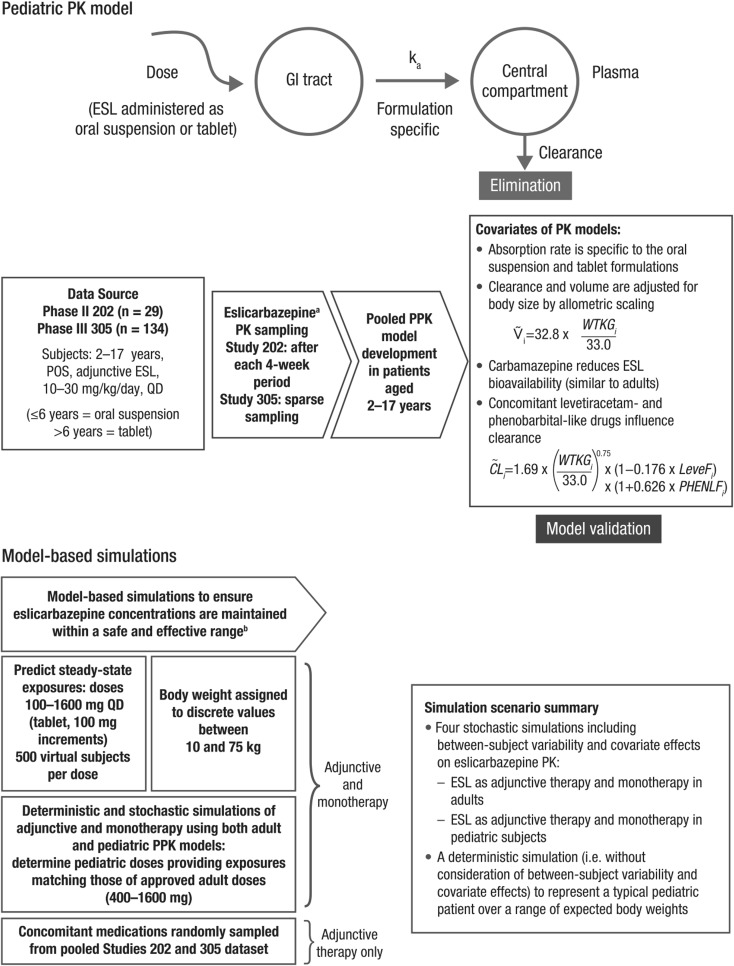
Modeling and simulations were used to support body weight-based dose selection for eslicarbazepine acetate (ESL) in pediatric subjects aged 4-17 years with partial-onset seizures. A one-compartment pediatric population pharmacokinetic model with formulation-specific first-order absorption, first-order elimination, and weight-based allometric scaling of clearance and distribution volume was developed with PK data from subjects 2-18 years of age treated with ESL 5-30 mg/kg/day. Covariate analysis was performed to quantify the effects of key demographic and clinical covariates (including body weight and concomitant use of carbamazepine, levetiracetam, and phenobarbital-like antiepileptic drugs [AEDs]) on variability in PK parameters. Model evaluation performed using a simulation-based visual predictive check and a non-parametric bootstrap procedure indicated no substantial bias in the overall model and in the accuracy of estimates. The model estimated that concomitant use of carbamazepine or phenobarbital-like AEDs with ESL would decrease the exposure of eslicarbazepine, and that concomitant use of levetiracetam with ESL would increase the exposure of eslicarbazepine, although the small effect of levetiracetam may not represent a true difference. Model-based simulations were subsequently performed to apply target exposure matching of selected ESL doses for pediatric subjects (aged 4-17 years) to attain eslicarbazepine exposures associated with effective and well-tolerated ESL doses in adults. Overall, model-based exposure matching allowed for extrapolation of efficacy to support pediatric dose selection as part of the submission to obtain FDA approval for ESL (adjunctive therapy and monotherapy) in subjects aged 4-17 years, without requiring an additional clinical study.
模型和模拟被用于支持基于体重的艾司利卡西平醋酸盐(ESL)剂量选择,用于 4-17 岁有部分发作性癫痫的儿科患者。开发了一个具有特定配方的一房室儿科人群药代动力学模型,具有配方特异性的一级吸收、一级消除以及基于体重的清除率和分布容积的比例缩放。该模型的 PK 数据来自接受 ESL 5-30mg/kg/天治疗的 2-18 岁患者。进行了协变量分析,以量化关键人口统计学和临床协变量(包括体重以及与卡马西平、左乙拉西坦和苯巴比妥样抗癫痫药物[AEDs]的同时使用)对 PK 参数变异性的影响。使用基于模拟的可视化预测检查和非参数自举程序进行的模型评估表明,整体模型和估计的准确性没有实质性偏差。该模型估计,与 ESL 同时使用卡马西平或苯巴比妥样 AED 会降低艾司利卡西平的暴露,与 ESL 同时使用左乙拉西坦会增加艾司利卡西平的暴露,尽管左乙拉西坦的小效应可能不代表真正的差异。随后进行了基于模型的模拟,以将选定的 ESL 剂量的目标暴露与儿科患者(4-17 岁)相匹配,以达到与成人中有效且耐受良好的 ESL 剂量相关的艾司利卡西平暴露。总体而言,基于模型的暴露匹配允许外推疗效,以支持作为获得 FDA 批准用于 4-17 岁患者(附加疗法和单药疗法)的 ESL 儿科剂量选择的一部分,而无需进行额外的临床研究。