Supartini Atin, Oishi Taro, Yagi Nobuyuki
Contract Research Organization (CRO) Department, Iberica Co., Ltd., 2-18-30 Hakataekihigashi, Hakata-ku, Fukuoka 812-0013, Japan.
Faculty of Socio-Environmental Studies, Fukuoka Institute of Technology, 3-30-1, Wajiro-higashi, Higashi-ku, Fukuoka 811-0295, Japan.
Foods. 2018 Jun 26;7(7):97. doi: 10.3390/foods7070097.
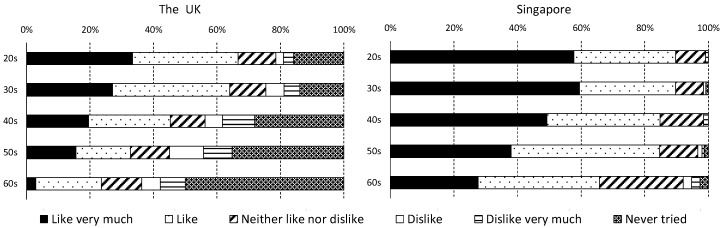
It is widely known that rapid population growth and income improvement in some developing countries, and growing health consciousness in some developed countries, are the main factors that have contributed to the global increase in the consumption of fishery products in the past few decades. While a detailed analysis of fish consumption behavior is being conducted in several countries, there are other countries where changes in fish consumption desire and their social and psychological factors are not fully clarified. This study investigates the changes in fish consumption desire and its associated factors in the United Kingdom (UK) and Singapore. Primary data were gathered from 1200 participants through a web questionnaire survey in the UK and Singapore. The results show that approximately five times as many respondents stated that the desire to purchase fish had increased in both the UK and Singapore compared to those that believed it had not 10 years ago. Second, the increase in fish consumption in the UK is positively associated with younger age, cheaper price, the health benefits of fish, concern over the health of meat, and religion. Third, the increase in fish consumption in Singapore is positively associated with cheaper prices and is negatively associated with concerns over sustainability.
众所周知,一些发展中国家人口的快速增长和收入的提高,以及一些发达国家健康意识的增强,是过去几十年来全球渔业产品消费量增加的主要因素。虽然一些国家正在对鱼类消费行为进行详细分析,但在其他一些国家,鱼类消费欲望的变化及其社会和心理因素尚未完全阐明。本研究调查了英国和新加坡鱼类消费欲望的变化及其相关因素。通过在英国和新加坡进行的网络问卷调查,从1200名参与者那里收集了原始数据。结果显示,与10年前认为购买鱼类欲望未增加的受访者相比,英国和新加坡表示购买鱼类欲望增加的受访者数量大约是其五倍。其次,英国鱼类消费的增加与年龄较小、价格较低、鱼类对健康有益、对肉类健康的担忧以及宗教信仰呈正相关。第三,新加坡鱼类消费的增加与价格较低呈正相关,与对可持续性的担忧呈负相关。