Liu Shuaichen, Jin Yu, Zhang Dongwei, Wang Jingbo, Wang Guangyi, Lee Caroline G L
Department of Hepatobiliary & Pancreas Surgery, The First Hospital, Jilin University, Changchun 130021, China.
Department of Biochemistry, National University of Singapore, Singapore 119077, Singapore.
Genes (Basel). 2018 Jun 26;9(7):319. doi: 10.3390/genes9070319.
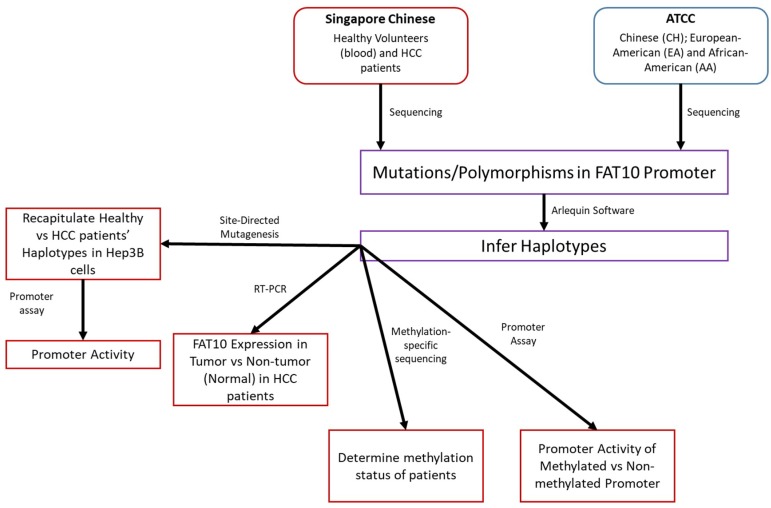
FAT10, which is also known as diubiquitin, has been implicated to play important roles in immune regulation and tumorigenesis. Its expression is up-regulated in the tumors of Hepatocellular Carcinoma (HCC) and other cancer patients. High levels of FAT10 in cells have been shown to result in increased mitotic non-disjunction and chromosome instability, leading to tumorigenesis. To evaluate whether the aberrant up-regulation of the FAT10 gene in the tumors of HCC patients is due to mutations or the aberrant methylation of CG dinucleotides at the FAT10 promoter, sequencing and methylation-specific sequencing of the promoter of FAT10 was performed. No mutations were found that could explain the differential expression of FAT10 between the tumor and non-tumorous tissues of HCC patients. However, six single nucleotide polymorphisms (SNPs), including one that has not been previously reported, were identified at the promoter of the FAT10 gene. Different haplotypes of these SNPs were found to significantly mediate different FAT10 promoter activities. Consistent with the experimental observation, differential FAT10 expression in the tumors of HCC patients carrying haplotype 1 was generally higher than those carrying haplotype II. Notably, the methylation status of this promoter was found to correlate with FAT10 expression levels. Hence, the aberrant overexpression of the FAT10 gene in the tumors of HCC patients is likely due to aberrant methylation, rather than mutations at the FAT10 promoter.
FAT10,也被称为双泛素,已被证明在免疫调节和肿瘤发生中发挥重要作用。其表达在肝细胞癌(HCC)和其他癌症患者的肿瘤中上调。细胞中高水平的FAT10已被证明会导致有丝分裂非整倍性增加和染色体不稳定,从而导致肿瘤发生。为了评估HCC患者肿瘤中FAT10基因的异常上调是由于突变还是FAT10启动子处CG二核苷酸的异常甲基化,对FAT10启动子进行了测序和甲基化特异性测序。未发现可解释HCC患者肿瘤组织与非肿瘤组织之间FAT10差异表达的突变。然而,在FAT10基因启动子处鉴定出六个单核苷酸多态性(SNP),其中包括一个以前未报道过的。发现这些SNP的不同单倍型可显著介导不同的FAT10启动子活性。与实验观察结果一致,携带单倍型1的HCC患者肿瘤中FAT10的差异表达通常高于携带单倍型II的患者。值得注意的是,发现该启动子的甲基化状态与FAT10表达水平相关。因此,HCC患者肿瘤中FAT10基因的异常过表达可能是由于异常甲基化,而不是FAT10启动子处的突变。