Hsieh I-Ni, De Luna Xavier, White Mitchell R, Hartshorn Kevan L
Boston University School of Medicine, Boston, MA, United States.
Front Immunol. 2018 Jun 13;9:1368. doi: 10.3389/fimmu.2018.01368. eCollection 2018.
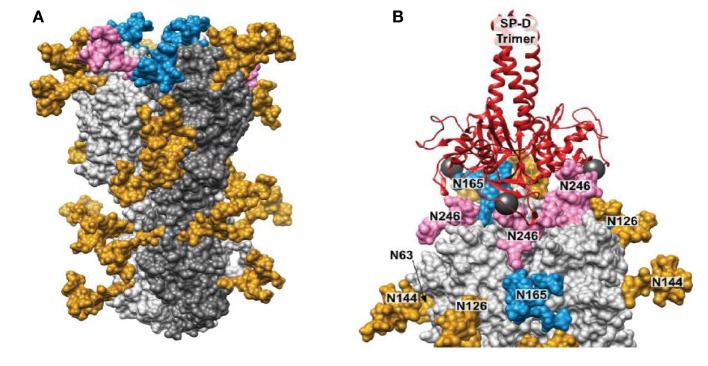
Influenza A viruses (IAVs) continue to pose major risks of morbidity and mortality during yearly epidemics and periodic pandemics. The genomic instability of IAV allows it to evade adaptive immune responses developed during prior infection. Of particular concern are pandemics which result from wholesale incorporation of viral genome sections from animal sources. These pandemic strains are radically different from circulating human strains and pose great risk for the human population. For these reasons, innate immunity plays a strong role in the initial containment of IAV infection. Soluble inhibitors present in respiratory lining fluids and blood provide a level of early protection against IAV. In general, these inhibitors act by binding to the viral hemagglutinin (HA). Surfactant protein D (SP-D) and mannose-binding lectin (MBL) attach to mannosylated glycans on the HA in a calcium dependent manner. In contrast, surfactant protein A, ficolins, and other inhibitors present sialic acid rich ligands to which the HA can bind. Among these inhibitors, SP-D seems to be the most potent due to its specific mode of binding to viral carbohydrates and its ability to strongly aggregate viral particles. We have studied specific properties of the N-terminal and collagen domain of SP-D that enable formation of highly multimerized molecules and cooperative binding among the multiple trimeric lectin domains in the protein. In addition, we have studied in depth the lectin activity of SP-D through expression of isolated lectin domains and targeted mutations of the SP-D lectin binding site. Through modifying specific residues around the saccharide binding pocket, antiviral activity of isolated lectin domains of SP-D can be markedly increased for seasonal strains of IAV. Wild-type SP-D causes little inhibition of pandemic IAV, but mutated versions of SP-D were able to inhibit pandemic IAV through enhanced binding to the reduced number of mannosylated glycans present on the HA of these strains. Through collaborative studies involving crystallography of isolated lectin domains of SP-D, glycomics analysis of the HA, and molecular modeling, the mechanism of binding of wild type and mutant forms of SP-D have been determined. These studies could guide investigation of the interactions of SP-D with other pathogens.
甲型流感病毒(IAV)在每年的流行和周期性大流行期间,仍然是导致发病和死亡的主要风险因素。IAV的基因组不稳定性使其能够逃避先前感染期间产生的适应性免疫反应。特别令人担忧的是由动物源病毒基因组片段的大规模整合导致的大流行。这些大流行毒株与正在传播的人类毒株截然不同,对人类种群构成巨大风险。出于这些原因,先天免疫在IAV感染的初始控制中发挥着重要作用。呼吸道内衬液和血液中存在的可溶性抑制剂为抵抗IAV提供了一定程度的早期保护。一般来说,这些抑制剂通过与病毒血凝素(HA)结合发挥作用。表面活性蛋白D(SP-D)和甘露糖结合凝集素(MBL)以钙依赖的方式附着在HA上的甘露糖基化聚糖上。相比之下,表面活性蛋白A、纤维胶凝蛋白和其他抑制剂呈现富含唾液酸的配体,HA可以与之结合。在这些抑制剂中,SP-D似乎是最有效的,因为它与病毒碳水化合物的特定结合方式以及强烈聚集病毒颗粒的能力。我们研究了SP-D的N端和胶原结构域的特定特性,这些特性能够形成高度多聚化的分子,并使蛋白质中多个三聚体凝集素结构域之间产生协同结合。此外,我们通过分离凝集素结构域的表达和SP-D凝集素结合位点的靶向突变,深入研究了SP-D的凝集素活性。通过修饰糖结合口袋周围的特定残基,SP-D分离凝集素结构域对季节性IAV毒株的抗病毒活性可显著提高。野生型SP-D对大流行IAV几乎没有抑制作用,但SP-D的突变体能够通过增强与这些毒株HA上数量减少的甘露糖基化聚糖的结合来抑制大流行IAV。通过涉及SP-D分离凝集素结构域的晶体学、HA的糖组学分析和分子建模的合作研究,已经确定了野生型和突变型SP-D的结合机制。这些研究可以指导对SP-D与其他病原体相互作用的研究。