Sato M, Tateishi R, Yasunaga H, Matsui H, Fushimi K, Ikeda H, Yatomi Y, Koike K
Department of Clinical Laboratory Medicine University of Tokyo Tokyo Japan.
Department of Gastroenterology, Graduate School of Medicine University of Tokyo Tokyo Japan.
BJS Open. 2017 Jul 26;1(2):50-54. doi: 10.1002/bjs5.9. eCollection 2017 Apr.
Radiofrequency ablation (RFA) is a minimally invasive treatment for hepatocellular carcinoma (HCC). There is increasing evidence of an association between increasing hospital volume and lower postoperative mortality for many surgical procedures, but this is difficult to establish with minimally invasive treatments, where postoperative mortality is low. The aim of this study was to investigate the relationship between hospital volume and in-hospital mortality following RFA using a Japanese nationwide database.
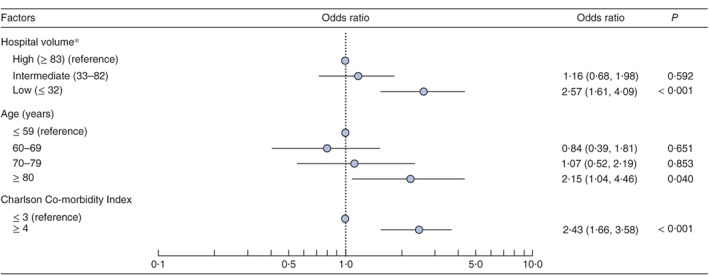
Data from the Diagnostic Procedure Combination database were analysed from 1 July 2010 to 31 March 2012. Multivariable logistic regression was used to analyse the relationship between hospital volume and in-hospital mortality following RFA, with adjustment for patient background.
Some 36 675 patients with HCC were identified in the database. The overall in-hospital mortality rate from RFA was 0·31 per cent. In-hospital mortality was significantly higher in low-volume than high-volume hospitals (odds ratio 2·57, 95 per cent c.i. 1·61 to 4·09; P < 0·001). Higher in-hospital mortality was significantly associated with older age and a higher Charlson Co-morbidity Index score.
RFA for HCC was associated with acceptably low mortality in Japan, but in-hospital mortality following RFA was affected by hospital procedural volume.
射频消融术(RFA)是一种用于肝细胞癌(HCC)的微创治疗方法。越来越多的证据表明,对于许多外科手术而言,医院手术量的增加与术后死亡率的降低之间存在关联,但对于术后死亡率较低的微创治疗来说,很难证实这一点。本研究旨在利用日本全国性数据库调查医院手术量与射频消融术后住院死亡率之间的关系。
分析诊断程序组合数据库中2010年7月1日至2012年3月31日的数据。采用多变量逻辑回归分析医院手术量与射频消融术后住院死亡率之间的关系,并对患者背景进行校正。
数据库中识别出约36675例肝细胞癌患者。射频消融术的总体住院死亡率为0.31%。低手术量医院的住院死亡率显著高于高手术量医院(比值比2.57,95%可信区间1.61至4.09;P<0.001)。较高的住院死亡率与高龄和较高的Charlson合并症指数评分显著相关。
在日本,肝细胞癌的射频消融术死亡率较低,可接受,但射频消融术后的住院死亡率受医院手术量的影响。