MMWR Morb Mortal Wkly Rep. 2018 Jun 29;67(25):707-713. doi: 10.15585/mmwr.mm6725a2.
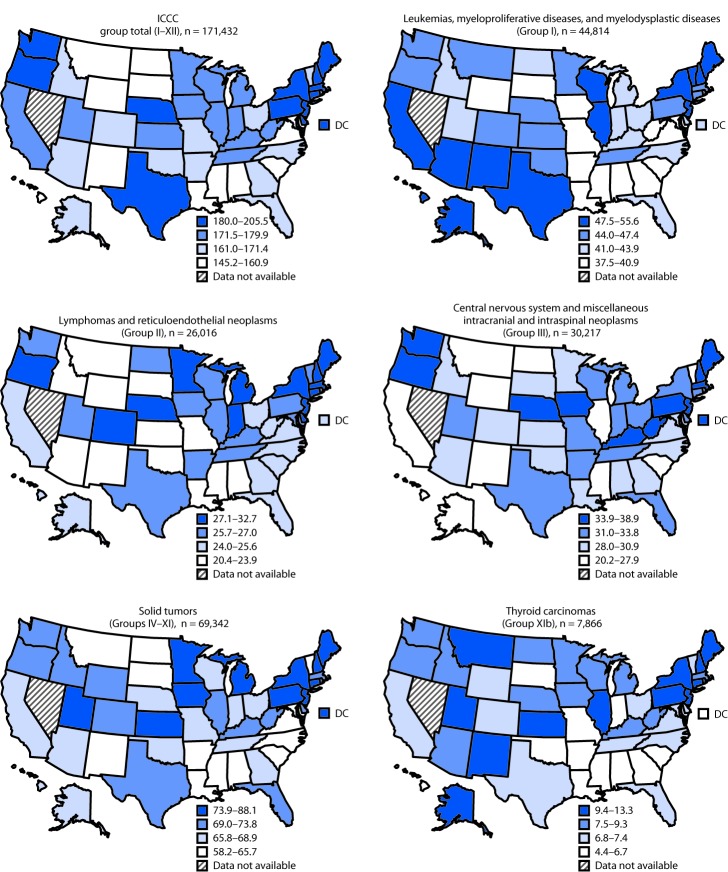
Approximately 15,000 persons aged <20 years receive a cancer diagnosis each year in the United States (1). National surveillance data could provide understanding of geographic variation in occurrence of new cases to guide public health planning and investigation (2,3). Past research on pediatric cancer incidence described differences by U.S. Census region but did not provide state-level estimates (4). To adequately describe geographic variation in cancer incidence among persons aged <20 years in the United States, CDC analyzed data from United States Cancer Statistics (USCS) during 2003-2014 and identified 171,432 cases of pediatric cancer during this period (incidence = 173.7 cases per 1 million persons). The cancer types with the highest incidence rates were leukemias (45.7), brain tumors (30.9), and lymphomas (26.2). By U.S. Census region, pediatric cancer incidence was highest in the Northeast (188.0) and lowest in the South (168.0), whereas by state (including the District of Columbia [DC]), rates were highest in New Hampshire, DC, and New Jersey. Among non-Hispanic whites (whites) and non-Hispanic blacks (blacks), pediatric cancer incidence was highest in the Northeast, and the highest rates among Hispanics were in the South. The highest rates of leukemia were in the West, and the highest rates of lymphoma and brain tumors were in the Northeast. State-based differences in pediatric cancer incidence could guide interventions related to accessing care (e.g., in states with large distances to pediatric oncology centers), clinical trial enrollment, and state or regional studies designed to further explore variations in cancer incidence.
每年大约有 15000 名年龄<20 岁的人在美国被诊断患有癌症(1)。国家监测数据可以帮助了解新发病例的地理差异,从而指导公共卫生规划和调查(2,3)。过去关于儿科癌症发病率的研究描述了美国人口普查区的差异,但没有提供州一级的估计(4)。为了充分描述美国年龄<20 岁人群癌症发病率的地理差异,疾病预防控制中心分析了 2003-2014 年美国癌症统计(USCS)的数据,在此期间确定了 171432 例儿科癌症病例(发病率为每百万人 173.7 例)。发病率最高的癌症类型是白血病(45.7)、脑肿瘤(30.9)和淋巴瘤(26.2)。按美国人口普查区划分,东北部儿科癌症发病率最高(188.0),南部最低(168.0),而按州(包括哥伦比亚特区[DC])划分,发病率最高的是新罕布什尔州、DC 和新泽西州。在非西班牙裔白人(白人)和非西班牙裔黑人(黑人)中,东北部儿科癌症发病率最高,而南部的西班牙裔发病率最高。白血病发病率最高的是西部,淋巴瘤和脑肿瘤发病率最高的是东北部。儿科癌症发病率的州际差异可以指导与获得医疗服务相关的干预措施(例如,在距离儿科肿瘤中心较远的州)、临床试验登记以及旨在进一步探索癌症发病率变化的州或区域研究。