Alliance for Research in Exercise, Nutrition and Activity (ARENA), University of South Australia, Adelaide, Australia.
Murdoch Children's Research Institute, Melbourne, Australia.
PLoS One. 2018 Jun 28;13(6):e0199605. doi: 10.1371/journal.pone.0199605. eCollection 2018.
Retirement is a life transition involving an obligatory change in how people use their time. Because there are strong associations between use of time and health, different changes in time use following retirement may have different impacts on mental health.
105 participants were followed from 6 months before retirement to 12 months after retirement. At each time-point, use of time was quantified using a validated computerised 24-hour recall. Depression, anxiety and stress were assessed using the Depression, Anxiety and Stress Scales (DASS21), well-being with the Short Warwick-Edinburgh Mental Well-being Scale (SWEMWBS), life satisfaction with the Australian Unity Personal Well-being Index (AUPWI), and self-esteem with the Rosenberg Self-Esteem Scale. Time-use data were analysed using compositional data analysis, which treats the 24-h day as a holistic "activity composition" rather than as individual activity domains. Time flow analytics were used to map patterns of change in time use from pre-retirement to post-retirement. Regression analysis was used to determine whether changes in the activity composition were significantly associated with changes in mental health. Compositional isotemporal substitution models were used to illustrate dose-response relationships between changes in time use and conditional changes in mental health for individual activity domains, such as sleep, screen time and physical activity.
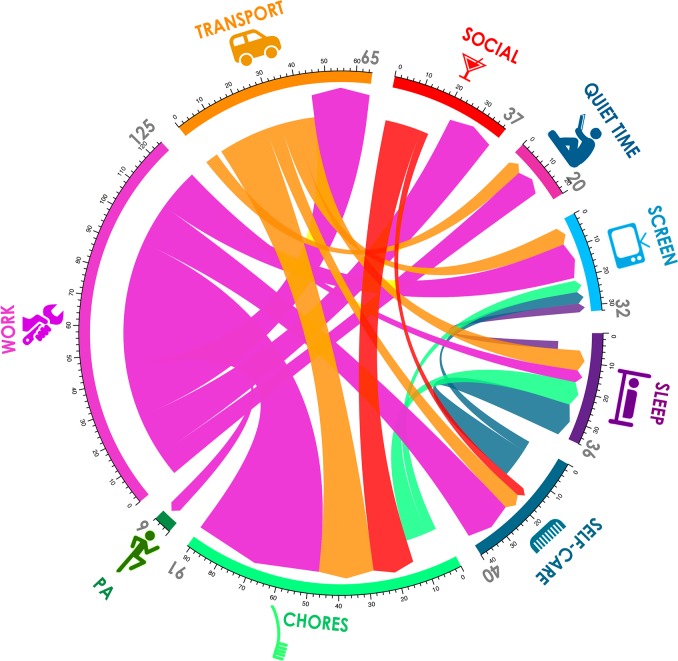
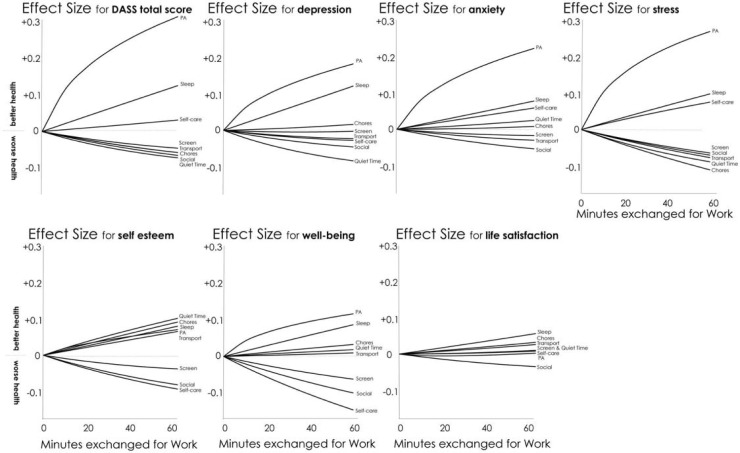
Following retirement, time no longer spent in work flowed mainly to household chores, sleep, screen time and quiet time (e.g. reading). Mental health improved overall. Changes in the activity composition were significantly related to conditional changes in DASS21 total score, depression, stress, and self-esteem, but not to anxiety, well-being or life satisfaction. Replacing work time with physical activity or sleep was associated with positive changes in mental health. Effect sizes for 60-minute substitutions ranged from -0.15 to +0.31.
Following retirement, replacing work with physical activity, and to a lesser extent sleep, is associated with better mental health.
退休是人生的一个重要转折点,需要人们改变原有的时间利用方式。由于时间利用与健康之间存在密切联系,退休后不同的时间利用方式可能会对心理健康产生不同的影响。
105 名参与者从退休前 6 个月到退休后 12 个月进行随访。在每个时间点,使用经过验证的计算机 24 小时回忆法来量化时间利用。使用抑郁、焦虑和压力量表(DASS21)评估抑郁、焦虑和压力,使用简短的沃里克-爱丁堡心理健康量表(SWEMWBS)评估幸福感,使用澳大利亚统一个人幸福感指数(AUPWI)评估生活满意度,使用罗森伯格自尊量表(Rosenberg Self-Esteem Scale)评估自尊。使用成分数据分析时间利用数据,该方法将 24 小时的一天视为一个整体的“活动构成”,而不是单独的活动领域。时间流分析用于从退休前到退休后绘制时间利用变化模式。回归分析用于确定活动构成的变化是否与心理健康的变化显著相关。组成等时替代模型用于说明单个活动领域(如睡眠、屏幕时间和体育活动)的时间利用变化与心理健康条件变化之间的剂量-反应关系。
退休后,不再用于工作的时间主要流向家务、睡眠、屏幕时间和安静时间(如阅读)。整体心理健康状况得到改善。活动构成的变化与 DASS21 总分、抑郁、压力和自尊的条件变化显著相关,但与焦虑、幸福感或生活满意度无关。用体育活动或睡眠代替工作时间与心理健康的积极变化有关。60 分钟替代的效应大小范围从-0.15 到+0.31。
退休后,用体育活动代替工作,在较小程度上用睡眠代替工作,与更好的心理健康相关。