Center for Observational Research, Amgen Inc., South San Francisco, CA, USA.
Department of Research and Evaluation, Kaiser Permanente Southern California, Pasadena, CA, USA.
Cancer Med. 2018 Aug;7(8):4121-4131. doi: 10.1002/cam4.1580. Epub 2018 Jun 28.
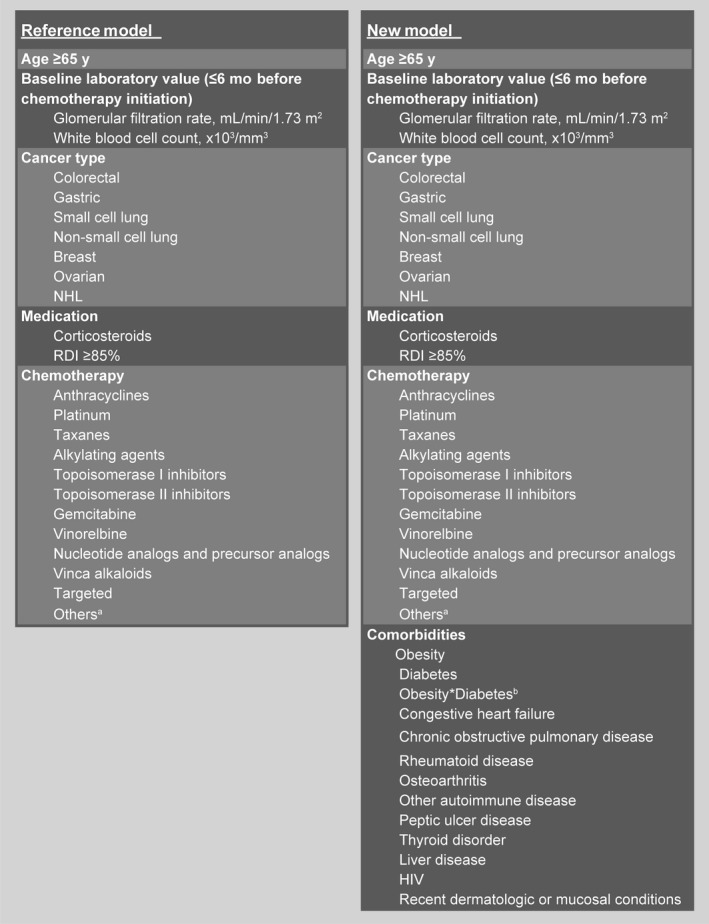
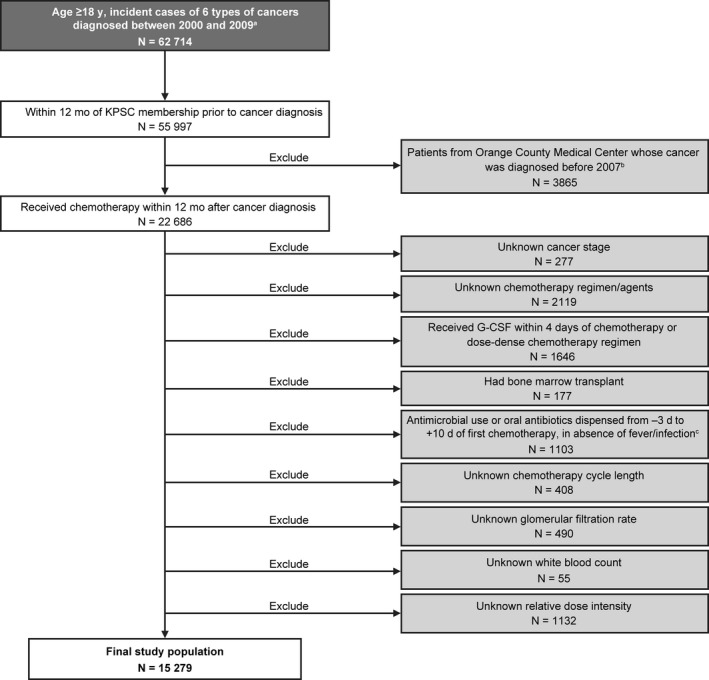
Several comorbidities have recently been shown to affect risk of chemotherapy-induced febrile neutropenia (FN). Here, we evaluated the added predictive value of these comorbidities beyond established FN risk factors. A retrospective cohort study was conducted among adult patients diagnosed with cancer and treated with chemotherapy at Kaiser Permanente Southern California between 2000 and 2009. The study cohort was equally split into training and validation datasets to develop and evaluate the performance of FN risk prediction models in the first chemotherapy cycle. A reference model was developed based on the model proposed by Lyman et al (Cancer 2011;117:1917). A new model was developed by incorporating the newly identified comorbidities such as rheumatoid conditions and thyroid disorders into the reference model. Area under the receiver operating characteristic curve (AUROCC), risk reclassification, and integrated discrimination improvement (IDI) were used to evaluate the potential improvement of FN risk prediction by incorporating comorbidities. A total of 15 279 patients were included; 4.2% experienced FN in the first chemotherapy cycle. Including comorbidities in FN risk prediction did not improve AUROCC (reference model 0.71 vs new model 0.72). A significant improvement in individual-level FN risk prediction was indicated by IDI (P = .02). However, significant improvement in risk reclassification was not observed overall (although 6% of all patients were more accurately classified for their FN risk level, 5% were less accurately classified) or when examining predicted FN risk among patients who did and did not develop FN. Incorporating several new comorbidities into FN prediction led to improved FN risk prediction in the first chemotherapy cycle, although the observed improvements were small and might not be clinically relevant.
最近有几项合并症被证明会影响化疗引起的发热性中性粒细胞减少症(FN)的风险。在这里,我们评估了这些合并症在既定 FN 危险因素之外的附加预测价值。一项回顾性队列研究在 2000 年至 2009 年期间在 Kaiser Permanente Southern California 接受癌症诊断和化疗治疗的成年患者中进行。研究队列平均分为训练数据集和验证数据集,以开发和评估首次化疗周期中 FN 风险预测模型的性能。基于 Lyman 等人提出的模型(Cancer 2011;117:1917),建立了参考模型。通过将新确定的合并症(如类风湿性疾病和甲状腺疾病)纳入参考模型,建立了新模型。使用接收者操作特征曲线下的面积(AUROCC)、风险再分类和综合判别改善(IDI)来评估通过合并症改善 FN 风险预测的潜力。共纳入 15279 例患者;其中 4.2%的患者在第一个化疗周期中发生 FN。在 FN 风险预测中纳入合并症并未提高 AUROCC(参考模型为 0.71,新模型为 0.72)。IDI 表明个体水平 FN 风险预测有显著改善(P =.02)。然而,总体风险再分类并未观察到显著改善(尽管所有患者中有 6%的 FN 风险水平分类更准确,5%的 FN 风险水平分类更不准确),或在检查发生和未发生 FN 的患者的预测 FN 风险时。将几种新的合并症纳入 FN 预测中,导致首次化疗周期 FN 风险预测有所改善,尽管观察到的改善很小,可能没有临床意义。