Sheehy Joshua, Gallanagh Marianne, Sullivan Clair, Lane Steven
Haematology and Bone Marrow Transplant Department, Cancer Care Services, The Royal Brisbane and Women's Hospital, Brisbane, QLD, Australia.
Faculty of Medicine, The University of Queensland, Brisbane, QLD, Australia.
Support Care Cancer. 2025 Jun 4;33(7):537. doi: 10.1007/s00520-025-09562-y.
Febrile neutropenia (FN) is a life-threatening complication of chemotherapy. Although practice guidelines suggest the use of existing prediction models when making decisions to prevent and treat FN, recent evidence suggests that these models are limited in their discriminative ability. This study aims to systematically review and critically evaluate the recent literature to assess the question: what evidence-based clinical prediction models can be used to predict FN or its outcomes?
PubMed, EMBASE, Web of Science, and SCOPUS were searched for primary journal articles that developed or validated models that predicted FN or outcomes in patients with FN. Risk of bias was critically evaluated using the Prediction model Risk of Bias Assessment Tool (PROBAST).
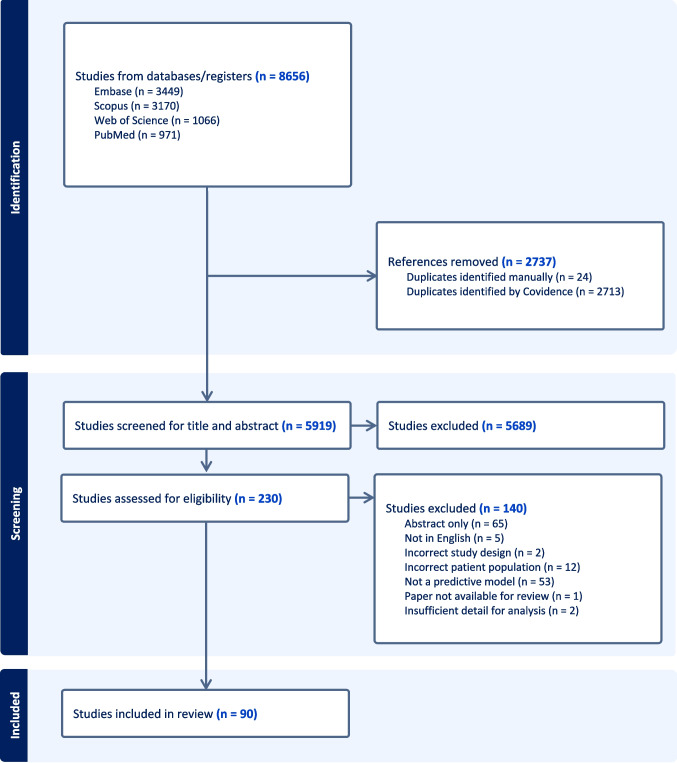
Five thousand nine hundred nineteen articles were identified, of which 90 met inclusion criteria. Twenty-five studies predicted FN, and 65 studies predicted outcomes in patients with FN, including 28 that predicted mortality, 35 that predicted microbiological outcomes, and 35 that predicted other complications. Eight studies used machine learning methods in their development, and few studies were externally validated. All 90 studies were graded as high risk of bias using PROBAST.
Prediction models for FN and its outcomes demonstrate promising discriminatory ability; however, several limitations have prevented these from translating clinically. These limitations include variable FN definitions, high ROB in current models, limited external validation, and heterogeneous cohorts. Future work is needed to further develop and validate robust, well-evidenced models that can translate into clinical practice. This may best be achieved through machine learning and electronic medical record integration.
发热性中性粒细胞减少症(FN)是化疗的一种危及生命的并发症。尽管实践指南建议在做出预防和治疗FN的决策时使用现有的预测模型,但最近的证据表明这些模型的判别能力有限。本研究旨在系统回顾和批判性评价近期文献,以评估以下问题:哪些基于证据的临床预测模型可用于预测FN或其结局?
在PubMed、EMBASE、Web of Science和SCOPUS中检索开发或验证预测FN或FN患者结局的模型的原始期刊文章。使用预测模型偏倚风险评估工具(PROBAST)对偏倚风险进行批判性评估。
共识别出5919篇文章,其中90篇符合纳入标准。25项研究预测FN,65项研究预测FN患者的结局,包括28项预测死亡率、35项预测微生物学结局和35项预测其他并发症。8项研究在其开发过程中使用了机器学习方法,很少有研究进行外部验证。使用PROBAST对所有90项研究的偏倚风险分级均为高风险。
FN及其结局的预测模型显示出有前景的判别能力;然而,一些局限性阻碍了这些模型在临床上的应用。这些局限性包括FN定义的差异、当前模型中较高的偏倚风险、有限的外部验证以及队列的异质性。需要未来的工作来进一步开发和验证能够转化为临床实践的强大且有充分证据的模型。这可能最好通过机器学习和电子病历整合来实现。