Department of Environmental Zoology, Institute of Animal Sciences, University of Agriculture in Krakow, Mickiewicza av. 24/28, 30-059, Krakow, Poland.
Research Station and Museum of the Tatra National Park, 059 60, Tatranská Lomnica, Slovakia.
Parasit Vectors. 2018 Jun 28;11(1):369. doi: 10.1186/s13071-018-2958-6.
Nematodes of the subfamily Ostertagiinae appear to be rather specific to a species or family of hosts, but some are observed in a wide variety of hosts. The nematode Ostertagia leptospicularis draws special attention due to its presence or absence among the same host species in different European countries. Therefore, this paper focuses mainly on the host specificity among nematodes of the subfamily Ostertagiinae. The second aim of this study is to assess the possibility of treating O. leptospicularis as an Ostertagia species complex.
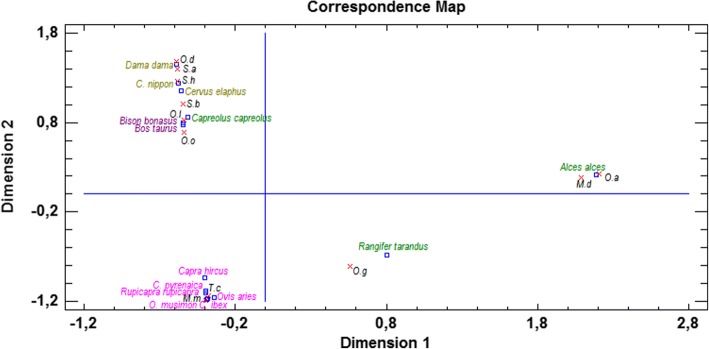
Data were gathered from post-mortem examinations of domestic and wild ruminants (n = 157), as well as bibliographical references (n = 96), which were pooled and discussed. The research area was limited to European countries, hence the studied ostertagiine species are limited to native ones; likewise, the host species. Special emphasis was placed on the mean abundance values that allowed a typical host or hosts for each nematode species to be specified. Correspondence analysis was performed to confirm the stated host specificity.
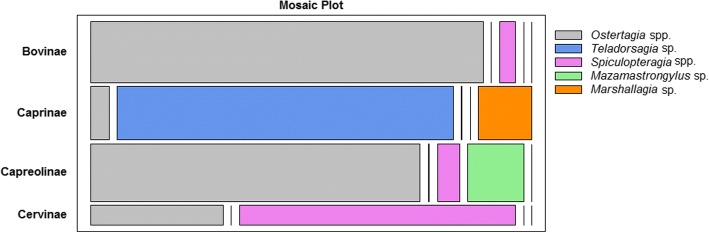
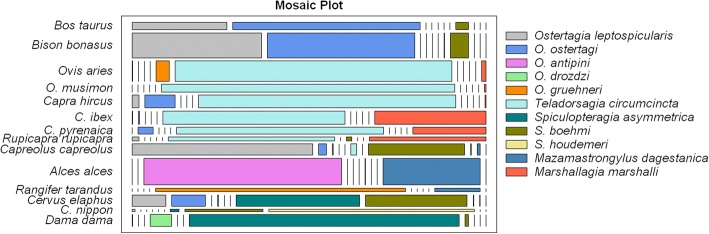
The analysis revealed that nematodes of this subfamily tend to use ruminants from a particular subfamily as their principal host. The results indicate that Ostertagia leptospicularis, similar to Teladorsagia circumcincta, may represent a potential species complex. This nematode, as the sole member of the subfamily Ostertagiinae, occurs in almost all representatives of the Bovidae subfamily, as well as in the Cervidae.
Despite the stated narrow host specificity, the results obtained may suggest that O. leptospicularis is not strongly connected to any host or is comparably associated with a very wide and diverse group of hosts (Cervidae, Bovidae). The Ostertagia complex may have particular cryptic species or strains typical for any individual host or group of hosts. Such a conclusion requires further investigations on a wider scale.
Ostertagiinae 亚科的线虫似乎对宿主的物种或科非常特异,但有些线虫在宿主的广泛范围内被发现。Ostertagia leptospicularis 线虫因其在不同欧洲国家的同一宿主物种中存在或不存在而受到特别关注。因此,本文主要关注 Ostertagiinae 亚科线虫的宿主特异性。本研究的第二个目的是评估将 O. leptospicularis 视为 Ostertagia 种复合体的可能性。
从国内和野生反刍动物的剖检(n = 157)以及文献参考(n = 96)中收集数据,对其进行汇总和讨论。研究范围仅限于欧洲国家,因此研究的 ostertagiine 物种仅限于本地物种;同样,宿主物种也是如此。特别强调平均丰度值,以便确定每个线虫物种的典型宿主。进行对应分析以确认所声称的宿主特异性。
分析表明,该亚科的线虫倾向于使用特定亚科的反刍动物作为其主要宿主。结果表明,Ostertagia leptospicularis 与 Teladorsagia circumcincta 相似,可能代表一个潜在的种复合体。这种线虫作为 Ostertagiinae 亚科的唯一成员,几乎出现在牛科的所有代表物种中,以及鹿科中。
尽管宿主特异性较窄,但研究结果表明,O. leptospicularis 与任何宿主的联系并不紧密,或者与非常广泛和多样化的宿主群(鹿科、牛科)相关。Ostertagia 复合体可能具有特定的隐种或菌株,这些种或菌株是任何单个宿主或宿主群特有的。这一结论需要在更大范围内进行进一步研究。