Chakhtoura Marlene, Rahme Maya, Chamoun Nariman, El-Hajj Fuleihan Ghada
Calcium Metabolism and Osteoporosis Program, WHO Collaborating Center for Metabolic Bone Disorders, American University of Beirut Medical Center, Beirut, P.O. Box: 113-6044/C8, Lebanon.
Bone Rep. 2018 Mar 17;8:135-146. doi: 10.1016/j.bonr.2018.03.004. eCollection 2018 Jun.
The Middle East and North Africa (MENA) region registers some of the lowest serum 25‑hydroxyvitamin D [25(OH)D] concentrations, worldwide. We describe the prevalence and the risk factors for hypovitaminosis D, completed and ongoing clinical trials, and available guidelines for vitamin D supplementation in this region.
This review is an update of previous reviews published by our group in 2013 for observational studies, and in 2015 for randomized controlled trials (RCTs) from the region. We conducted a comprehensive search in Medline, PubMed, and Embase, and the Cochrane Library, using MeSH terms and keywords relevant to vitamin D, vitamin D deficiency, and the MENA region, for the period 2012-2017 for observational studies, and 2015-2017 for RCTs. We included large cross-sectional studies with at least 100 subjects/study, and RCTs with at least 50 participants per arm.
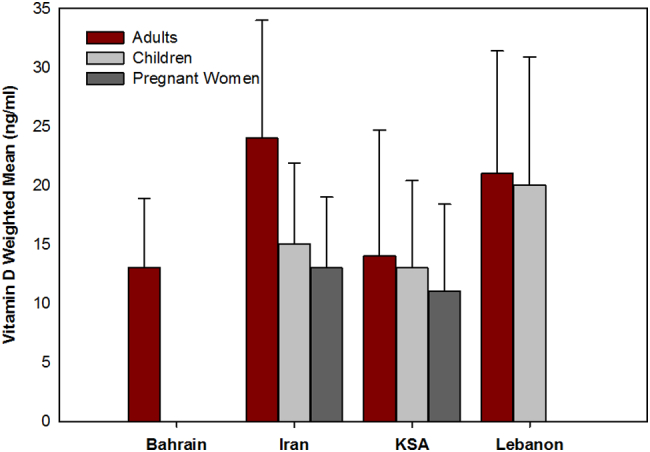
We identified 41 observational studies. The prevalence of hypovitaminosis D, defined as a 25‑hydroxyvitamin D [25(OH)D] level below the desirable level of 20 ng/ml, ranged between 12-96% in children and adolescents, and 54-90% in pregnant women. In adults, it ranged between 44 and 96%, and the mean 25(OH)D varied between 11 and 20 ng/ml. In general, significant predictors of low 25(OH)D levels were female gender, increasing age and body mass index, veiling, winter season, use of sun screens, lower socioeconomic status, and higher latitude.We retrieved 14 RCTs comparing supplementation to control or placebo, published during the period 2015-2017: 2 in children, 8 in adults, and 4 in pregnant women. In children and adolescents, a vitamin D dose of 1000-2000 IU/d was needed to maintain serum 25(OH)D level at target. In adults and pregnant women, the increment in 25(OH)D level was inversely proportional to the dose, ranging between 0.9 and 3 ng/ml per 100 IU/d for doses ≤2000 IU/d, and between 0.1 and 0.6 ng/ml per 100 IU/d for doses ≥3000 IU/d. While the effect of vitamin D supplementation on glycemic indices is still controversial in adults, vitamin D supplementation may be protective against gestational diabetes mellitus in pregnant women. In the only identified study in the elderly, there was no significant difference between 600 IU/day and 3750 IU/day doses on bone mineral density. We did not identify any fracture studies.The available vitamin D guidelines in the region are based on expert opinion, with recommended doses between 400 and 2000 IU/d, depending on the age category, and country.
Hypovitaminosis D is prevalent in the MENA region, and doses of 1000-2000 IU/d may be necessary to reach a desirable 25(OH)D level of 20 ng/ml. Studies assessing the effect of such doses of vitamin D on major outcomes, and confirming their long term safety, are needed.
中东和北非(MENA)地区的血清25-羟基维生素D[25(OH)D]浓度在全球处于最低水平。我们描述了该地区维生素D缺乏症的患病率、风险因素、已完成和正在进行的临床试验以及维生素D补充的现有指南。
本综述是我们小组在2013年发表的关于观察性研究的综述以及2015年发表的关于该地区随机对照试验(RCT)综述的更新。我们在Medline、PubMed、Embase和Cochrane图书馆进行了全面检索,使用与维生素D、维生素D缺乏症和MENA地区相关的医学主题词(MeSH)和关键词,检索时间范围为2012 - 2017年的观察性研究以及2015 - 2017年的RCT。我们纳入了至少有100名受试者/研究的大型横断面研究以及每组至少有50名参与者的RCT。
我们确定了41项观察性研究。维生素D缺乏症的患病率定义为25-羟基维生素D[25(OH)D]水平低于理想水平20 ng/ml,在儿童和青少年中为12% - 96%,在孕妇中为54% - 90%。在成年人中,患病率为44% - 96%,平均25(OH)D在11 - 20 ng/ml之间。一般来说,25(OH)D水平低的显著预测因素包括女性、年龄增长、体重指数增加、戴面纱、冬季、使用防晒霜、社会经济地位较低以及纬度较高。我们检索到14项在2015 - 2017年期间发表的比较补充剂与对照或安慰剂的RCT:2项针对儿童,8项针对成年人,4项针对孕妇。在儿童和青少年中,需要每日1000 - 2000 IU的维生素D剂量才能将血清25(OH)D水平维持在目标水平。在成年人和孕妇中,25(OH)D水平的增量与剂量成反比,对于≤2000 IU/d的剂量,每100 IU/d增加0.9 - 3 ng/ml,对于≥3000 IU/d的剂量,每100 IU/d增加0.1 - 0.6 ng/ml。虽然维生素D补充剂对成年人血糖指标的影响仍存在争议,但维生素D补充剂可能对孕妇预防妊娠期糖尿病有保护作用。在唯一一项针对老年人的已确定研究中,600 IU/天和3750 IU/天的剂量对骨密度没有显著差异。我们未找到任何骨折研究。该地区现有的维生素D指南基于专家意见,推荐剂量根据年龄类别和国家在400 - 2000 IU/d之间。
维生素D缺乏症在MENA地区普遍存在,可能需要每日1000 - 2000 IU的剂量才能达到理想的25(OH)D水平20 ng/ml。需要开展研究评估此类维生素D剂量对主要结局的影响,并确认其长期安全性。