Istituto Nazionale Tumori -IRCCS- 'Fondazione G. Pascale', 80131 Naples, Italy.
Unit of Cancer Genetics, Institute of Biomolecular Chemistry, National Research Council, 07100 Sassari, Italy.
Int J Oncol. 2018 Sep;53(3):1149-1159. doi: 10.3892/ijo.2018.4457. Epub 2018 Jun 27.
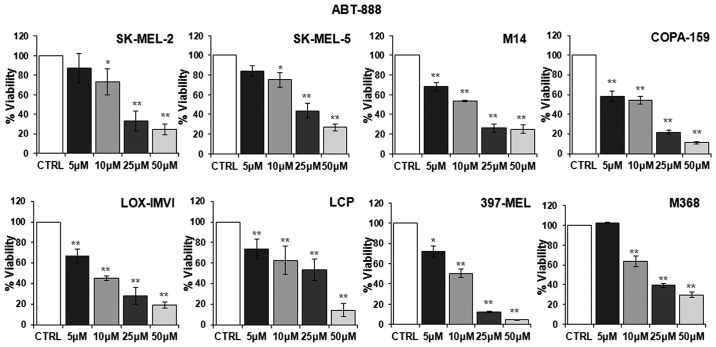
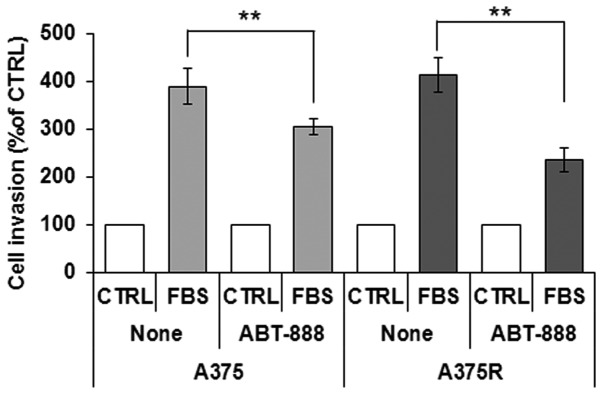
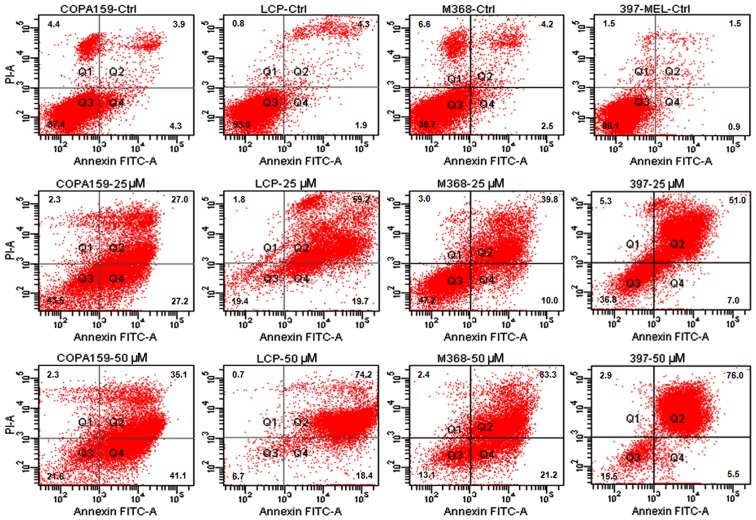
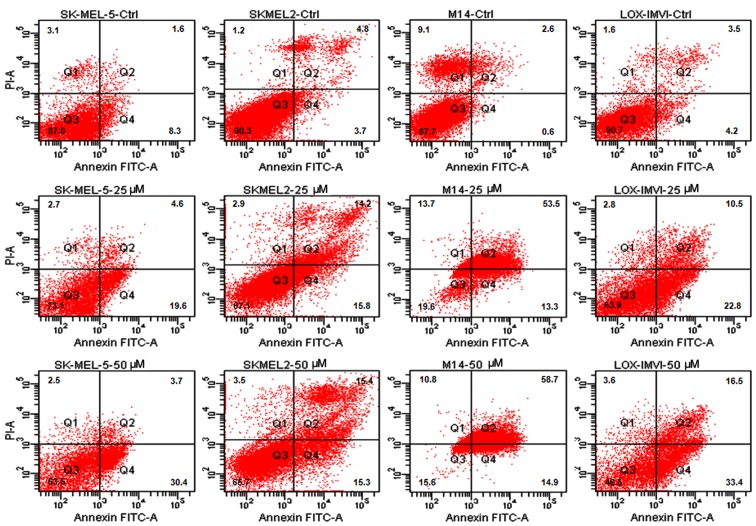
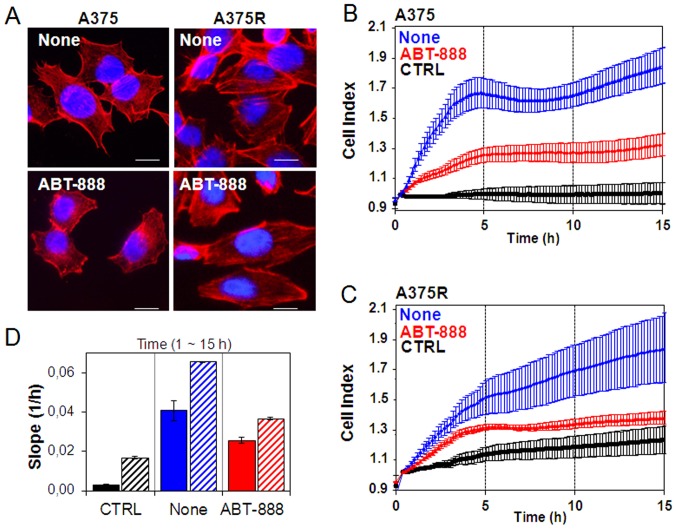
Melanoma is a molecularly heterogeneous disease with many genetic mutations and altered signaling pathways. Activating mutations in the BRAF oncogene are observed in approximately 50% of cutaneous melanomas and the use of BRAF inhibitor (BRAFi) compounds has been reported to improve the outcome of patients with BRAF-mutated metastatic melanoma. However, the majority of these patients develop resistance within 6-8 months following the initiation of BRAFi treatment. In this study, we examined the possible use of the poly(ADP-ribose) polymerase 1 (PARP1) inhibitor, ABT-888 (veliparib), as a novel molecule that may be successfully employed in the treatment of BRAFi-resistant melanoma cells. Sensitive and resistant to BRAFi dabrafenib A375 cells were exposed to increasing concentrations of ABT-888. Cell viability and apoptosis were assessed by MTT assay and Annexin V-FITC analysis, respectively. The cell migratory and invasive ability was investigated using the xCELLigence technology and Boyden chamber assays, respectively. ABT-888 was found to reduce cell viability and exhibited pro-apoptotic activity in melanoma cell lines, independently from the BRAF/NRAS mutation status, in a dose-dependent manner, with the maximal effect being reached in the 25-50 µM concentration range. Moreover, ABT-888 promoted apoptosis in both the sensitive and resistant A375 cells, suggesting that ABT-888 may be useful in the treatment of BRAFi-resistant subsets of melanoma cells. Finally, in accordance with the involvement of PARP1 in actin cytoskeletal machinery, we found that the cytoskeletal organization, motility and invasive capability of both the A375 and A375R cells decreased upon exposure to 5 µM ABT-888 for 24 h. On the whole, the findings of this study highlight the pivotal role of PARP1 in the migration and invasion of melanoma cells, suggesting that ABT-888 may indeed be effective, not only as a pro-apoptotic drug for use in the treatment of BRAFi-resistant melanoma cells, but also in suppressing their migratory and invasive activities.
黑色素瘤是一种分子异质性疾病,存在许多基因突变和信号通路改变。大约 50%的皮肤黑色素瘤存在 BRAF 癌基因的激活突变,使用 BRAF 抑制剂(BRAFi)化合物已被报道可改善 BRAF 突变转移性黑色素瘤患者的预后。然而,大多数患者在开始 BRAFi 治疗后 6-8 个月内会产生耐药性。在这项研究中,我们研究了聚(ADP-核糖)聚合酶 1(PARP1)抑制剂 ABT-888(veliparib)作为一种可能成功用于治疗 BRAFi 耐药黑色素瘤细胞的新型分子的可能性。我们用不同浓度的 BRAFi 达拉非尼处理敏感和耐药的 A375 细胞。通过 MTT 检测和 Annexin V-FITC 分析分别评估细胞活力和细胞凋亡。使用 xCELLigence 技术和 Boyden 室测定法分别研究细胞迁移和侵袭能力。结果发现,ABT-888 可降低黑色素瘤细胞系的细胞活力,并表现出剂量依赖性的促凋亡活性,与 BRAF/NRAS 突变状态无关,最大效应出现在 25-50 μM 浓度范围内。此外,ABT-888 可促进敏感和耐药的 A375 细胞的凋亡,表明 ABT-888 可能对 BRAFi 耐药的黑色素瘤细胞亚群有用。最后,根据 PARP1 参与肌动蛋白细胞骨架机制,我们发现暴露于 5 μM ABT-888 24 小时后,A375 和 A375R 细胞的细胞骨架组织、运动性和侵袭能力均降低。总的来说,这项研究的结果强调了 PARP1 在黑色素瘤细胞迁移和侵袭中的关键作用,表明 ABT-888 不仅可作为一种促凋亡药物有效用于治疗 BRAFi 耐药黑色素瘤细胞,而且还可抑制其迁移和侵袭活性。