Respiratory Research Unit, Bispebjerg University Hospital, Copenhagen, Denmark.
Respiratory Research Unit, Bispebjerg University Hospital, Copenhagen, Denmark.
Respir Med. 2018 Jul;140:50-56. doi: 10.1016/j.rmed.2018.05.016. Epub 2018 May 19.
Several animal studies, and one inoculation study in adult asthmatics have shown that interleukin-33 (IL-33) is a major contributor to type-2 inflammation in acute asthma. However, the link between IL-33 and type-2 inflammation has not been shown in naturally occurring asthma exacerbations.
To determine if airway IL-33 is associated with type-2 inflammation measured by type-2 cytokines, FeNO and sputum eosinophils in patients presenting to the Emergency Department with an asthma exacerbations.
Adult patients hospitalized due to acute asthma were enrolled. Upper airways were sampled with nasal swabs and lower airways with induced sputum. Cytokines were measured at protein level using a Luminex assay and mRNA expression level using droplet-digital-PCR. Airway sampling was repeated four weeks after exacerbation.
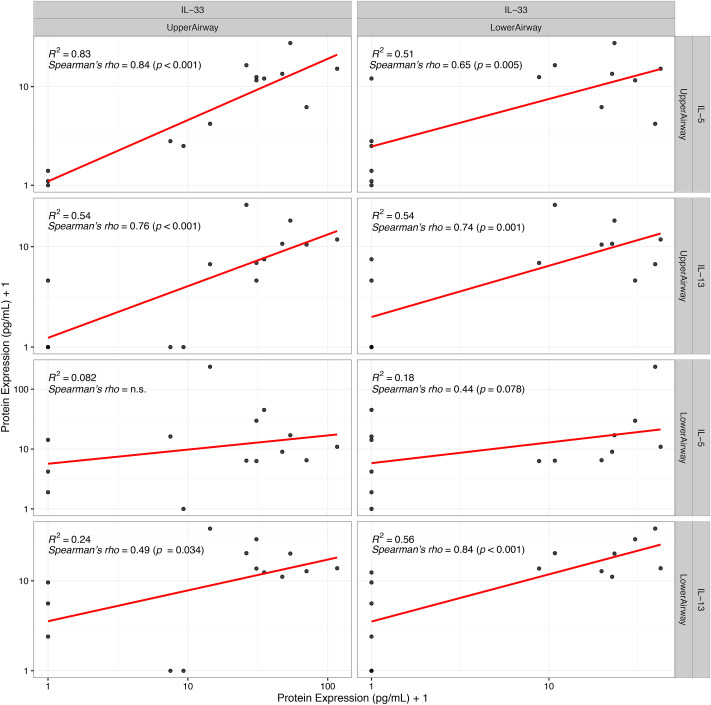
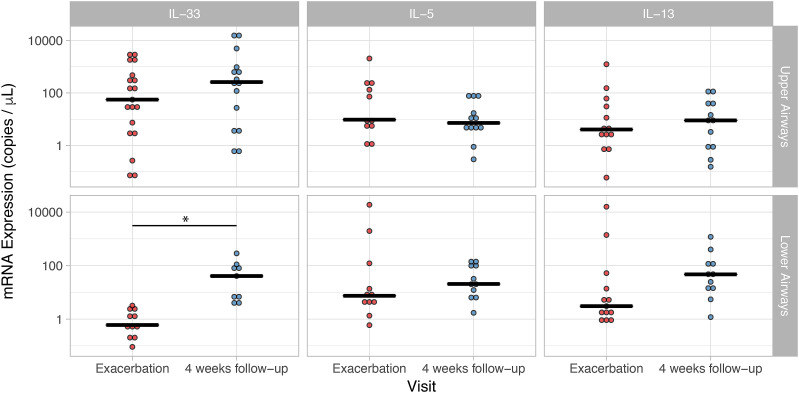
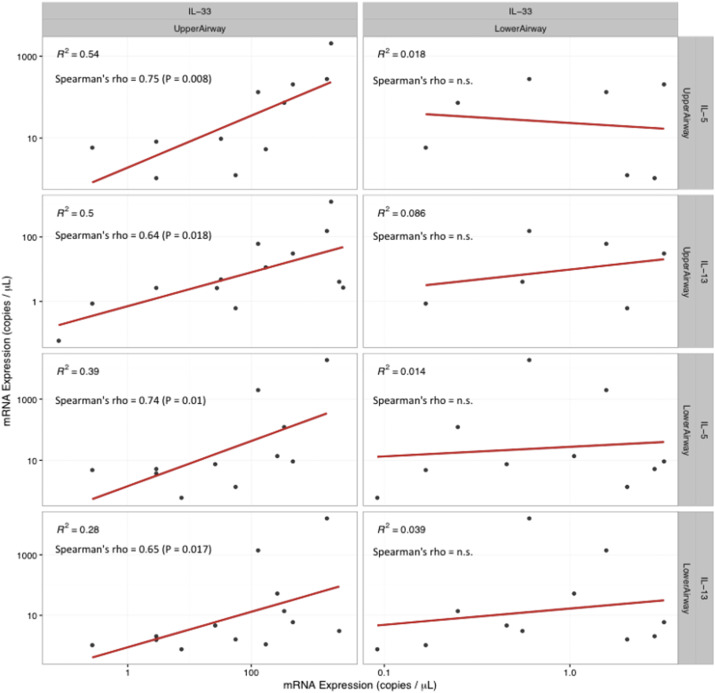
At the time of exacerbation, upper airway IL-33 correlated with upper airway IL-5 and IL-13 (R = 0.84, p < 0.01 and R = 0.76, p < 0.01, respectively) and with lower airway IL-13 (R = 0.49, p = 0.03). Similar associations were observed for mRNA expression. Lower airway IL-33 positively correlated with lower airway IL-13 (R = 0.84, p < 0.01). IL-13 and IL-33 were positively correlated with FeNO, and IL-5 with eosinophils. The association between IL-33 and type-2 cytokines were still present four weeks after exacerbation.
This is the first study to demonstrate that airway IL-33 is associated with type-2 cytokines in naturally occurring asthma exacerbations in adults, providing in vivo evidence supporting that IL-33 may be driving type-2 inflammation in acute asthma. Thus supporting IL-33 as a potential future drug target due to its role, upstream in the immunological cascade.
几项动物研究和一项成人哮喘接种研究表明,白细胞介素-33(IL-33)是急性哮喘中 2 型炎症的主要贡献者。然而,IL-33 与 2 型炎症之间的联系尚未在自然发生的哮喘恶化中得到证实。
确定在因急性哮喘而住院的患者中,气道中的白细胞介素-33 是否与通过 2 型细胞因子、FeNO 和痰嗜酸性粒细胞测量的 2 型炎症相关。
招募因急性哮喘住院的成年患者。使用鼻拭子对上呼吸道进行采样,使用诱导痰对下呼吸道进行采样。使用 Luminex 测定法测量细胞因子的蛋白水平,并使用液滴数字 PCR 测量 mRNA 表达水平。在哮喘恶化后四周重复气道采样。
在恶化时,上呼吸道的 IL-33 与上呼吸道的 IL-5 和 IL-13 相关(R=0.84,p<0.01 和 R=0.76,p<0.01),与下呼吸道的 IL-13 相关(R=0.49,p=0.03)。mRNA 表达也观察到类似的相关性。下呼吸道的 IL-33 与下呼吸道的 IL-13 呈正相关(R=0.84,p<0.01)。IL-13 和 IL-33 与 FeNO 呈正相关,IL-5 与嗜酸性粒细胞呈正相关。IL-33 与 2 型细胞因子之间的关联在哮喘恶化后四周仍然存在。
这是第一项表明在成人自然发生的哮喘恶化中气道 IL-33 与 2 型细胞因子相关的研究,提供了支持 IL-33 可能在急性哮喘中驱动 2 型炎症的体内证据。因此,由于其在免疫级联中的上游作用,支持 IL-33 作为潜在的未来药物靶点。