Retinal Circuit Development & Genetics Unit, Building 6, Room 331B Center Drive, Bethesda, MD, 20892-0610, USA.
Genomics Core, Neurobiology-Neurodegeneration & Repair Laboratory, National Eye Institute, NIH, Building 6, Room 331B Center Drive, Bethesda, MD, 20892-0610, USA.
Neural Dev. 2018 Jun 29;13(1):15. doi: 10.1186/s13064-018-0110-0.
About 20-30 distinct Retinal Ganglion Cell (RGC) types transmit visual information from the retina to the brain. The developmental mechanisms by which RGCs are specified are still largely unknown. Brn3a is a member of the Brn3/Pou4f transcription factor family, which contains key regulators of RGC postmitotic specification. In particular, Brn3a ablation results in the loss of RGCs with small, thick and dense dendritic arbors ('midget-like' RGCs), and morphological changes in other RGC subpopulations. To identify downstream molecular mechanisms underlying Brn3a effects on RGC numbers and morphology, our group recently performed a RNA deep sequencing screen for Brn3a transcriptional targets in mouse RGCs and identified 180 candidate transcripts.
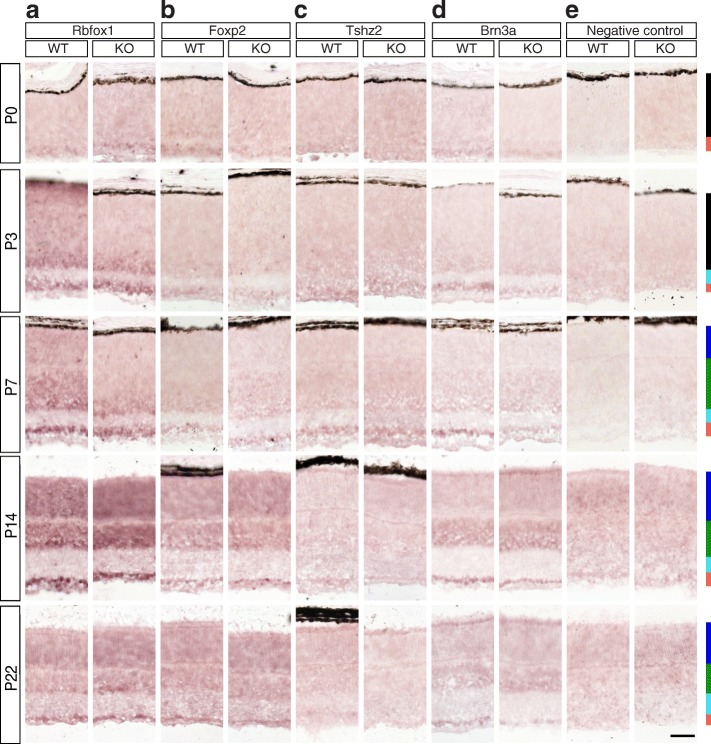
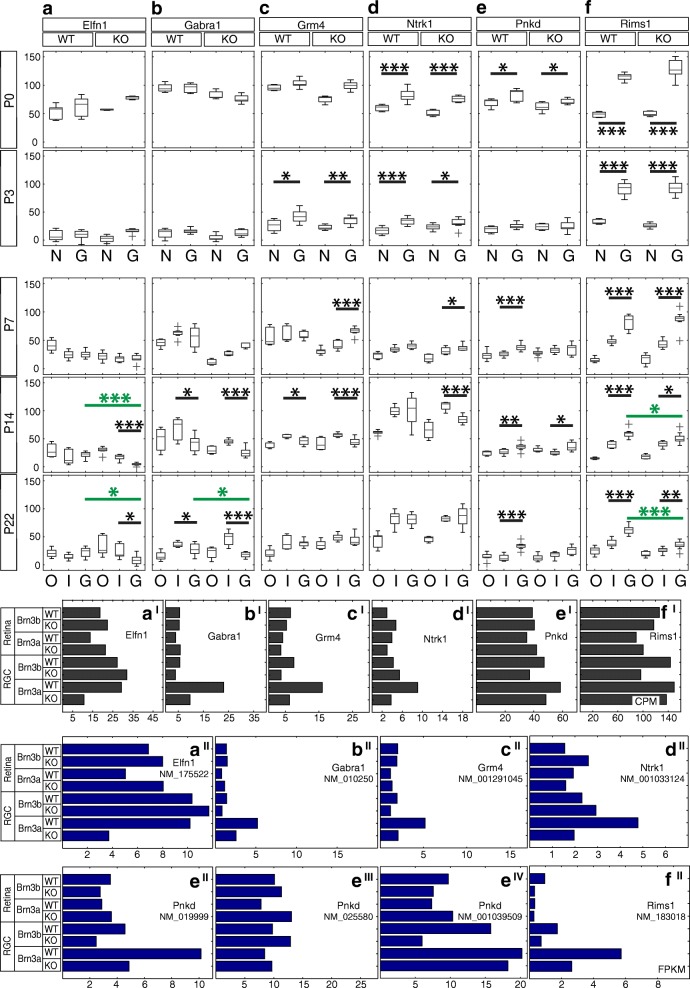
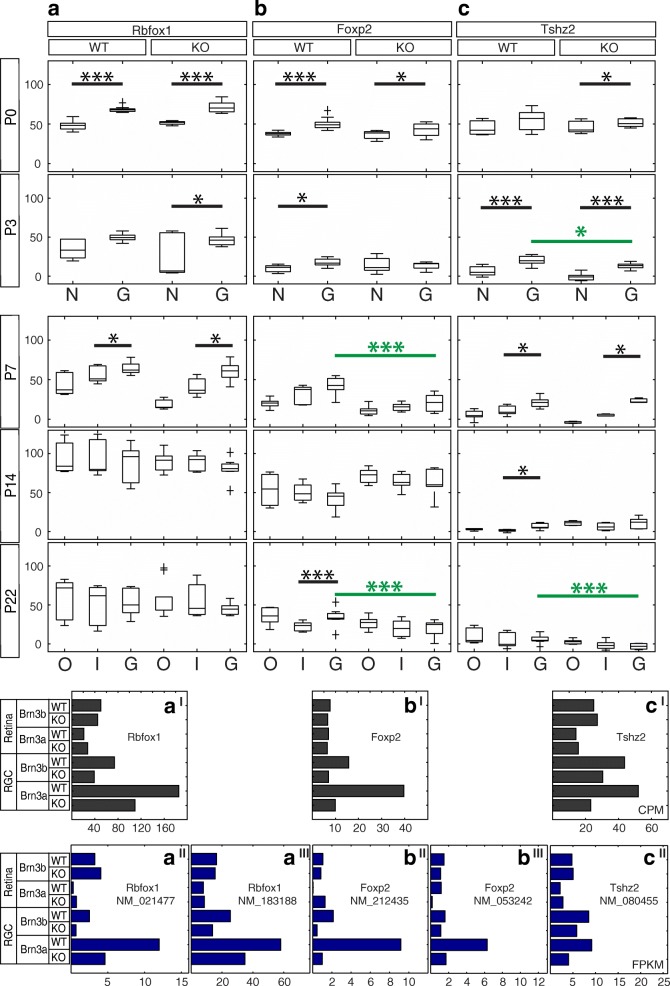
We now focus on a subset of 28 candidate genes encoding potential cell type determinant proteins. We validate and further define their retinal expression profile at five postnatal developmental time points between birth and adult stage, using in situ hybridization (ISH), RT-PCR and fluorescent immunodetection (IIF).
We find that a majority of candidate genes are enriched in the ganglion cell layer during early stages of postnatal development, but dynamically change their expression profile. We also document transcript-specific expression differences for two example candidates, using RT-PCR and ISH. Brn3a dependency could be confirmed by ISH and IIF only for a fraction of our candidates.
Amongst our candidate Brn3a target genes, a majority demonstrated ganglion cell layer specificity, however only around two thirds showed Brn3a dependency. Some were previously implicated in RGC type specification, while others have known physiological functions in RGCs. Only three genes were found to be consistently regulated by Brn3a throughout postnatal retina development - Mapk10, Tusc5 and Cdh4.
大约有 20-30 种不同的视网膜神经节细胞(RGC)类型将视觉信息从视网膜传递到大脑。RGC 特异性的发育机制在很大程度上仍不清楚。Brn3a 是 Brn3/Pou4f 转录因子家族的成员,该家族包含 RGC 有丝后特化的关键调节因子。特别是,Brn3a 的缺失导致具有小而粗且密集树突的 RGC(“微小型”RGC)丧失,以及其他 RGC 亚群的形态变化。为了确定 Brn3a 对 RGC 数量和形态影响的下游分子机制,我们的小组最近对小鼠 RGC 中的 Brn3a 转录靶标进行了 RNA 深度测序筛选,并鉴定了 180 个候选转录本。
我们现在专注于一组 28 个候选基因,这些基因编码潜在的细胞类型决定蛋白。我们使用原位杂交(ISH)、RT-PCR 和荧光免疫检测(IIF),在出生到成年阶段的五个出生后发育时间点上验证并进一步定义它们在视网膜中的表达谱。
我们发现大多数候选基因在出生后发育的早期阶段在神经节细胞层中富集,但它们的表达谱会动态变化。我们还通过 RT-PCR 和 ISH 记录了两个示例候选基因的转录特异性表达差异。通过 ISH 和 IIF 仅能确认候选基因中的一部分依赖 Brn3a。
在我们的候选 Brn3a 靶基因中,大多数表现出神经节细胞层特异性,但只有大约三分之二显示出 Brn3a 依赖性。其中一些先前被认为与 RGC 类型特化有关,而其他则在 RGC 中具有已知的生理功能。只有三个基因在整个出生后视网膜发育过程中始终受到 Brn3a 的调节 - Mapk10、Tusc5 和 Cdh4。