Department of Medicine, Boston Children's Hospital, Harvard Medical School, Boston, Massachusetts.
Renal Division, University Medical Center Freiburg, Faculty of Medicine, University of Freiburg, Freiburg, Germany.
J Am Soc Nephrol. 2018 Aug;29(8):2123-2138. doi: 10.1681/ASN.2017121312. Epub 2018 Jun 29.
Steroid-resistant nephrotic syndrome (SRNS) is a frequent cause of CKD. The discovery of monogenic causes of SRNS has revealed specific pathogenetic pathways, but these monogenic causes do not explain all cases of SRNS.
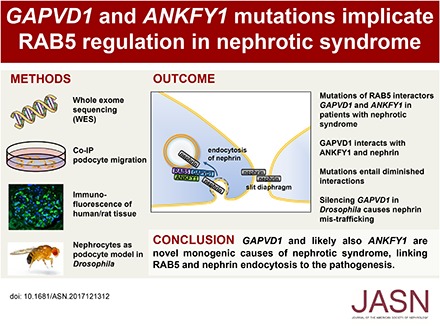
To identify novel monogenic causes of SRNS, we screened 665 patients by whole-exome sequencing. We then evaluated the functional significance of two genes and the mutations therein that we discovered through this sequencing and conducted complementary studies in podocyte-like nephrocytes.
We identified conserved, homozygous missense mutations of in two families with early-onset NS and a homozygous missense mutation of in two siblings with SRNS. GAPVD1 and ANKFY1 interact with the endosomal regulator RAB5. Coimmunoprecipitation assays indicated interaction between GAPVD1 and ANKFY1 proteins, which also colocalized when expressed in HEK293T cells. Silencing either protein diminished the podocyte migration rate. Compared with wild-type GAPVD1 and ANKFY1, the mutated proteins produced upon ectopic expression of or bearing the patient-derived mutations exhibited altered binding affinity for active RAB5 and reduced ability to rescue the knockout-induced defect in podocyte migration. Coimmunoprecipitation assays further demonstrated a physical interaction between nephrin and GAPVD1, and immunofluorescence revealed partial colocalization of these proteins in rat glomeruli. The patient-derived mutations reduced nephrin-GAPVD1 binding affinity. In , silencing impaired endocytosis and caused mistrafficking of the nephrin ortholog.
Mutations in and probably in are novel monogenic causes of NS. The discovery of these genes implicates RAB5 regulation in the pathogenesis of human NS.
激素耐药性肾病综合征(SRNS)是 CKD 的常见病因。单基因病因的发现揭示了特定的发病机制途径,但这些单基因病因并不能解释所有的 SRNS 病例。
为了确定 SRNS 的新的单基因病因,我们通过全外显子组测序筛选了 665 名患者。然后,我们评估了通过测序发现的两个基因及其突变的功能意义,并在足细胞样肾细胞中进行了补充研究。
我们在两个早发性 NS 家族中发现了保守的、纯合的错义突变,在两个患有 SRNS 的同胞中发现了一个纯合的错义突变。GAPVD1 和 ANKFY1 与内体调节因子 RAB5 相互作用。共免疫沉淀试验表明 GAPVD1 和 ANKFY1 蛋白之间存在相互作用,当在 HEK293T 细胞中表达时,它们也共定位。沉默任何一种蛋白质都会降低足细胞的迁移率。与野生型 GAPVD1 和 ANKFY1 相比,外显子表达时产生的携带患者衍生突变的突变蛋白对活性 RAB5 的结合亲和力发生改变,并且拯救足细胞迁移中缺失诱导的缺陷的能力降低。共免疫沉淀试验进一步证明了 nephrin 和 GAPVD1 之间的物理相互作用,免疫荧光显示这些蛋白质在大鼠肾小球中部分共定位。患者衍生的 突变降低了 nephrin-GAPVD1 的结合亲和力。在 中,沉默 会损害内吞作用并导致 nephrin 同源物的错误运输。
和 中的突变是 NS 的新的单基因病因。这些基因的发现提示 RAB5 调节在人类 NS 的发病机制中起作用。