Department of Neurology, The Central Hospital of Wuhan Affiliated to Tongji Medical College, Huazhong University of Science and Technology, Wuhan City, 430014, China.
Sci Rep. 2018 Jun 29;8(1):9833. doi: 10.1038/s41598-018-27991-0.
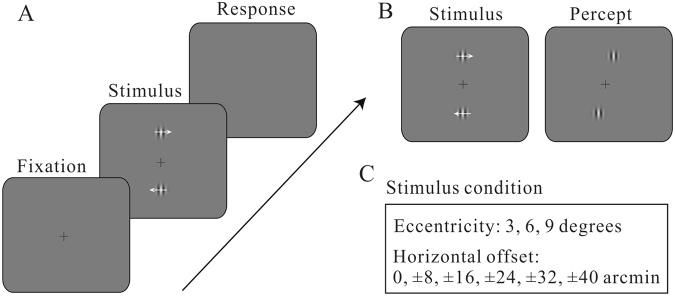
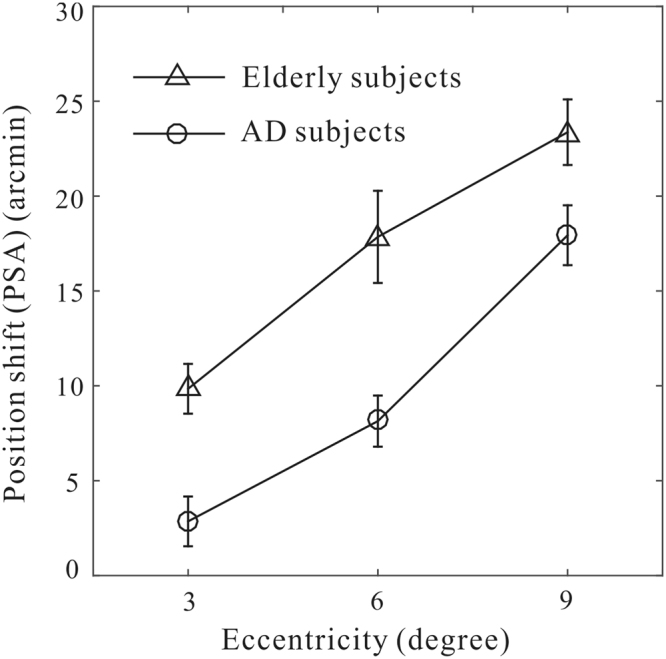
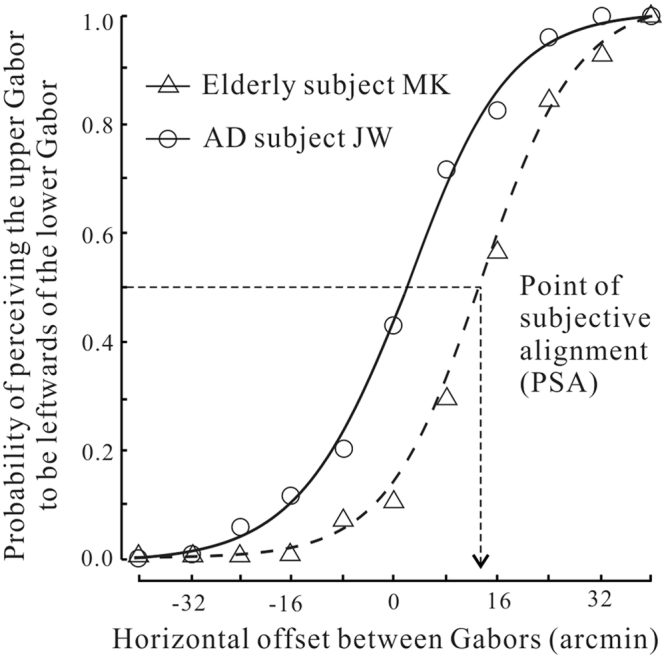
The localization of object position in space is one of the most important visual abilities in humans. Motion-induced position shift is a perceptual illusion in which the position of a moving object is perceived to be shifted in the direction of motion. In this study, we wanted to explore whether and how Alzheimer's disease (AD) affects this illusion. We recruited a group of patients with early AD and a group of age-matched healthy controls. In our experiments, two drifting Gabor patches moving in opposite directions were presented and participants were asked to report whether the upper Gabor appeared rightwards or leftwards of the lower one. We measured the psychometric functions, of which the point of subjective alignment was taken as the magnitude of motion-induced position shift. We compared the position shift across the two groups at three different retinal eccentricities. We found that position shifts were systematically smaller in the AD group as comparing to the elderly control group. Our data demonstrated that AD patients were less prone to motion-induced position shift. The results add to the existing knowledge of perceptual deficits in AD patients. We suggest that motion induced position shift may be effective as a new behavioral indicator for AD identification.
物体在空间中位置的定位是人类最重要的视觉能力之一。运动诱导的位置移动是一种知觉错觉,在这种错觉中,移动物体的位置被感知为向运动方向移动。在这项研究中,我们想探讨阿尔茨海默病(AD)是否以及如何影响这种错觉。我们招募了一组早期 AD 患者和一组年龄匹配的健康对照组。在我们的实验中,呈现了两个向相反方向移动的漂移 Gabor 补丁,要求参与者报告上一个 Gabor 是否比下一个 Gabor 看起来更偏右或偏左。我们测量了心理物理函数,其中主观对准点被视为运动诱导的位置移动的幅度。我们比较了两组在三个不同视网膜偏心度下的位置移动。我们发现,与老年对照组相比,AD 组的位置移动明显较小。我们的数据表明,AD 患者不太容易受到运动诱导的位置移动的影响。结果增加了 AD 患者知觉缺陷的现有知识。我们建议,运动诱导的位置移动可能是 AD 识别的一种有效的新行为指标。