Beyer Fiona, Lynch Ellen, Kaner Eileen
Institute of Health and Society, Newcastle University, Baddiley-Clark Building, Richardson Road, Newcastle upon Tyne, NE2 4AX UK.
Curr Addict Rep. 2018;5(2):265-273. doi: 10.1007/s40429-018-0198-7. Epub 2018 May 3.
Excessive drinking is a major public health problem that adversely affects all parts of the population. Previous systematic reviews and meta-analyses have reported that brief interventions delivered in primary care are effective at reducing alcohol consumption, albeit with small effect sizes that have decreased over time. This review summarises the updated evidence base on practitioner and digitally delivered brief interventions.
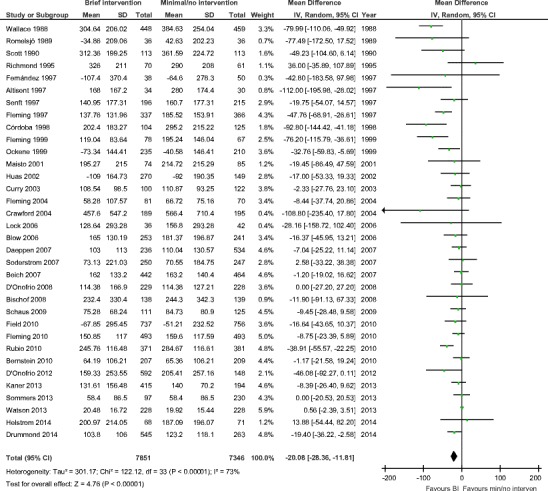
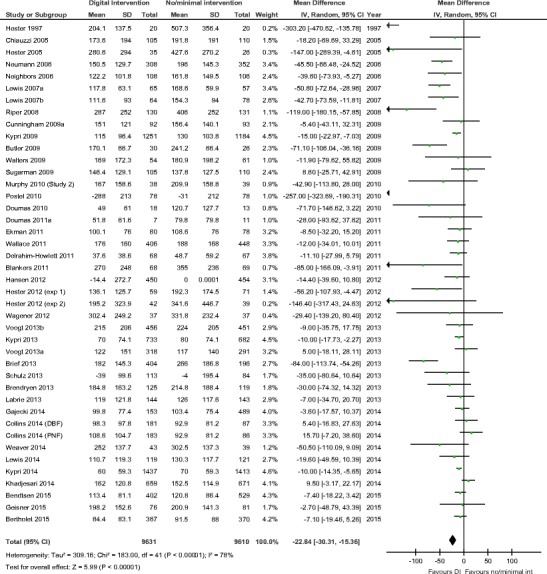
Using Cochrane methodology, 69 primary care brief intervention trials (33,642 participants) and 57 digital intervention trials (34,390 participants) were identified. Meta-analyses showed both approaches significantly reduced consumption compared to controls. Five trials (390 participants) compared practitioner-delivered and digital interventions directly with no evidence of difference in outcomes at follow-up.
Brief interventions have the potential to impact at both individual and population levels. Future research should focus on optimising components and delivery mechanisms, and on alcohol-related harms. Digital interventions may overcome some of the implementation barriers faced by practitioner-delivered interventions.
过度饮酒是一个严重的公共卫生问题,对各人群均有不利影响。以往的系统评价和荟萃分析报告称,在初级保健中实施的简短干预措施在减少酒精消费方面是有效的,尽管随着时间的推移效应量较小。本综述总结了关于从业者提供的和数字化提供的简短干预措施的最新证据基础。
采用Cochrane方法,确定了69项初级保健简短干预试验(33642名参与者)和57项数字干预试验(34390名参与者)。荟萃分析表明,与对照组相比,这两种方法均显著减少了酒精消费。五项试验(390名参与者)直接比较了从业者提供的干预措施和数字干预措施,随访结果没有差异。
简短干预措施有可能在个体和人群层面产生影响。未来的研究应侧重于优化干预措施的组成部分和实施机制,以及与酒精相关的危害。数字干预措施可能会克服从业者提供的干预措施所面临的一些实施障碍。