• 文献检索
  • 文档翻译
  • 深度研究
  • 学术资讯
  • Suppr Zotero 插件Zotero 插件
  • 邀请有礼
  • 套餐&价格
  • 历史记录
应用&插件
Suppr Zotero 插件Zotero 插件浏览器插件Mac 客户端Windows 客户端微信小程序
定价
高级版会员购买积分包购买API积分包
服务
文献检索文档翻译深度研究API 文档MCP 服务
关于我们
关于 Suppr公司介绍联系我们用户协议隐私条款
关注我们

Suppr 超能文献

核心技术专利:CN118964589B侵权必究
粤ICP备2023148730 号-1Suppr @ 2026

文献检索

告别复杂PubMed语法,用中文像聊天一样搜索,搜遍4000万医学文献。AI智能推荐,让科研检索更轻松。

立即免费搜索

文件翻译

保留排版,准确专业,支持PDF/Word/PPT等文件格式,支持 12+语言互译。

免费翻译文档

深度研究

AI帮你快速写综述,25分钟生成高质量综述,智能提取关键信息,辅助科研写作。

立即免费体验

基底神经节和小脑对自我定时的预备活动的不同贡献。

Different contributions of preparatory activity in the basal ganglia and cerebellum for self-timing.

机构信息

Department of Physiology, Hokkaido University School of Medicine, Sapporo, Japan.

Laboratory of Sensorimotor Research, National Eye Institute, National Institutes of Health, Bethesda, United States.

出版信息

Elife. 2018 Jul 2;7:e35676. doi: 10.7554/eLife.35676.

DOI:10.7554/eLife.35676
PMID:29963985
原文链接:https://pmc.ncbi.nlm.nih.gov/articles/PMC6050043/
Abstract

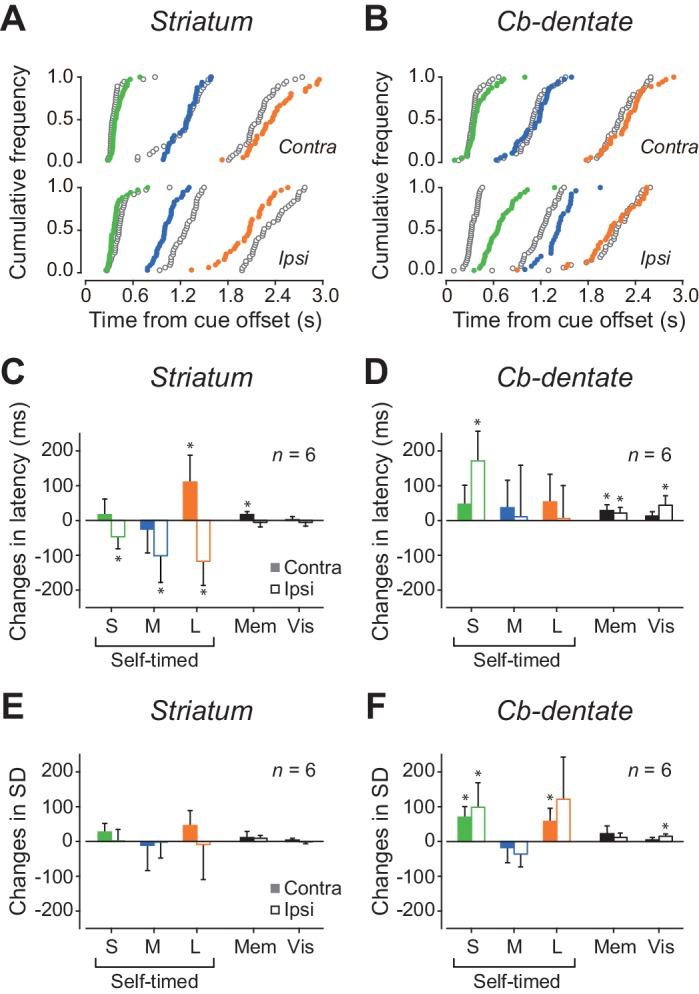
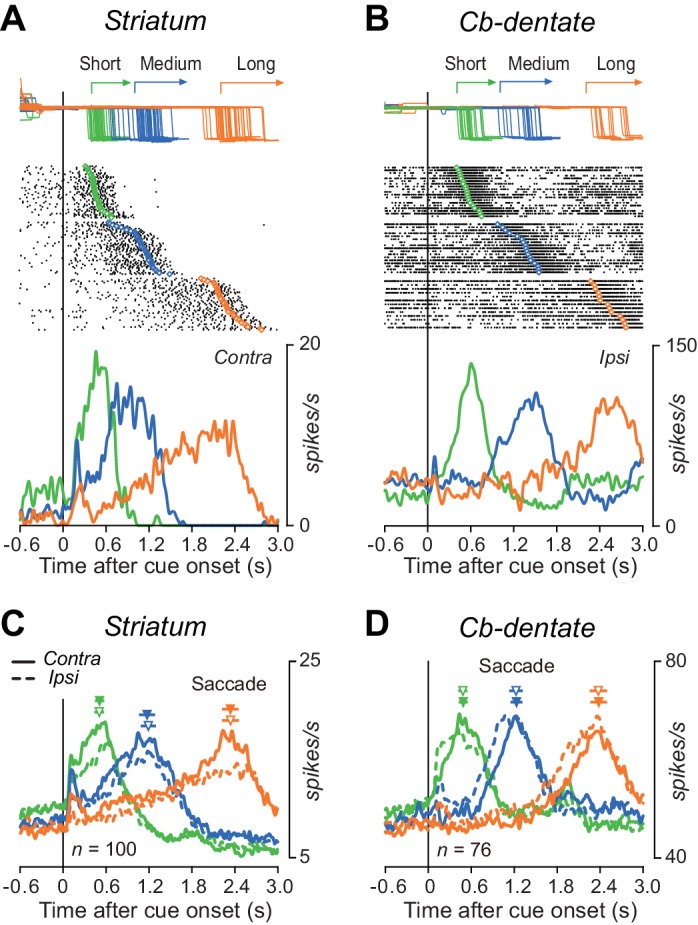
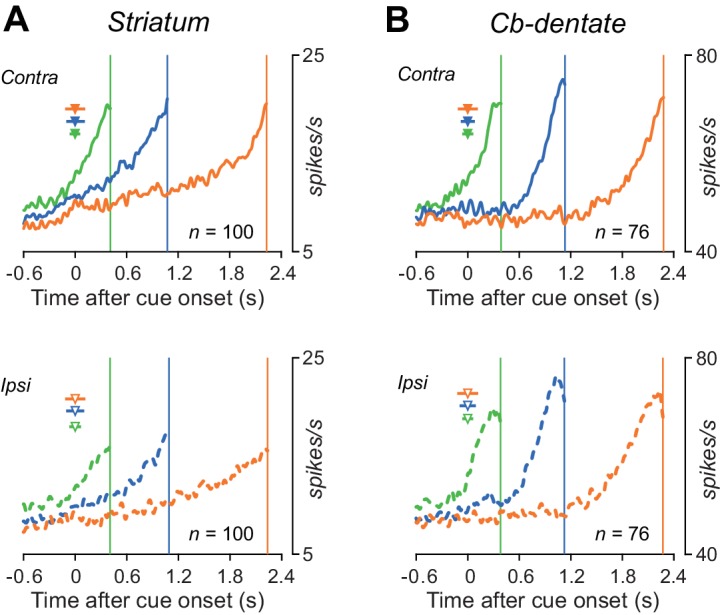
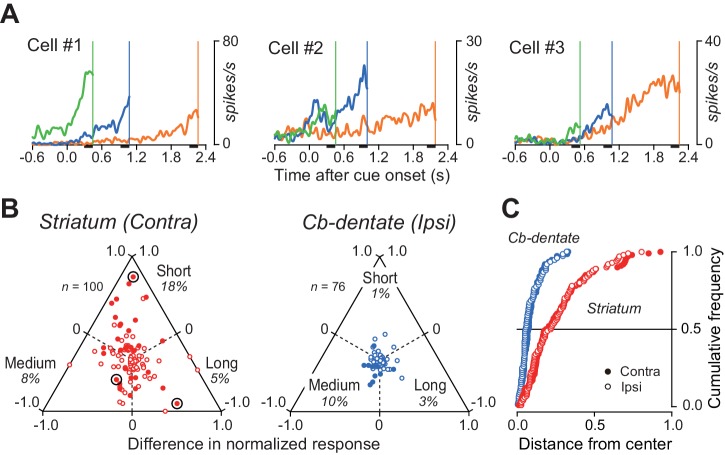
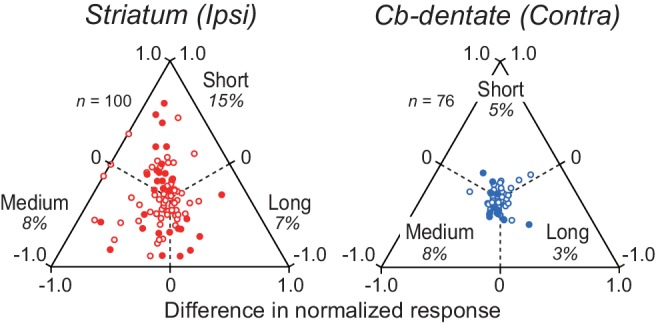
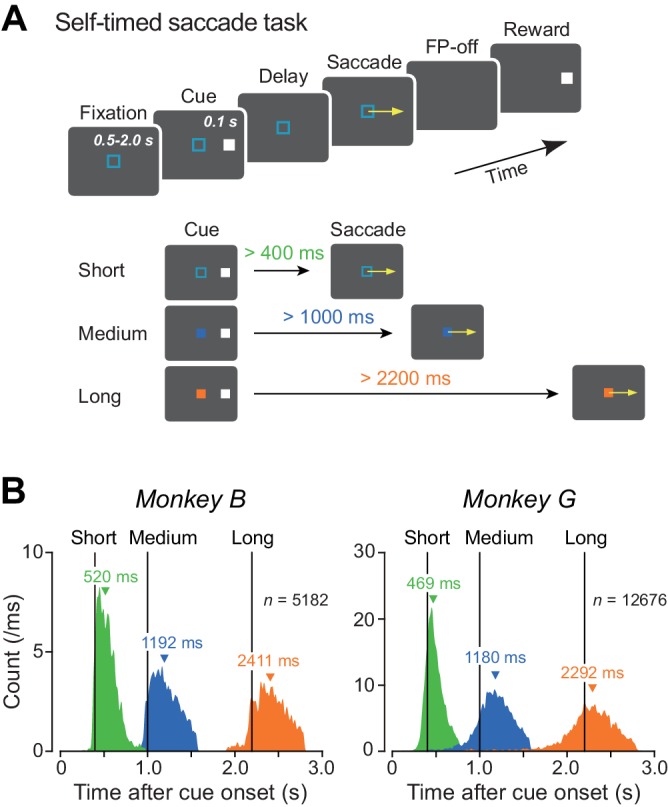
The ability to flexibly adjust movement timing is important for everyday life. Although the basal ganglia and cerebellum have been implicated in monitoring of supra- and sub-second intervals, respectively, the underlying neuronal mechanism remains unclear. Here, we show that in monkeys trained to generate a self-initiated saccade at instructed timing following a visual cue, neurons in the caudate nucleus kept track of passage of time throughout the delay period, while those in the cerebellar dentate nucleus were recruited only during the last part of the delay period. Conversely, neuronal correlates of trial-by-trial variation of self-timing emerged earlier in the cerebellum than the striatum. Local inactivation of respective recording sites confirmed the difference in their relative contributions to supra- and sub-second intervals. These results suggest that the basal ganglia may measure elapsed time relative to the intended interval, while the cerebellum might be responsible for the fine adjustment of self-timing.

摘要

灵活调整运动时间的能力对日常生活很重要。尽管基底神经节和小脑分别被认为与超秒和亚秒间隔的监测有关,但潜在的神经元机制仍不清楚。在这里,我们发现在猴子被训练以在视觉提示后按照指令时间自主产生扫视时,尾状核中的神经元在整个延迟期间都能记录时间的流逝,而齿状核中的神经元则仅在延迟期间的最后部分被募集。相反,自我定时的逐次试验变化的神经元相关性在小脑比纹状体更早出现。在各自的记录部位进行局部失活确认了它们对超秒和亚秒间隔的相对贡献的差异。这些结果表明,基底神经节可能会测量相对于预期间隔的经过时间,而小脑可能负责自我定时的精细调整。
https://cdn.ncbi.nlm.nih.gov/pmc/blobs/a92d/6050043/626ddd8f3b45/elife-35676-fig7.jpg
https://cdn.ncbi.nlm.nih.gov/pmc/blobs/a92d/6050043/65732e250cc6/elife-35676-fig1.jpg
https://cdn.ncbi.nlm.nih.gov/pmc/blobs/a92d/6050043/cdf625276731/elife-35676-fig2.jpg
https://cdn.ncbi.nlm.nih.gov/pmc/blobs/a92d/6050043/fb3cffff37db/elife-35676-fig3.jpg
https://cdn.ncbi.nlm.nih.gov/pmc/blobs/a92d/6050043/5d815ba71707/elife-35676-fig3-figsupp1.jpg
https://cdn.ncbi.nlm.nih.gov/pmc/blobs/a92d/6050043/07b229b95e9a/elife-35676-fig3-figsupp2.jpg
https://cdn.ncbi.nlm.nih.gov/pmc/blobs/a92d/6050043/8d489fb492fa/elife-35676-fig3-figsupp3.jpg
https://cdn.ncbi.nlm.nih.gov/pmc/blobs/a92d/6050043/88278a4347e5/elife-35676-fig4.jpg
https://cdn.ncbi.nlm.nih.gov/pmc/blobs/a92d/6050043/42523d4a4d36/elife-35676-fig5.jpg
https://cdn.ncbi.nlm.nih.gov/pmc/blobs/a92d/6050043/7a37d6aadac5/elife-35676-fig6.jpg
https://cdn.ncbi.nlm.nih.gov/pmc/blobs/a92d/6050043/e7d26dc80c8d/elife-35676-fig6-figsupp1.jpg
https://cdn.ncbi.nlm.nih.gov/pmc/blobs/a92d/6050043/626ddd8f3b45/elife-35676-fig7.jpg
https://cdn.ncbi.nlm.nih.gov/pmc/blobs/a92d/6050043/65732e250cc6/elife-35676-fig1.jpg
https://cdn.ncbi.nlm.nih.gov/pmc/blobs/a92d/6050043/cdf625276731/elife-35676-fig2.jpg
https://cdn.ncbi.nlm.nih.gov/pmc/blobs/a92d/6050043/fb3cffff37db/elife-35676-fig3.jpg
https://cdn.ncbi.nlm.nih.gov/pmc/blobs/a92d/6050043/5d815ba71707/elife-35676-fig3-figsupp1.jpg
https://cdn.ncbi.nlm.nih.gov/pmc/blobs/a92d/6050043/07b229b95e9a/elife-35676-fig3-figsupp2.jpg
https://cdn.ncbi.nlm.nih.gov/pmc/blobs/a92d/6050043/8d489fb492fa/elife-35676-fig3-figsupp3.jpg
https://cdn.ncbi.nlm.nih.gov/pmc/blobs/a92d/6050043/88278a4347e5/elife-35676-fig4.jpg
https://cdn.ncbi.nlm.nih.gov/pmc/blobs/a92d/6050043/42523d4a4d36/elife-35676-fig5.jpg
https://cdn.ncbi.nlm.nih.gov/pmc/blobs/a92d/6050043/7a37d6aadac5/elife-35676-fig6.jpg
https://cdn.ncbi.nlm.nih.gov/pmc/blobs/a92d/6050043/e7d26dc80c8d/elife-35676-fig6-figsupp1.jpg
https://cdn.ncbi.nlm.nih.gov/pmc/blobs/a92d/6050043/626ddd8f3b45/elife-35676-fig7.jpg

相似文献

1
Different contributions of preparatory activity in the basal ganglia and cerebellum for self-timing.基底神经节和小脑对自我定时的预备活动的不同贡献。
Elife. 2018 Jul 2;7:e35676. doi: 10.7554/eLife.35676.
2
Cerebellar Roles in Self-Timing for Sub- and Supra-Second Intervals.小脑在亚秒级和超秒级时间间隔自我计时中的作用。
J Neurosci. 2017 Mar 29;37(13):3511-3522. doi: 10.1523/JNEUROSCI.2221-16.2017. Epub 2017 Feb 27.
3
Temporal Information Processing in the Cerebellum and Basal Ganglia.小脑和基底神经节的时间信息处理。
Adv Exp Med Biol. 2024;1455:95-116. doi: 10.1007/978-3-031-60183-5_6.
4
Implications of Lateral Cerebellum in Proactive Control of Saccades.外侧小脑在扫视运动的主动控制中的意义
J Neurosci. 2016 Jun 29;36(26):7066-74. doi: 10.1523/JNEUROSCI.0733-16.2016.
5
Presaccadic omnidirectional burst activity in the basal interstitial nucleus in the monkey cerebellum.猴小脑基底间质核中的扫视前全向爆发活动。
Exp Brain Res. 1998 Aug;121(4):442-50. doi: 10.1007/s002210050479.
6
Delay activity of saccade-related neurons in the caudal dentate nucleus of the macaque cerebellum.延迟猴小脑齿状核尾部的扫视相关神经元的活动。
J Neurophysiol. 2013 Apr;109(8):2129-44. doi: 10.1152/jn.00906.2011. Epub 2013 Jan 30.
7
Temporally specific sensory signals for the detection of stimulus omission in the primate deep cerebellar nuclei.灵长类动物小脑深部核中用于检测刺激缺失的时间特异性感觉信号。
J Neurosci. 2013 Sep 25;33(39):15432-41. doi: 10.1523/JNEUROSCI.1698-13.2013.
8
Primate basal ganglia activity in a precued reaching task: preparation for movement.灵长类动物在预提示伸手任务中的基底神经节活动:运动准备。
Exp Brain Res. 1993;95(1):51-64. doi: 10.1007/BF00229653.
9
Saccadic burst neurons in the oculomotor region of the fastigial nucleus of macaque monkeys.猕猴顶核动眼区的扫视爆发神经元。
J Neurophysiol. 1991 Jun;65(6):1422-34. doi: 10.1152/jn.1991.65.6.1422.
10
Action and outcome encoding in the primate caudate nucleus.灵长类动物尾状核中的动作与结果编码
J Neurosci. 2007 Dec 26;27(52):14502-14. doi: 10.1523/JNEUROSCI.3060-07.2007.

引用本文的文献

1
A cerebello-thalamo-cortical pathway transmits reward-based post-error signals for motor timing correction during learning in male mice.在雄性小鼠学习过程中,一条小脑-丘脑-皮质通路会传递基于奖励的错误后信号,用于运动时间校正。
Nat Commun. 2025 Aug 18;16(1):7663. doi: 10.1038/s41467-025-62831-6.
2
Pallidal prototypic neuron and astrocyte activities regulate flexible reward-seeking behaviors.苍白球原型神经元和星形胶质细胞的活动调节灵活的奖赏寻求行为。
bioRxiv. 2025 Feb 10:2025.02.10.637554. doi: 10.1101/2025.02.10.637554.
3
Encoding of cerebellar dentate neuron activity during visual attention in rhesus macaques.

本文引用的文献

1
The basal ganglia and the cerebellum: nodes in an integrated network.基底神经节和小脑:整合网络中的节点。
Nat Rev Neurosci. 2018 Jun;19(6):338-350. doi: 10.1038/s41583-018-0002-7.
2
Dynamic modulation of activity in cerebellar nuclei neurons during pavlovian eyeblink conditioning in mice.在小鼠的巴甫洛夫式眨眼条件反射中,小脑核神经元活动的动态调节。
Elife. 2017 Dec 15;6:e28132. doi: 10.7554/eLife.28132.
3
Flexible timing by temporal scaling of cortical responses.通过皮质响应的时间缩放实现灵活的定时。
恒河猴视觉注意力过程中小脑齿状神经元活动的编码
Elife. 2025 Jan 16;13:RP99696. doi: 10.7554/eLife.99696.
4
Ramping cells in the rodent medial prefrontal cortex encode time to past and future events via real Laplace transform.通过实时拉普拉斯变换,啮齿动物内侧前额叶皮层中的调谐细胞对过去和未来事件进行编码。
Proc Natl Acad Sci U S A. 2024 Sep 17;121(38):e2404169121. doi: 10.1073/pnas.2404169121. Epub 2024 Sep 10.
5
Temporal Information Processing in the Cerebellum and Basal Ganglia.小脑和基底神经节的时间信息处理。
Adv Exp Med Biol. 2024;1455:95-116. doi: 10.1007/978-3-031-60183-5_6.
6
Ramping cells in rodent mPFC encode time to past and future events via real Laplace transform.啮齿动物内侧前额叶皮质中的斜坡细胞通过实拉普拉斯变换对过去和未来事件的时间进行编码。
bioRxiv. 2024 Feb 14:2024.02.13.580170. doi: 10.1101/2024.02.13.580170.
7
Differential Formation of Motor Cortical Dynamics during Movement Preparation According to the Predictability of Go Timing.根据 Go 时间的可预测性,运动准备期间运动皮层动力学的差异形成。
J Neurosci. 2024 Feb 21;44(8):e1353232024. doi: 10.1523/JNEUROSCI.1353-23.2024.
8
Keeping time and rhythm by internal simulation of sensory stimuli and behavioral actions.通过对内源性感觉刺激和行为动作的模拟来保持时间和节奏。
Sci Adv. 2024 Jan 12;10(2):eadh8185. doi: 10.1126/sciadv.adh8185. Epub 2024 Jan 10.
9
Pre-supplementary Motor Cortex Mediates Learning Transfer from Perceptual to Motor Timing.预备运动皮层介导感知到运动时间的学习迁移。
J Neurosci. 2024 Feb 21;44(8):e3191202023. doi: 10.1523/JNEUROSCI.3191-20.2023.
10
A purely visual adaptation to motion can differentiate between perceptual timing and interval timing.单纯的视觉适应运动可以区分感知时间和间隔时间。
Proc Biol Sci. 2023 Jun 14;290(2000):20230415. doi: 10.1098/rspb.2023.0415. Epub 2023 Jun 7.
Nat Neurosci. 2018 Jan;21(1):102-110. doi: 10.1038/s41593-017-0028-6. Epub 2017 Dec 4.
4
Causal Role of Noradrenaline in the Timing of Internally Generated Saccades in Monkeys.去甲肾上腺素在猴子内源性眼球跳动定时中的因果作用。
Neuroscience. 2017 Dec 16;366:15-22. doi: 10.1016/j.neuroscience.2017.10.003. Epub 2017 Oct 9.
5
Distinct Sources of Deterministic and Stochastic Components of Action Timing Decisions in Rodent Frontal Cortex.在啮齿动物前额皮质中,动作时间决策的确定性和随机性成分的不同来源。
Neuron. 2017 May 17;94(4):908-919.e7. doi: 10.1016/j.neuron.2017.04.040.
6
Maintenance of persistent activity in a frontal thalamocortical loop.维持额叶丘脑皮质环路中的持续性活动。
Nature. 2017 May 11;545(7653):181-186. doi: 10.1038/nature22324. Epub 2017 May 3.
7
The Computational and Neural Basis of Rhythmic Timing in Medial Premotor Cortex.内侧运动前皮层节律性定时的计算与神经基础
J Neurosci. 2017 Apr 26;37(17):4552-4564. doi: 10.1523/JNEUROSCI.0367-17.2017. Epub 2017 Mar 23.
8
Cerebellar Roles in Self-Timing for Sub- and Supra-Second Intervals.小脑在亚秒级和超秒级时间间隔自我计时中的作用。
J Neurosci. 2017 Mar 29;37(13):3511-3522. doi: 10.1523/JNEUROSCI.2221-16.2017. Epub 2017 Feb 27.
9
Midbrain dopamine neurons control judgment of time.中脑多巴胺神经元控制时间判断。
Science. 2016 Dec 9;354(6317):1273-1277. doi: 10.1126/science.aah5234.
10
Correlation between Pupil Size and Subjective Passage of Time in Non-Human Primates.非人灵长类动物瞳孔大小与主观时间流逝的相关性
J Neurosci. 2016 Nov 2;36(44):11331-11337. doi: 10.1523/JNEUROSCI.2533-16.2016.