London School of Hygiene and Tropical Medicine, London, United Kingdom.
Medical Research Council Unit The Gambia, Fajara, Banjul, The Gambia.
PLoS Genet. 2018 Jul 2;14(7):e1007490. doi: 10.1371/journal.pgen.1007490. eCollection 2018 Jul.
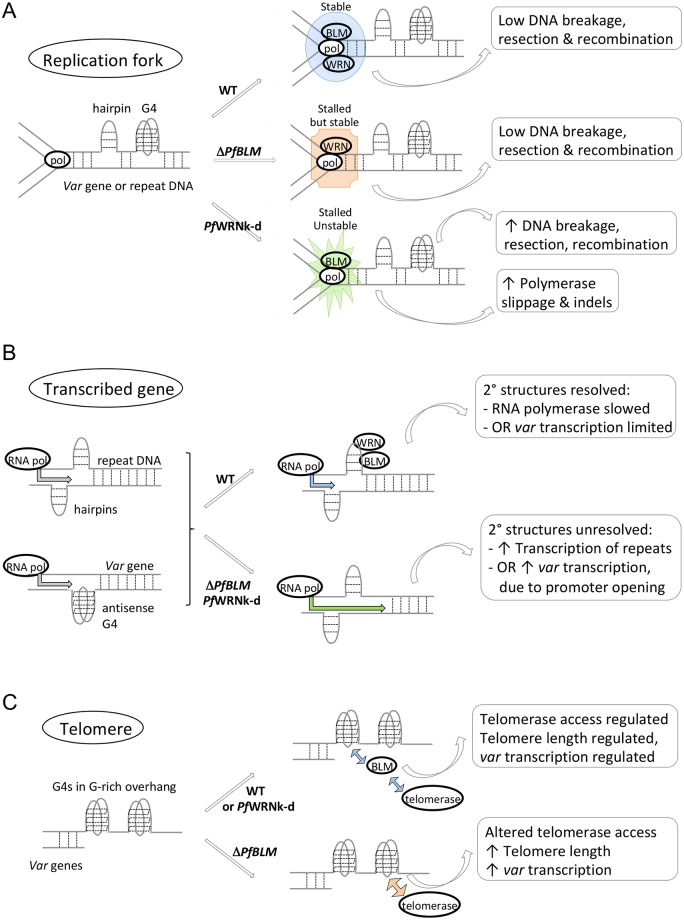
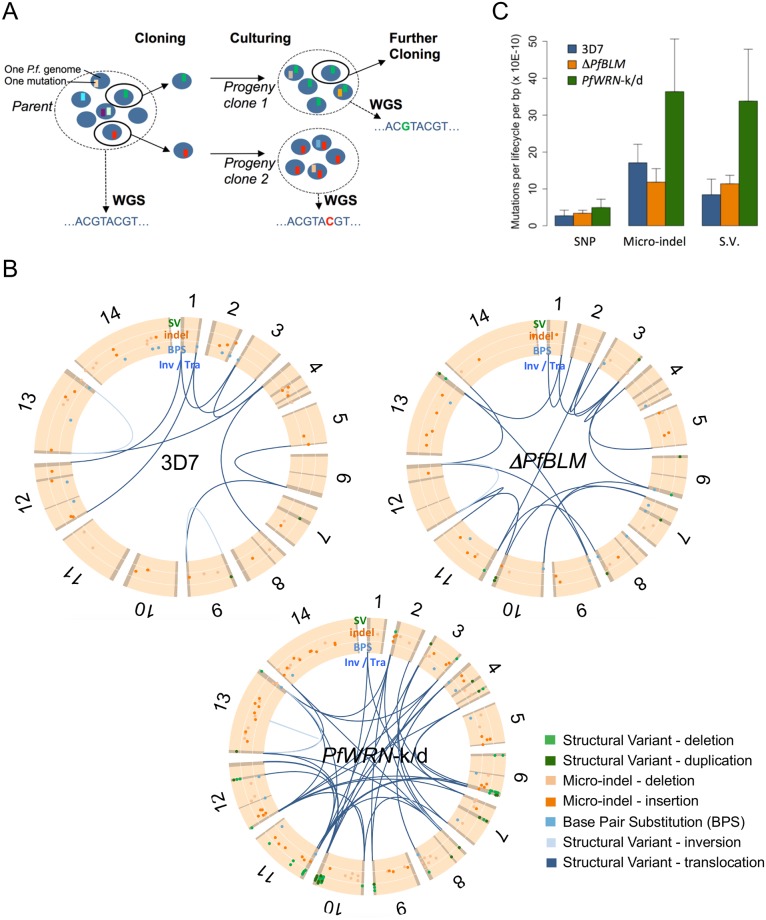
The malaria parasite Plasmodium falciparum has evolved an unusual genome structure. The majority of the genome is relatively stable, with mutation rates similar to most eukaryotic species. However, some regions are very unstable with high recombination rates, driving the generation of new immune evasion-associated var genes. The molecular factors controlling the inconsistent stability of this genome are not known. Here we studied the roles of the two putative RecQ helicases in P. falciparum, PfBLM and PfWRN. When PfWRN was knocked down, recombination rates increased four-fold, generating chromosomal abnormalities, a high rate of chimeric var genes and many microindels, particularly in known 'fragile sites'. This is the first identification of a gene involved in suppressing recombination and maintaining genome stability in Plasmodium. By contrast, no change in mutation rate appeared when the second RecQ helicase, PfBLM, was mutated. At the transcriptional level, however, both helicases evidently modulate the transcription of large cohorts of genes, with several hundred genes-including a large proportion of vars-showing deregulated expression in each RecQ mutant. Aberrant processing of stalled replication forks is a possible mechanism underlying elevated mutation rates and this was assessed by measuring DNA replication dynamics in the RecQ mutant lines. Replication forks moved slowly and stalled at elevated rates in both mutants, confirming that RecQ helicases are required for efficient DNA replication. Overall, this work identifies the Plasmodium RecQ helicases as major players in DNA replication, antigenic diversification and genome stability in the most lethal human malaria parasite, with important implications for genome evolution in this pathogen.
疟原虫恶性疟原虫已经进化出一种不寻常的基因组结构。大多数基因组相对稳定,突变率与大多数真核生物相似。然而,一些区域非常不稳定,重组率很高,从而产生新的免疫逃避相关的 VAR 基因。控制这种基因组不一致稳定性的分子因素尚不清楚。在这里,我们研究了两种假定的 RecQ 解旋酶在恶性疟原虫中的作用,PfBLM 和 PfWRN。当 PfWRN 被敲低时,重组率增加了四倍,导致染色体异常、嵌合 VAR 基因的高比率和许多微缺失,特别是在已知的“脆弱位点”。这是首次鉴定出参与抑制重组和维持疟原虫基因组稳定性的基因。相比之下,当第二个 RecQ 解旋酶 PfBLM 发生突变时,突变率没有变化。然而,在转录水平上,两种解旋酶显然都调节着大量基因的转录,有几百个基因——包括很大一部分 vars——在每个 RecQ 突变体中都表现出表达失调。停滞复制叉的异常处理可能是导致突变率升高的一种机制,这可以通过测量 RecQ 突变株中的 DNA 复制动力学来评估。复制叉在两个突变体中移动缓慢且停滞率升高,这证实了 RecQ 解旋酶是有效 DNA 复制所必需的。总的来说,这项工作确定了疟原虫 RecQ 解旋酶是最致命的人类疟原虫中 DNA 复制、抗原多样化和基因组稳定性的主要参与者,这对该病原体的基因组进化具有重要意义。