Molecular Biology Institute, University of California, Los Angeles, Los Angeles, California, United States of America.
Division of Dermatology, David Geffen School of Medicine at University of California, Los Angeles, Los Angeles, California, United States of America.
PLoS Negl Trop Dis. 2018 Jul 2;12(7):e0006608. doi: 10.1371/journal.pntd.0006608. eCollection 2018 Jul.
The immune system depends on effector pathways to eliminate invading pathogens from the host in vivo. Macrophages (MΦ) of the innate immune system are armed with vitamin D-dependent antimicrobial responses to kill intracellular microbes. However, how the physiological levels of vitamin D during MΦ differentiation affect phenotype and function is unknown.
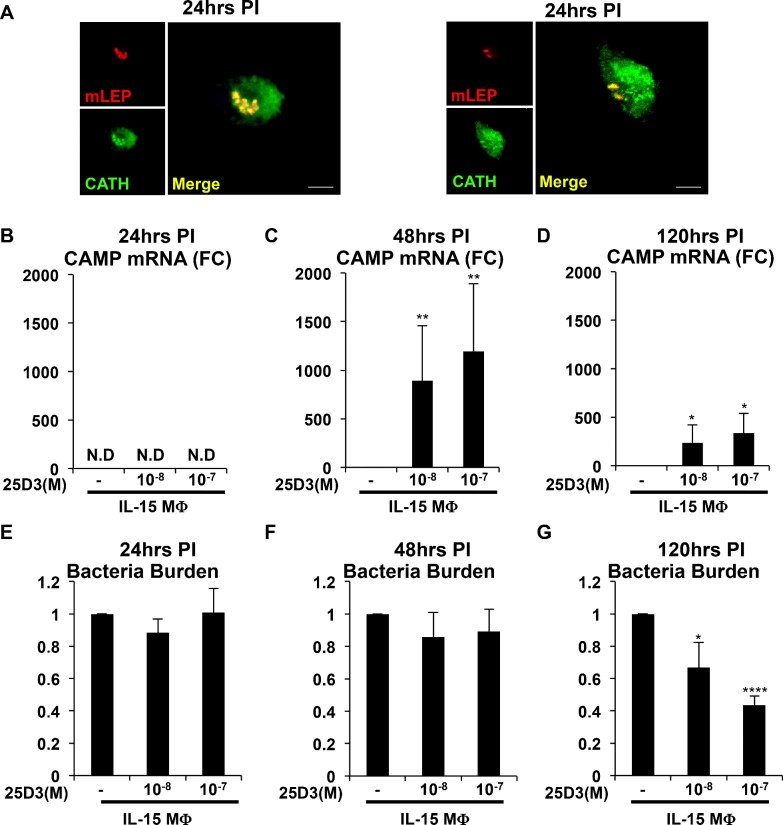
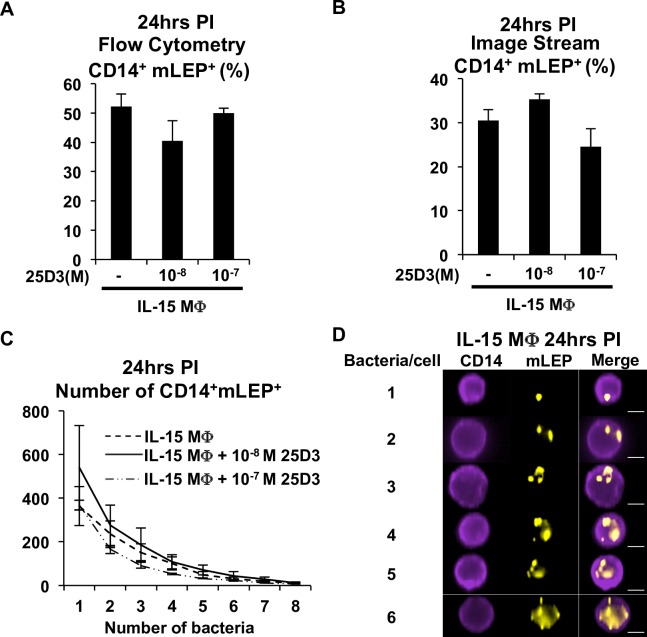
METHODOLOGY/PRINCIPAL: The human innate immune system consists of divergent MΦ subsets that serve distinct functions in vivo. Both IL-15 and IL-10 induce MΦ differentiation, but IL-15 induces primary human monocytes to differentiate into antimicrobial MΦ (IL-15 MΦ) that robustly express the vitamin D pathway. However, how vitamin D status alters IL-15 MΦ phenotype and function is unknown. In this study, we found that adding 25-hydroxyvitamin D3 (25D3) during the IL-15 induced differentiation of monocytes into MΦ increased the expression of the antimicrobial peptide cathelicidin, including both CAMP mRNA and the encoded protein cathelicidin in a dose-dependent manner. The presence of physiological levels of 25D during differentiation of IL-15 MΦ led to a significant vitamin D-dependent antimicrobial response against intracellular Mycobacterium leprae but did not change the phenotype or phagocytic function of these MΦ. These data suggest that activation of the vitamin D pathway during IL-15 MΦ differentiation augments the antimicrobial response against M. leprae infection.
CONCLUSIONS/SIGNIFICANCE: Our data demonstrates that the presence of vitamin D during MΦ differentiation bestows the capacity to mount an antimicrobial response against M. leprae.
免疫系统依赖效应途径在体内清除入侵宿主的病原体。先天免疫系统的巨噬细胞(MΦ)具有维生素 D 依赖性的抗菌反应,可杀死细胞内的微生物。然而,在 MΦ 分化过程中生理水平的维生素 D 如何影响表型和功能尚不清楚。
方法/原理:人体先天免疫系统由不同的 MΦ 亚群组成,这些亚群在体内具有不同的功能。IL-15 和 IL-10 都能诱导 MΦ 分化,但 IL-15 诱导原代人单核细胞分化为具有强大表达维生素 D 途径的抗菌 MΦ(IL-15 MΦ)。然而,维生素 D 状态如何改变 IL-15 MΦ 的表型和功能尚不清楚。在这项研究中,我们发现,在 IL-15 诱导单核细胞分化为 MΦ的过程中添加 25-羟维生素 D3(25D3),以剂量依赖的方式增加抗菌肽 cathelicidin 的表达,包括 CAMP mRNA 和编码蛋白 cathelicidin。在 IL-15 MΦ 分化过程中存在生理水平的 25D 会导致针对细胞内麻风分枝杆菌的显著维生素 D 依赖性抗菌反应,但不会改变这些 MΦ 的表型或吞噬功能。这些数据表明,在 IL-15 MΦ 分化过程中激活维生素 D 途径会增强针对麻风分枝杆菌感染的抗菌反应。
结论/意义:我们的数据表明,维生素 D 在 MΦ 分化过程中的存在赋予了对麻风分枝杆菌感染产生抗菌反应的能力。