Agent-Based Modelling Laboratory, York University, Toronto, ON, M3J 1P3, Canada.
Department of Biostatistics, Institute of Biosciences, São Paulo State University (UNESP), Botucatu, SP, 18618-689, Brazil.
BMC Med. 2018 Jul 3;16(1):100. doi: 10.1186/s12916-018-1091-x.
A number of Zika vaccine platforms are currently being investigated, some of which have entered clinical trials. We sought to evaluate the cost-effectiveness of a potential Zika vaccine candidate under the WHO Vaccine Target Product Profile for outbreak response, prioritizing women of reproductive age to prevent microcephaly and other neurological disorders.
Using an agent-based simulation model of ZIKV transmission dynamics in a Colombian population setting, we conducted cost-effectiveness analysis with and without pre-existing herd immunity. The model was parameterized with estimates associated with ZIKV infection, risks of microcephaly in different trimesters, direct medical costs, and vaccination costs. We assumed that a single dose of vaccine provides a protection efficacy in the range 60% to 90% against infection. Cost-effectiveness analysis was conducted from a government perspective.
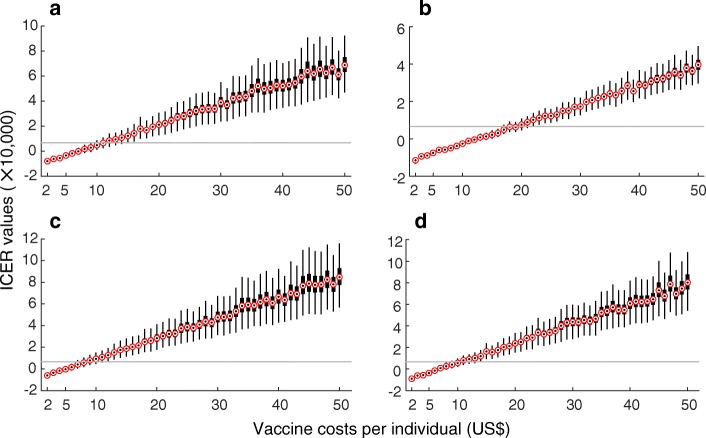
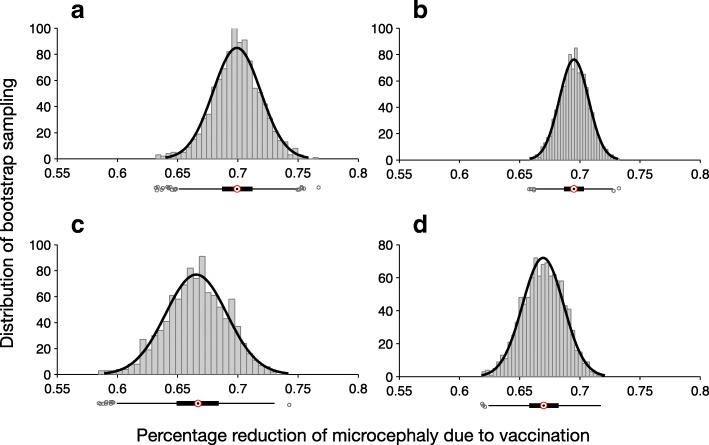
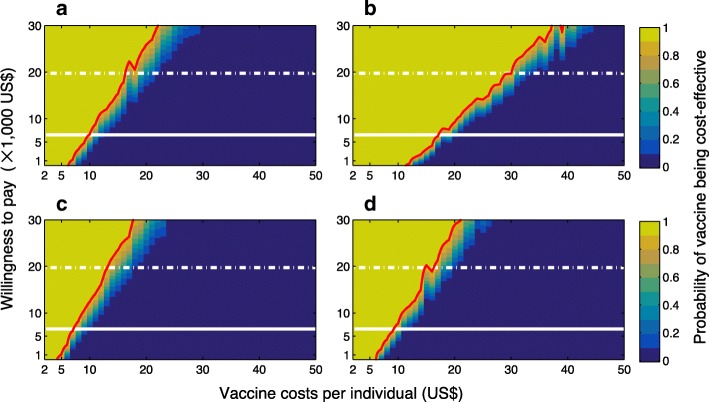
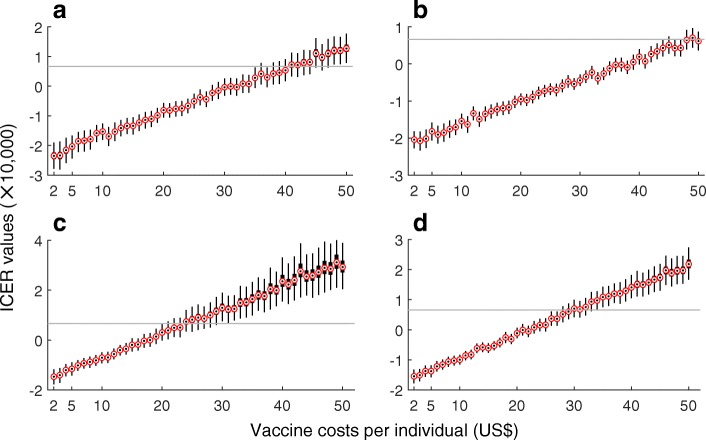
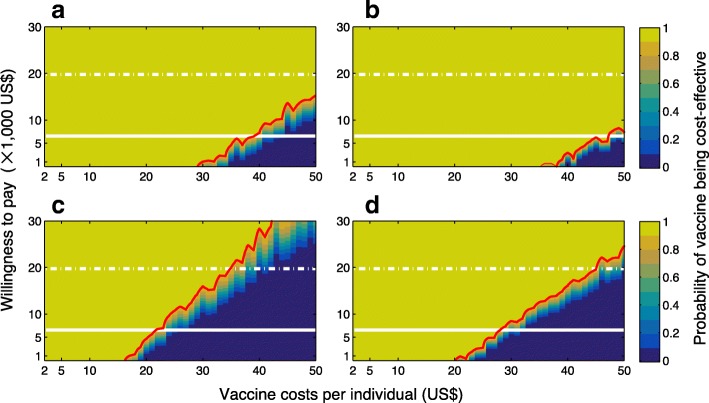
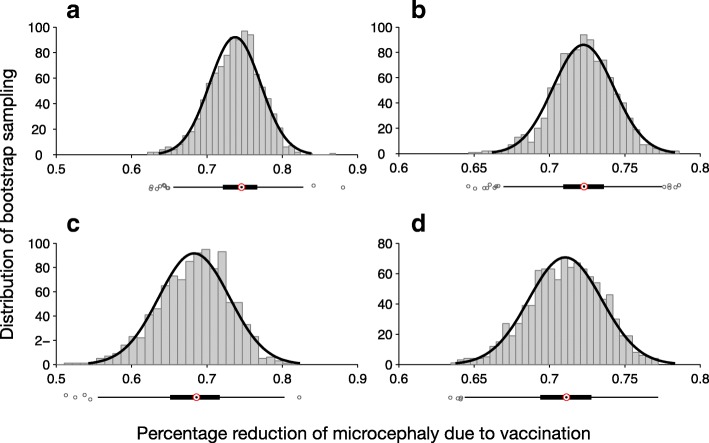
Under a favorable scenario when the reproduction number is relatively low (R = 2.2) and the relative transmissibility of asymptomatic infection is 10% compared with symptomatic infection, a vaccine is cost-saving (with negative incremental cost-effective ratio; ICER) for vaccination costs up to US$6 per individual without herd immunity, and up to US$4 per individual with 8% herd immunity. For positive ICER values, vaccination is highly cost-effective for vaccination costs up to US$10 (US$7) in the respective scenarios with the willingness-to-pay of US$6610 per disability-adjusted life-year, corresponding to the average per capita GDP of Colombia between 2013 and 2017. Our results indicate that the effect of other control measures targeted to reduce ZIKV transmission decreases the range of vaccination costs for cost-effectiveness due to reduced returns of vaccine-induced herd immunity. In all scenarios investigated, the median reduction of microcephaly exceeded 64% with vaccination.
Our study suggests that a Zika vaccine with protection efficacy as low as 60% could significantly reduce the incidence of microcephaly. From a government perspective, Zika vaccination is highly cost-effective, and even cost-saving in Colombia if vaccination costs per individual is sufficiently low. Efficacy data from clinical trials and number of vaccine doses will be important requirements in future studies to refine our estimates, and conduct similar studies in other at-risk populations.
目前正在研究多种寨卡病毒疫苗平台,其中一些已进入临床试验阶段。我们旨在评估世界卫生组织针对疫情爆发的疫苗目标产品概况下一种潜在寨卡病毒候选疫苗的成本效益,优先考虑育龄妇女,以预防小头畸形和其他神经障碍。
我们使用基于个体的寨卡病毒传播动力学模拟模型,在哥伦比亚人群中进行了成本效益分析,包括有无预先存在的群体免疫。该模型的参数包括寨卡病毒感染、不同孕期小头畸形风险、直接医疗成本和疫苗接种成本的估计值。我们假设一剂疫苗对感染的保护效力在 60%至 90%之间。成本效益分析从政府的角度进行。
在繁殖数相对较低(R=2.2)和无症状感染的相对传染性比有症状感染高 10%的有利情况下,如果没有群体免疫,疫苗的接种成本为 6 美元/人以下,且具有 8%的群体免疫,疫苗的接种成本为 4 美元/人以下,则疫苗接种是具有成本效益的(增量成本效益比为负;ICER)。对于正的 ICER 值,在各自的情况下,在愿意支付每残疾调整生命年 6610 美元的情况下,疫苗接种的成本效益非常高,对应的是哥伦比亚 2013 年至 2017 年的人均国内生产总值。我们的结果表明,针对降低寨卡病毒传播的其他控制措施的效果降低了疫苗接种成本的成本效益范围,因为疫苗诱导的群体免疫的回报降低了。在所有研究的情况下,接种疫苗可使小头畸形的发生率中位数降低 64%以上。
我们的研究表明,保护效力低至 60%的寨卡病毒疫苗可以显著降低小头畸形的发病率。从政府的角度来看,在哥伦比亚,如果每人的疫苗接种成本足够低,寨卡病毒疫苗接种具有很高的成本效益,甚至可以节省成本。临床试验的疗效数据和疫苗接种剂量数将是未来研究的重要要求,以完善我们的估计,并在其他高危人群中进行类似的研究。