Hospital Medicine, Dartmouth-Hitchcock Medical Center, One Medical Center Drive, Lebanon, NH, 03756, USA.
Hematology/Oncology, Norris Cotton Cancer Center, One Medical Center Drive, Lebanon, NH, 03756, USA.
J Immunother Cancer. 2018 Jul 2;6(1):64. doi: 10.1186/s40425-018-0375-1.
Metformin is one of the biguanides commonly used in patients with type II Diabetes Mellitus. Apart from its hypoglycemic properties, metformin also inhibits the cell cycle by restricting protein synthesis and cell proliferation via regulating the LKB1/AMPL pathway. Furthermore, it also enhances the PD-1 blockade through a reduction of tumor hypoxia. Metformin has shown a significant favorable impact on treatment-related outcomes in solid tumors, but these outcomes have not been replicated in the limited clinical studies done on malignant melanoma. Moreover, none of these studies have reported on the efficacy of the combined use of metformin and immune checkpoint inhibitors (ICIs).
This is a retrospective cohort study that includes patients diagnosed with metastatic malignant melanoma and treated with ipilimumab, nivolumab, and/or pembrolizumab (Cohort A); or ipilimumab, nivolumab, and/or pembrolizumab plus metformin (Cohort B) between January 1st 2011 through December 15th 2017. In this study, patients are stratified based on anti-PD-1 only and anti-CTLA4/anti-PD-1 combination therapies in each cohort. Objective response rate (ORR) is the primary endpoint. Disease control rate (DCR), overall survival (OS) and progression-free survival (PFS) are the secondary endpoints.
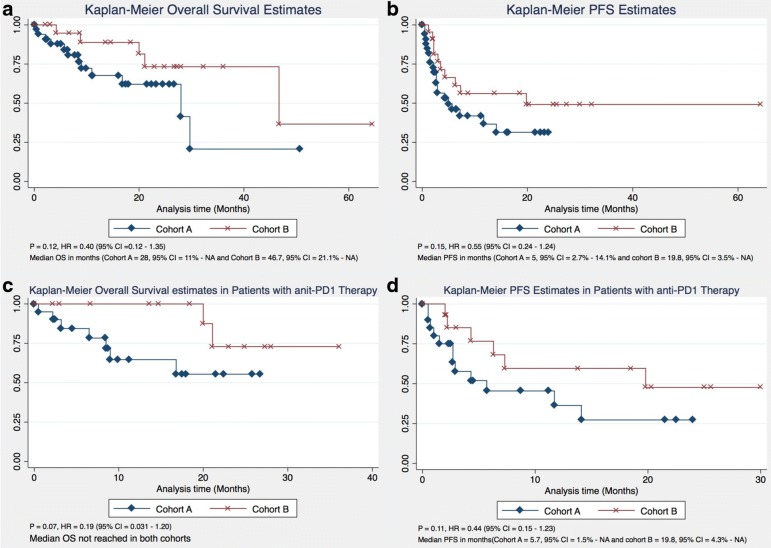
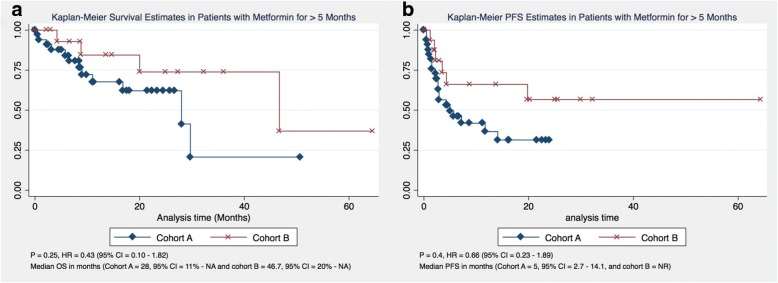
Cohort A had 33 patients (60%), while cohort B had 22 (40%). Overall patient characteristics were similar between both cohorts. ORR was higher in cohort B (68.2% vs. 54.5%, P = 0.31). The DCR was higher in cohort B as well (77.3% vs. 60.6%, P = 0.19). Median OS (46.7 months vs. 28 months), and median PFS (19.8 months vs. 5 months) were longer in cohort B. However, on univariate and multivariate analyses, none of these differences were statistically significant. The mean number of new metastatic sites which appeared during therapy were significantly higher in cohort A (A:1.51 vs. B:0.59, P = 0.009).
We have observed favorable treatment-related outcomes (ORR, DCR, median PFS and median OS) in patients who have received metformin in combination with ICIs without reaching significance, probably, due to small sample size. Hence, large prospective clinical trials are required to study the synergistic effect of metformin in combination with ICIs before it can be recommended as routine additive therapy.
二甲双胍是二型糖尿病患者常用的双胍类药物之一。除了降血糖作用外,二甲双胍还通过调节 LKB1/AMPL 通路限制蛋白质合成和细胞增殖来抑制细胞周期。此外,它还通过降低肿瘤缺氧来增强 PD-1 阻断作用。二甲双胍在实体瘤的治疗相关结局方面表现出显著的有利影响,但这些结果在恶性黑色素瘤的有限临床研究中并未得到复制。此外,这些研究均未报告二甲双胍与免疫检查点抑制剂(ICIs)联合使用的疗效。
这是一项回顾性队列研究,纳入了 2011 年 1 月 1 日至 2017 年 12 月 15 日期间接受依匹单抗、纳武单抗和/或 pembrolizumab(队列 A)或依匹单抗、纳武单抗和/或 pembrolizumab 加二甲双胍(队列 B)治疗的转移性恶性黑色素瘤患者。在这项研究中,根据每个队列中仅抗 PD-1 治疗和抗 CTLA4/抗 PD-1 联合治疗对患者进行分层。客观缓解率(ORR)是主要终点。疾病控制率(DCR)、总生存期(OS)和无进展生存期(PFS)是次要终点。
队列 A 有 33 例患者(60%),队列 B 有 22 例患者(40%)。两个队列的总体患者特征相似。队列 B 的 ORR 更高(68.2% vs. 54.5%,P=0.31)。队列 B 的 DCR 也更高(77.3% vs. 60.6%,P=0.19)。队列 B 的中位 OS(46.7 个月 vs. 28 个月)和中位 PFS(19.8 个月 vs. 5 个月)更长。然而,在单变量和多变量分析中,这些差异均无统计学意义。在治疗期间出现的新转移部位的平均数量在队列 A 中明显更高(A:1.51 vs. B:0.59,P=0.009)。
我们观察到接受 ICIs 联合二甲双胍治疗的患者有较好的治疗相关结局(ORR、DCR、中位 PFS 和中位 OS),但未达到统计学意义,可能是由于样本量较小。因此,需要进行大型前瞻性临床试验来研究二甲双胍联合 ICIs 的协同作用,然后才能推荐其作为常规附加治疗。