Prasifka Jarrad R, Mallinger Rachel E, Portlas Zoe M, Hulke Brent S, Fugate Karen K, Paradis Travis, Hampton Marshall E, Carter Clay J
Red River Valley Agricultural Research Center, United States Department of Agriculture-Agricultural Research Service, Fargo, ND, United States.
Department of Entomology and Nematology, University of Florida, Gainesville, FL, United States.
Front Plant Sci. 2018 Jun 18;9:812. doi: 10.3389/fpls.2018.00812. eCollection 2018.
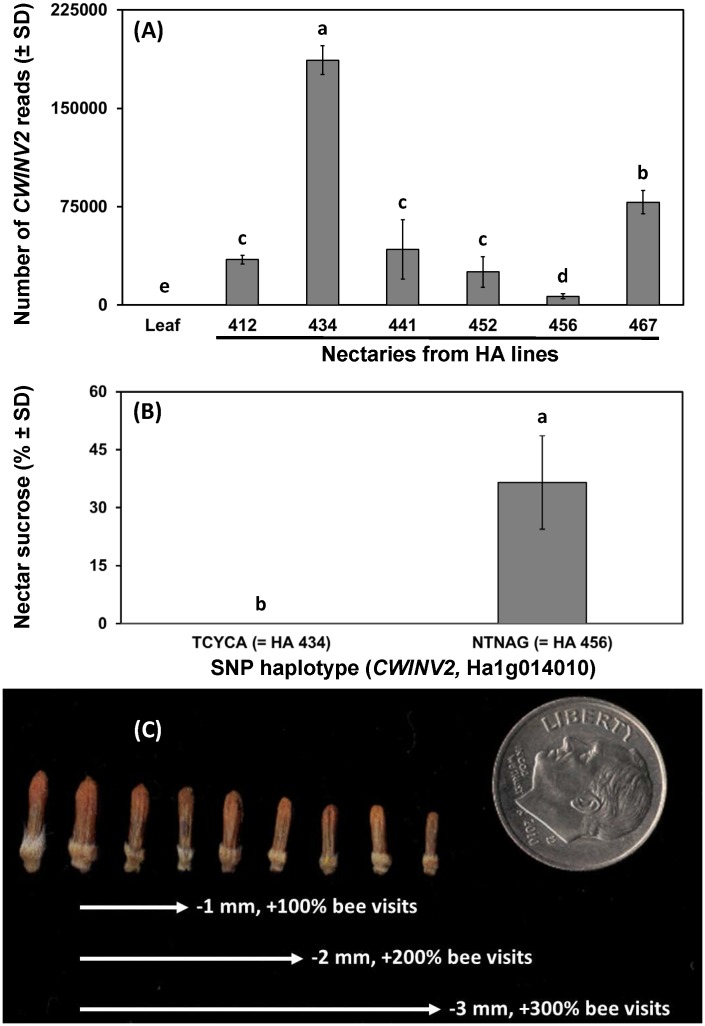
Floral nectar and other reward facilitate crop pollination, and in so doing, increase the amount and breadth of food available for humans. Though abundance and diversity of pollinators (particularly bees) have declined over the past several decades, a concomitant increase in reliance on pollinators presents a challenge to food production. Development of crop varieties with specific nectar or nectar-related traits to attract and retain pollinating insects is an appealing strategy to help address needs of agriculture and pollinators for several reasons. First, many crops have specific traits which have been identified to enhance crop-pollinator interactions. Also, an improved understanding of mechanisms that govern nectar-related traits suggest simplified phenotyping and breeding are possible. Finally, the use of nectar-related traits to enhance crop pollination should complement other measures promoting pollinators and will not limit options for crop production or require any changes by growers (other than planting varieties that are more attractive or rewarding to pollinators). In this article, we review the rationale for improving crop-pollinator interactions, the effects of specific plant traits on pollinator species, and use cultivated sunflowers as a case study. Recent research in sunflower has (i) associated variation in bee visitation with specific floral traits, (ii) quantified benefits of pollinators to hybrid yields, and (iii) used genetic resources in sunflower and other plants to find markers associated with key floral traits. Forthcoming work to increase pollinator rewards should enable sunflower to act as a model for using nectar-related traits to enhance crop-pollinator interactions.
花蜜和其他奖赏有助于农作物授粉,进而增加人类可获得食物的数量和种类。尽管在过去几十年里传粉者(尤其是蜜蜂)的数量和多样性有所下降,但对传粉者依赖的相应增加给粮食生产带来了挑战。培育具有特定花蜜或与花蜜相关性状的作物品种以吸引和留住传粉昆虫,是一种颇具吸引力的策略,原因如下。首先,许多作物具有已被确定能增强作物与传粉者相互作用的特定性状。其次,对控制花蜜相关性状机制的进一步了解表明,简化表型分析和育种是可行的。最后,利用与花蜜相关的性状来增强作物授粉应能补充其他促进传粉者的措施,且不会限制作物生产的选择,也无需种植者做出任何改变(除了种植对传粉者更具吸引力或回报更高的品种)。在本文中,我们回顾了改善作物与传粉者相互作用的基本原理、特定植物性状对传粉者物种的影响,并以栽培向日葵为例进行研究。向日葵的最新研究有:(i)将蜜蜂访花的差异与特定花部性状联系起来;(ii)量化传粉者对杂交产量的益处;(iii)利用向日葵和其他植物的遗传资源寻找与关键花部性状相关的标记。未来增加传粉者回报的工作应能使向日葵成为利用与花蜜相关性状增强作物与传粉者相互作用的典范。