Mela Research, P.O. Box 34422, Jehovah Nissi Building, Ayat Square, Addis Ababa, Ethiopia.
BMC Pregnancy Childbirth. 2018 Jul 3;18(1):276. doi: 10.1186/s12884-018-1917-8.
Ethiopia houses the second largest population of female adolescents in Africa. Adolescent childbearing can have detrimental effect to the health and wellbeing of women and their offspring. This study examined trends, sub-national variations and determinants of early childbearing (i.e. childbearing before age 20) in Ethiopia.
Data from the 2000-2011 Ethiopia Demographic and Health Surveys and from the 2014-2016 Performance Monitoring and Accountability surveys were pooled for this analysis. Based on the year the women reached puberty, five different cohorts were reconstructed that date back to the early 1970s. Kaplan-Meier methodology was used to estimate the cumulative probability of early childbearing and a Cox proportional hazard regression model to examine the associated factors.
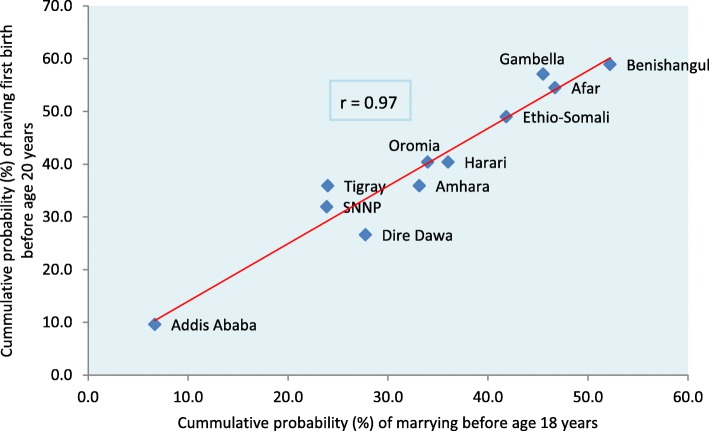
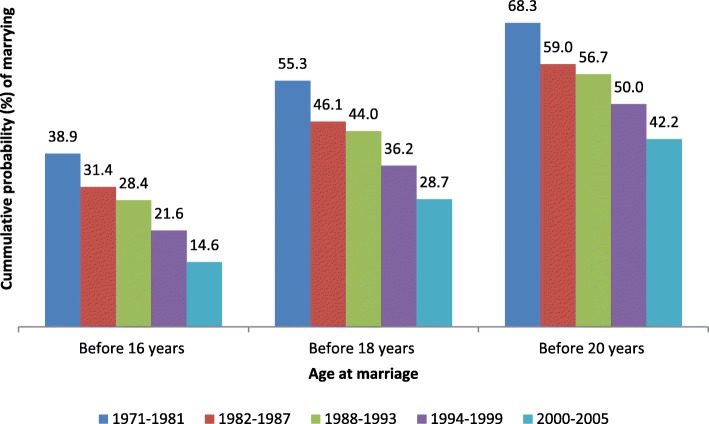
The cumulative probability of early childbearing declined by approximately two-fifth in the past four decades, from 57.6 to 35.3%. The occurrence of early childbearing varies substantially by region. In the most recent period, it ranged from 9.6% in Addis Ababa to 59% in Benishangul-Gumuz. Early childbearing risk was reduced by 95% for women who did not marry before the age of 20 years compared to those who married before the age of 18 years. For adolescents who married at the age of 18 and 19 years, early childbearing risk decreased by 60 and 78%, respectively. During the same period, there was a parallel decline in the cumulative probability of early marriage (i.e., before the legal age of 18 years) from 55.3 to 28.7%. Compared with adolescents with no education, those with elementary and secondary or higher education had a 50 and 82% lower risk of early childbearing, respectively.
Early childbearing declined in Ethiopia, largely driven by a parallel reduction in early marriage. However, a large portion of adolescents are still facing early childbearing, and the situation is more dismal in some regions than others. A further reduction in early childbearing is warranted by enforcing the law on the minimum marriage age and expanding secondary and higher education for females. These efforts should give greater emphasis to regions where early childbearing is markedly high.
埃塞俄比亚是非洲青少年女性第二大人口国。青少年生育会对妇女及其后代的健康和幸福产生不利影响。本研究考察了埃塞俄比亚少女早孕(即 20 岁前生育)的趋势、国家以下各级的差异和决定因素。
本分析汇总了 2000-2011 年埃塞俄比亚人口与健康调查和 2014-2016 年绩效监测和问责制调查的数据。根据妇女达到青春期的年份,重建了五个不同的队列,可追溯到 20 世纪 70 年代初。采用 Kaplan-Meier 方法估计早孕的累积概率,并用 Cox 比例风险回归模型检验相关因素。
在过去四十年中,早孕的累积概率下降了约五分之二,从 57.6%降至 35.3%。早孕的发生在不同地区有很大差异。在最近时期,它在亚的斯亚贝巴的发生率为 9.6%,在本尚古勒-古马兹州的发生率为 59%。与 18 岁前结婚的妇女相比,未在 20 岁前结婚的妇女早育风险降低了 95%。对于 18 岁和 19 岁结婚的青少年,早育风险分别降低了 60%和 78%。同期,早婚(即 18 岁以下)的累积概率也从 55.3%下降到 28.7%。与没有受过教育的青少年相比,接受过小学、中学或高等教育的青少年早育的风险分别降低了 50%和 82%。
埃塞俄比亚的早育率下降,主要原因是早婚率的平行下降。然而,仍有很大一部分青少年面临早育问题,一些地区的情况比其他地区更为严峻。通过执行最低结婚年龄法和扩大女性中等和高等教育,可以进一步降低早育率。这些努力应更加重视早育率明显较高的地区。