Nascimento José Carlos Rodrigues, Marinho David Silveira, Escalante Rodrigo Dornfeld, Pereira Junior Bodiyabaduge Emmanuel M Daya, Lopes Cristiane Gurgel, Nunes Rogean Rodrigues
Universidade Federal do Ceará (UFC), Faculdade de Medicina, Laboratório da Biologia da Cicatrização, Ontogenia e Nutrição de Tecidos (LABICONTE), Fortaleza, CE, Brasil; Universidade de Fortaleza (UNIFOR), Departamento de Pós-Graduação em Ciências Médicas, Fortaleza, CE, Brasil; Hospital Geral de Fortaleza, Departamento de Anestesia e Transplante Hepático, Fortaleza, CE, Brasil.
Hospital Geral de Fortaleza, Departamento de Anestesia e Transplante Hepático, Fortaleza, CE, Brasil.
Braz J Anesthesiol. 2018 Nov-Dec;68(6):645-649. doi: 10.1016/j.bjan.2018.01.012. Epub 2018 Jun 30.
Advanced hepatic disease may – in addition to the widely recognized hemorrhagic complications – occur with thrombotic events. We describe the case of a cirrhotic patient taking warfarin and whose coagulation management during liver transplantation was guided by thromboelastometry (ROTEM).
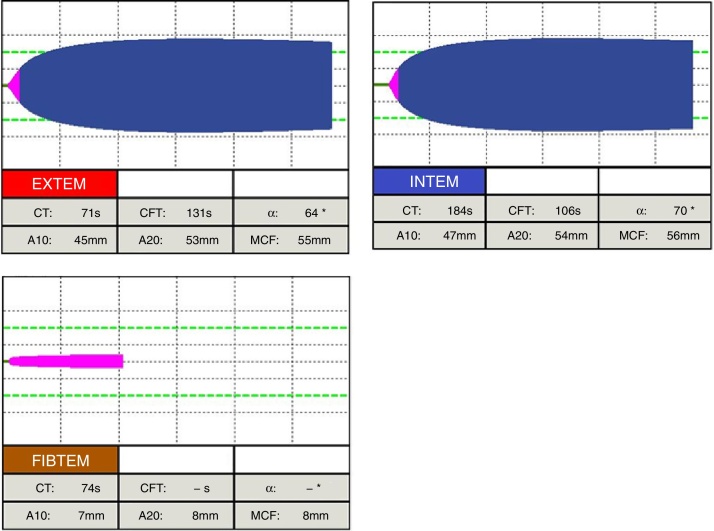
A 56 year-old male patient diagnosed with alcohol cirrhosis using warfarin (2.5 mg.day) for partial portal vein thrombosis with the International Normalized Ratio (INR) of 2.14. At the beginning of surgery, the ROTEM parameters were all normal. In the anhepatic phase, EXTEM and INTEM remained normal, but FIBTEM showed reduction of amplitude after 10 min and maximum clot firmness. Finally, in the neohepatic phase, there was a slight alteration in the hypocoagulability of most of the parameters of the EXTEM, INTEM and FIBTEM, besides a notable correction of the Coagulation Time (CT) in HEPTEM compared to the CT of the INTEM. Therefore, the patient did not receive any transfusion of blood products during surgery and in the postoperative period, being discharged on the 8th postoperative day.
Coagulation deficit resulting from cirrhosis distorts INR as a parameter of anticoagulation adequacy and as a determinant of the need for blood transfusion. Thus, thromboelastometry can provide important information for patient management.
除了广泛认可的出血并发症外,晚期肝病还可能伴有血栓形成事件。我们描述了一例服用华法林的肝硬化患者的病例,其肝移植过程中的凝血管理由血栓弹力图(ROTEM)指导。
一名56岁男性患者,诊断为酒精性肝硬化,因部分门静脉血栓形成服用华法林(2.5毫克/天),国际标准化比值(INR)为2.14。手术开始时,ROTEM参数均正常。在无肝期,EXTEM和INTEM保持正常,但FIBTEM在10分钟后显示振幅和最大血凝块硬度降低。最后,在新肝期,EXTEM、INTEM和FIBTEM的大多数参数的低凝状态有轻微改变,此外,与INTEM的凝血时间(CT)相比,HEPTEM的凝血时间有显著校正。因此,患者在手术期间和术后未接受任何血液制品输注,术后第8天出院。
肝硬化导致的凝血功能缺陷扭曲了INR作为抗凝充分性参数和输血需求决定因素的作用。因此,血栓弹力图可为患者管理提供重要信息。