Calvieri Camilla, Tanzilli Gaetano, Bartimoccia Simona, Cangemi Roberto, Arrivi Alessio, Dominici Marcello, Cammisotto Vittoria, Viceconte Nicola, Mangieri Enrico, Frati Giacomo, Violi Francesco
Department of Cardiovascular, Respiratory, Nephrology, Anaesthesiology and Geriatric Sciences, Sapienza University of Rome, 00161 Rome, Italy.
Department of Internal Medicine and Medical Specialties, Sapienza University of Rome, 00161 Rome, Italy.
Antioxidants (Basel). 2018 Jul 3;7(7):83. doi: 10.3390/antiox7070083.
Platelet activation and oxidative stress seem to play a key role in coronary thrombus formation and are associated with thrombus burden in ST-elevation myocardial infarction (STEMI). However, the interplay between oxidative stress and platelet activation has not been fully elucidated.
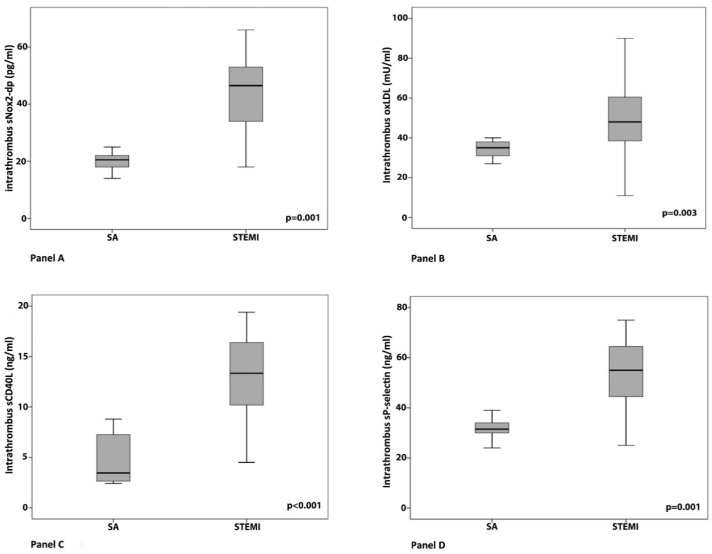
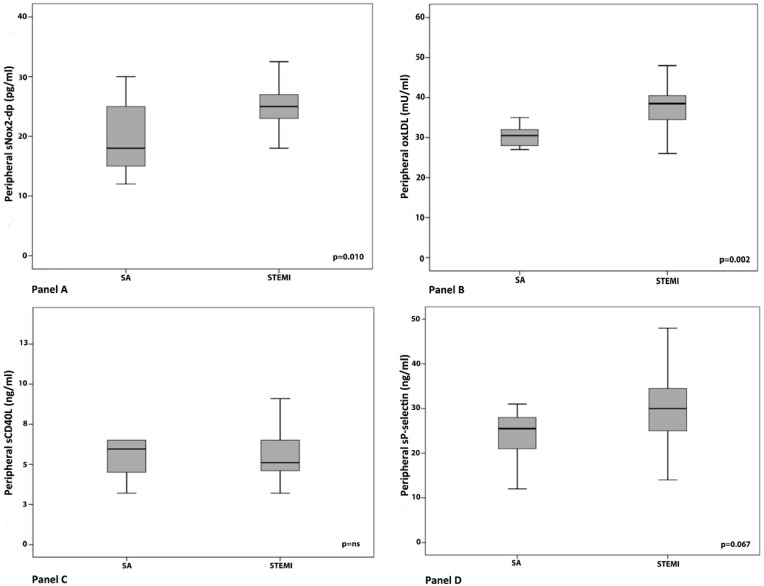
For 32 patients with STEMI undergoing primary percutaneous coronary intervention (PPCI) and 10 patients with stable angina (SA) and oxidative stress, as assessed by NADPH isoform 2 activity (soluble Nox2-derived peptide, sNox2-dp), levels of oxidized low-density lipoproteins (oxLDLs) and platelet activation markers such as soluble CD40 Ligand (sCD40L) and soluble P-selectin (sP-selectin) were measured in the retrieved material (coronary thrombi plus blood waste) of STEMI patients and in intracoronary blood of SA patients, respectively, and in peripheral blood samples of both groups.
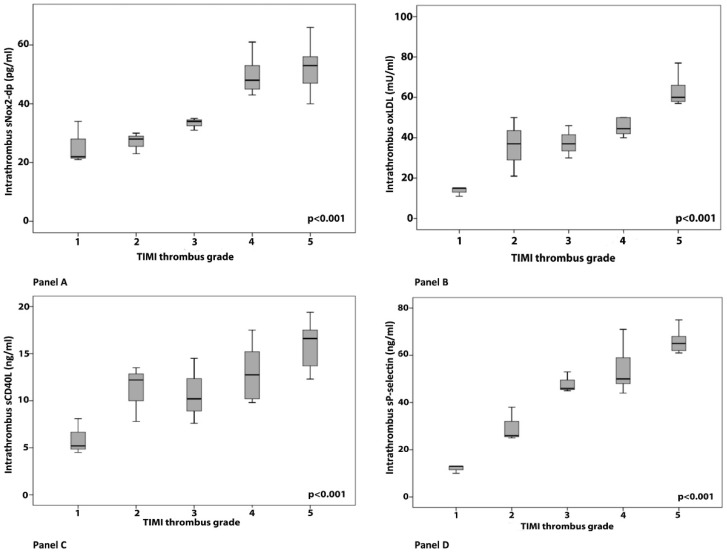
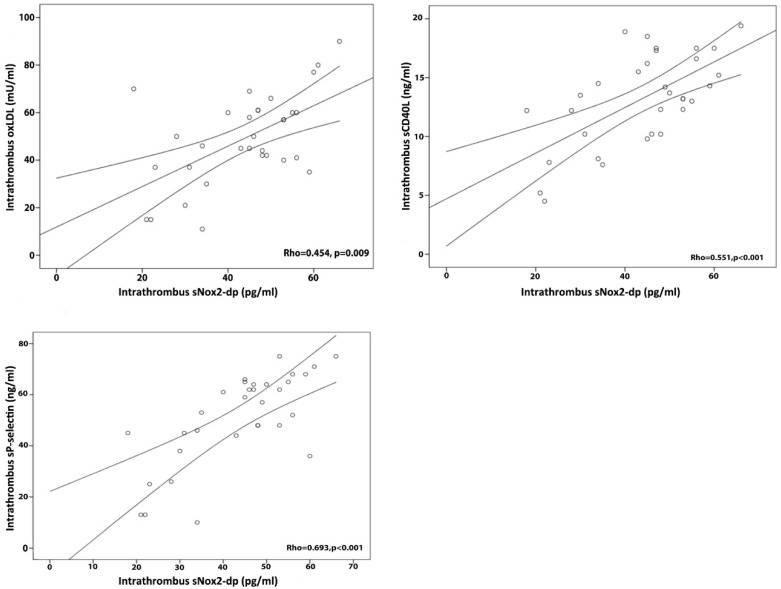
In aspirated thrombi and blood waste of STEMI patients we found higher serum levels of sNox2-dp, oxLDLs, sCD40L, and sP-selectin, as compared to the intracoronary blood samples of SA patients. Moreover, in thrombi and blood waste of STEMI patients, a direct correlation between markers of oxidative stress and of platelet activation was found. Also, in STEMI patients a progressive increase of oxidative stress and platelet activation markers was observed according to the thrombus score burden. STEMI patients showed higher peripheral blood Nox2 activity and oxLDL levels as compared to SA patients.
This study shows a close relationship between oxidative stress and platelet activation in the intracoronary blood waste and aspirated thrombi of STEMI patients, suggesting a role of oxidative stress in promoting thrombus formation and growth.
血小板活化和氧化应激似乎在冠状动脉血栓形成中起关键作用,并与ST段抬高型心肌梗死(STEMI)中的血栓负荷相关。然而,氧化应激与血小板活化之间的相互作用尚未完全阐明。
对32例行直接经皮冠状动脉介入治疗(PPCI)的STEMI患者以及10例稳定型心绞痛(SA)患者进行研究,通过NADPH亚型2活性(可溶性Nox2衍生肽,sNox2-dp)评估氧化应激,分别在STEMI患者的回收材料(冠状动脉血栓加血样)、SA患者的冠状动脉内血液以及两组患者的外周血样本中测量氧化型低密度脂蛋白(oxLDL)水平和血小板活化标志物,如可溶性CD40配体(sCD40L)和可溶性P选择素(sP-selectin)。
与SA患者的冠状动脉内血样相比,我们发现STEMI患者吸出的血栓和血样中sNox2-dp、oxLDL、sCD40L和sP-selectin的血清水平更高。此外,在STEMI患者的血栓和血样中,发现氧化应激标志物与血小板活化标志物之间存在直接相关性。而且,在STEMI患者中,根据血栓评分负担观察到氧化应激和血小板活化标志物逐渐增加。与SA患者相比,STEMI患者外周血Nox2活性和oxLDL水平更高。
本研究表明STEMI患者冠状动脉内血样和吸出的血栓中氧化应激与血小板活化之间存在密切关系,提示氧化应激在促进血栓形成和生长中起作用。