Pavlov Marin, Nikolić-Heitzler Vjeran, Babić Zdravko, Milošević Milan, Kordić Krešimir, Ćelap Ivana, Degoricija Vesna
Marin Pavlov, Department of Cardiology, Sestre Milosrdnice University Hospital Center, Vinogradska cesta 29, 10000 Zagreb, Croatia,
Croat Med J. 2018 Jun 30;59(3):108-117. doi: 10.3325/cmj.2018.59.108.
To determine the relationship between plasminogen activator inhibitor-1 (PAI-1) activity rise during the first 24 hours of ST-elevation myocardial infarction (STEMI) treatment and death after 5 years.
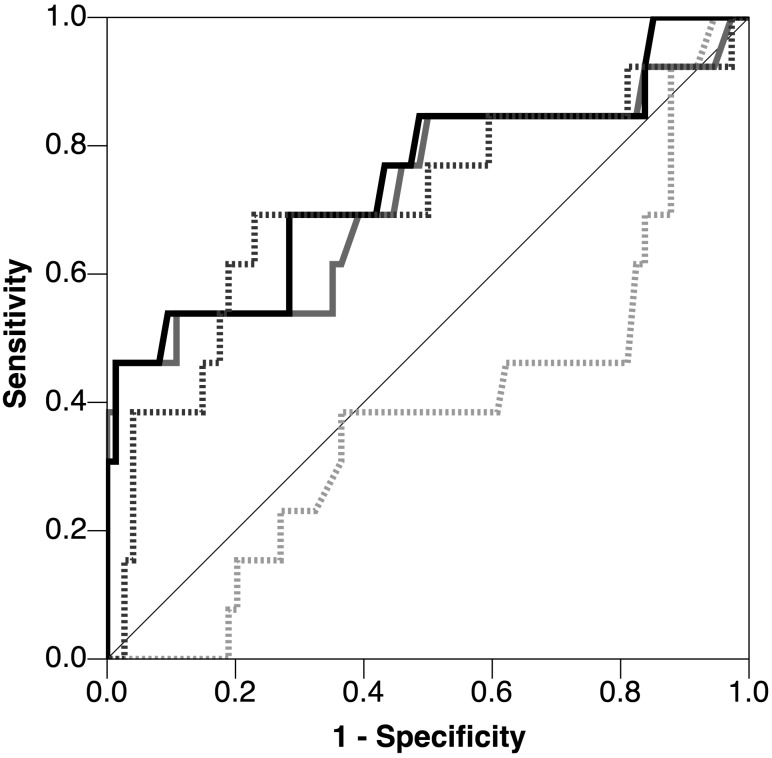
From May 1, 2009 to March 23, 2010, 87 STEMI patients treated with primary percutaneous coronary intervention (PCI) at the Sestre Milosrdnice University Hospital Center were consecutively enrolled in prospective single-center cohort study. PAI-1 activity was determined on admission and 24 hours later. The primary end-point was death after 5 years. The predictive value of PAI-1 activity variables as biomarkers of death was assessed using receiver operating characteristic (ROC) curve, independent predictors of death were assessed using multivariate Cox regression, and covariates independently related to higher PAI-1 activity rise were assessed using linear regression.
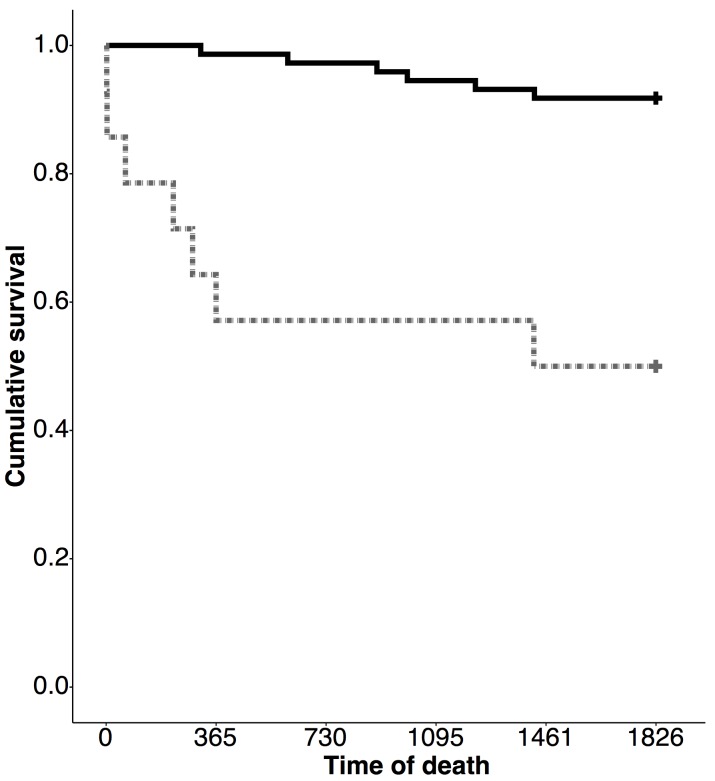
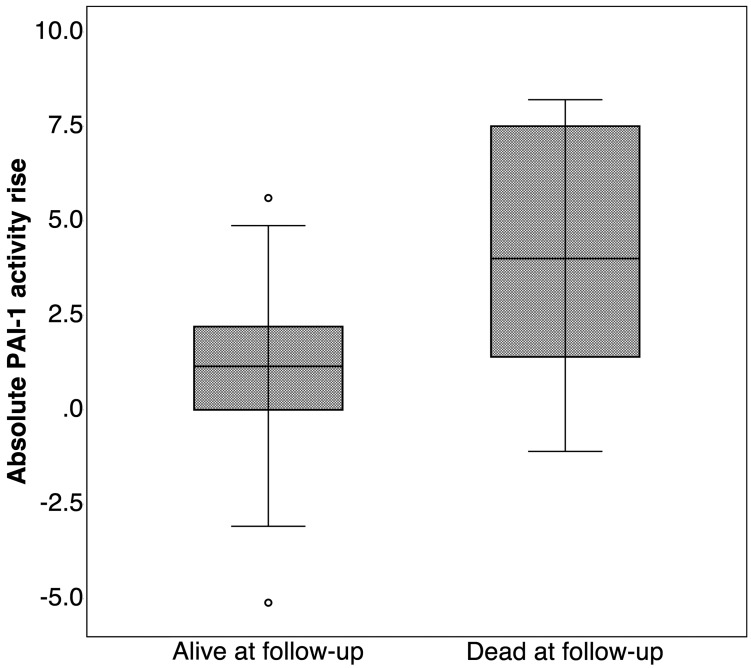
Two patients died during the hospital treatment and 11 during the follow-up. PAI-1 activity rise had the largest area under curve (0.748) for predicting death rate (optimal cut-off point 3.7 U/mL, sensitivity 53.8%, specificity 90.5%). Patients with PAI-1 activity rise higher than 3.7 U/mL had significantly higher mortality (P<0.001). Kaplan-Meier survival curve diverged within the first year after STEMI. Independent predictors of death were PAI-1 rise and final Thrombolysis in Myocardial Infarction flow. PAI-1 activity rise was independently related to heart failure, thrombus aspiration, and body weight.
PAI-1 activity rise higher than 3.7 U/mL is associated with higher 5-year death rate in STEMI patients treated with primary PCI.
确定ST段抬高型心肌梗死(STEMI)治疗最初24小时内纤溶酶原激活物抑制剂-1(PAI-1)活性升高与5年后死亡之间的关系。
2009年5月1日至2010年3月23日,在斯韦特米尔松尼察大学医院中心接受直接经皮冠状动脉介入治疗(PCI)的87例STEMI患者连续纳入前瞻性单中心队列研究。入院时及24小时后测定PAI-1活性。主要终点为5年后死亡。使用受试者工作特征(ROC)曲线评估PAI-1活性变量作为死亡生物标志物的预测价值,使用多变量Cox回归评估死亡的独立预测因素,使用线性回归评估与PAI-1活性升高独立相关的协变量。
2例患者在住院治疗期间死亡,11例在随访期间死亡。PAI-1活性升高对死亡率的预测曲线下面积最大(0.748)(最佳截断点为3.7 U/mL,敏感性为53.8%,特异性为90.5%)。PAI-1活性升高高于3.7 U/mL的患者死亡率显著更高(P<0.001)。STEMI后第一年Kaplan-Meier生存曲线出现分歧。死亡的独立预测因素为PAI-1升高和最终心肌梗死溶栓血流。PAI-1活性升高与心力衰竭、血栓抽吸和体重独立相关。
在接受直接PCI治疗的STEMI患者中,PAI-1活性升高高于3.7 U/mL与5年死亡率较高相关。