Drouillard James S
Department of Animal Sciences and Industry, Kansas State University, Manhattan, KS 66506, USA.
Asian-Australas J Anim Sci. 2018 Jul;31(7):1007-1016. doi: 10.5713/ajas.18.0428. Epub 2018 Jun 21.
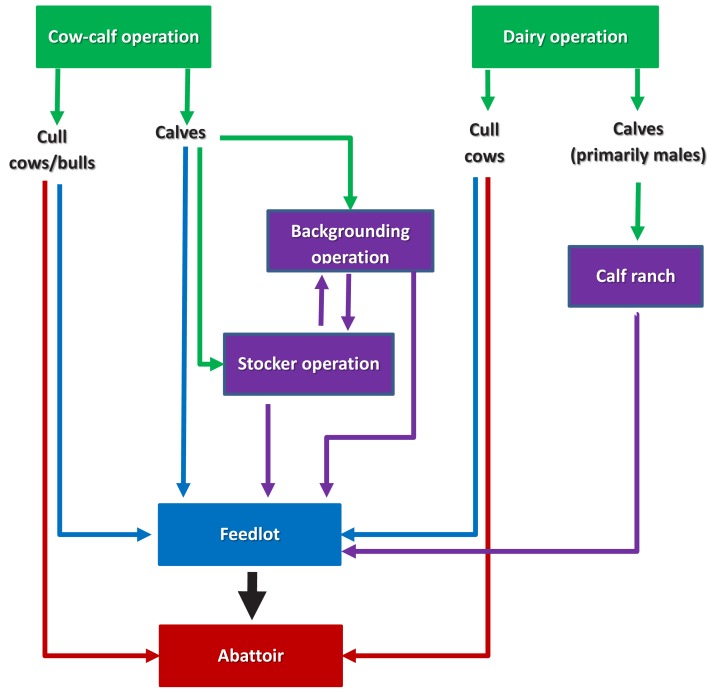
USA beef production is characterized by a diversity of climates, environmental conditions, animal phenotypes, management systems, and a multiplicity of nutritional inputs. The USA beef herd consists of more than 80 breeds of cattle and crosses thereof, and the industry is divided into distinct, but ofttimes overlapping sectors, including seedstock production, cow-calf production, stocker/backgrounding, and feedlot. Exception for male dairy calves, production is predominantly pastoral-based, with young stock spending relatively brief portions of their life in feedlots. The beef industry is very technology driven, utilizing reproductive management strategies, genetic improvement technologies, exogenous growth promoting compounds, vaccines, antibiotics, and feed processing strategies, focusing on improvements in efficiency and cost of production. Young steers and heifers are grain-based diets fed for an average of 5 months, mostly in feedlots of 1,000 head capacity or more, and typically are slaughtered at 15 to 28 months of age to produce tender, well-marbled beef. Per capita beef consumption is nearly 26 kg annually, over half of which is consumed in the form of ground products. Beef exports, which are increasingly important, consist primarily of high value cuts and variety meats, depending on destination. In recent years, adverse climatic conditions (i.e., draught), a shrinking agricultural workforce, emergence of food-borne pathogens, concerns over development of antimicrobial resistance, animal welfare/well-being, environmental impact, consumer perceptions of healthfulness of beef, consumer perceptions of food animal production practices, and alternative uses of traditional feed grains have become increasingly important with respect to their impact on both beef production and demand for beef products. Similarly, changing consumer demographics and globalization of beef markets have dictated changes in the types of products demanded by consumers of USA beef, both domestically and abroad. The industry is highly adaptive, however, and responds quickly to evolving economic signals.
美国牛肉生产的特点是气候多样、环境条件各异、动物表型不同、管理系统多样以及营养投入种类繁多。美国的牛群由80多个牛品种及其杂交品种组成,该行业分为不同但时常重叠的部门,包括种畜生产、母牛-犊牛生产、架子牛/育成牛饲养以及饲养场。除雄性奶牛犊外,生产主要以牧区为基础,幼畜在饲养场度过的生命时间相对较短。牛肉行业是技术驱动型的,采用繁殖管理策略、遗传改良技术、外源生长促进化合物、疫苗、抗生素和饲料加工策略,专注于提高生产效率和降低成本。年轻的公牛和小母牛以谷物为基础日粮,平均饲养5个月,大多在存栏量1000头及以上的饲养场,通常在15至28月龄时屠宰,以生产嫩度好、大理石花纹丰富的牛肉。人均牛肉消费量每年近26千克,其中一半以上是以碎肉产品的形式消费的。牛肉出口日益重要,主要包括高价值切块和牛杂碎,具体取决于目的地。近年来,不利的气候条件(如干旱)、农业劳动力减少、食源性病原体的出现、对抗菌素耐药性发展的担忧、动物福利/健康、环境影响、消费者对牛肉健康性的认知、消费者对食用动物生产方式的认知以及传统饲料谷物的替代用途,在对牛肉生产和牛肉产品需求的影响方面变得越来越重要。同样,消费者人口结构的变化和牛肉市场的全球化决定了美国国内外牛肉消费者需求产品类型的变化。然而,该行业具有高度适应性,能迅速对不断变化的经济信号做出反应。