Lee Jae Hee, Kong Kyoung Ae, Lee Duk Hee, Choi Yoon Hee, Jung Koo Young
Department of Emergency Medicine, Ewha Womans University College of Medicine, Seoul, Korea.
Department of Preventive Medicine, Ewha Womans University College of Medicine, Seoul, Korea.
Clin Exp Emerg Med. 2018 Jun;5(2):113-119. doi: 10.15441/ceem.17.228. Epub 2018 Jun 29.
Several abbreviated versions of the Alcohol Use Disorder Identification Test (AUDIT) have been developed and are widely used in clinical settings. In this study, we provide evidence supporting the use of abbreviated versions of AUDIT by comparing the utility of various abbreviated versions and determining cut-off values for the population of South Korea.
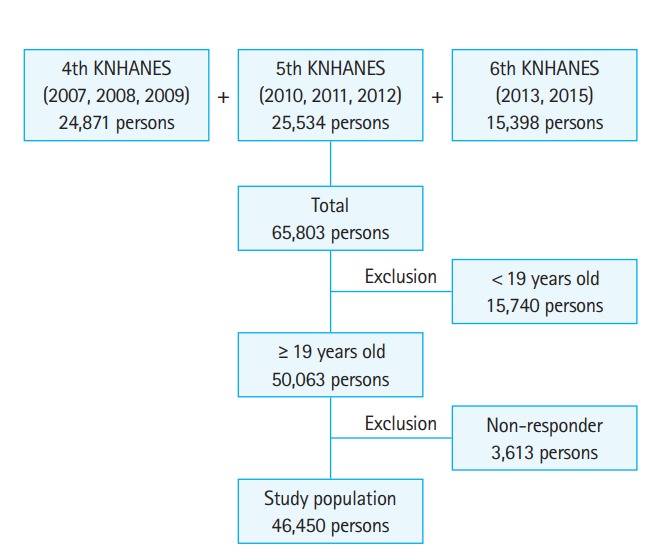
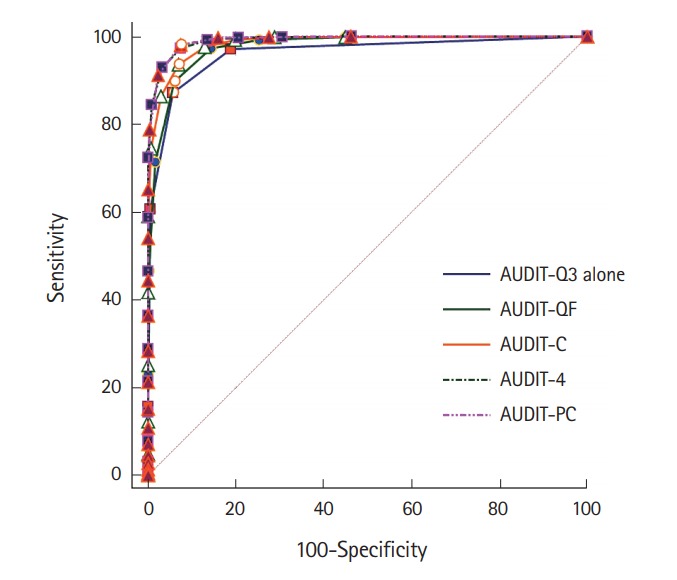
Data were obtained from the 4th to 6th Korean National Health and Nutrition Examination Surveys. After calculating the whole AUDIT score, we applied the cut-off value of at-risk drinking proposed by the World Health Organization and divided the study sample into normal and at-risk drinking groups. Receiver operating characteristic curves were drawn for AUDIT-3rd question (Q3) alone, AUDIT-quantity and frequency (QF), AUDIT-consumption (C), AUDIT-4, and AUDIT-primary clinic (PC), and optimal cut-off values were obtained for each group.
A total of 46,450 subjects were analyzed. The at-risk drinking group comprised 29.2% of all subjects. The area under receiver operating characteristic curve (AUROC) of the abbreviated versions of AUDIT increased from 0.954 to 0.991 as the number of questions increased from one to four. The differences in AUROC between the abbreviated versions of AUDIT were statistically significant. The most appropriate cut-off values for AUDIT-Q3 alone, AUDIT-QF, AUDIT-C, AUDIT-4, and AUDIT-PC for adults over age 19 were 2, 4, 5, 6, and 4 points, respectively.
As the number of items analyzed increased from one to four items, the AUROC increased to a statistically significant level. Cut-off values for abbreviated versions of AUDIT are similar in South Korea to other countries.
已开发出几种酒精使用障碍识别测试(AUDIT)的简化版本,并在临床环境中广泛使用。在本研究中,我们通过比较各种简化版本的效用并确定韩国人群的临界值,为使用AUDIT简化版本提供证据支持。
数据来自韩国第四次至第六次全国健康与营养检查调查。在计算出完整的AUDIT分数后,我们应用了世界卫生组织提出的危险饮酒临界值,并将研究样本分为正常饮酒组和危险饮酒组。分别针对AUDIT第3个问题(Q3)、AUDIT数量与频率(QF)、AUDIT饮酒量(C)、AUDIT-4和AUDIT基层医疗(PC)绘制受试者工作特征曲线,并为每组获得最佳临界值。
共分析了46450名受试者。危险饮酒组占所有受试者的29.2%。随着问题数量从1个增加到4个,AUDIT简化版本的受试者工作特征曲线下面积(AUROC)从0.954增加到0.991。AUDIT简化版本之间的AUROC差异具有统计学意义。对于19岁以上成年人,单独的AUDIT-Q3、AUDIT-QF、AUDIT-C、AUDIT-4和AUDIT-PC的最合适临界值分别为2分、4分、5分、6分和4分。
随着分析项目数量从1项增加到4项,AUROC增加到具有统计学意义的水平。AUDIT简化版本的临界值在韩国与其他国家相似。