Division of Nephrology, Department of Internal Medicine, Shin-Kong Wu Ho-Su Memorial Hospital, 95, Wen-Chang Rd, Shih-Lin, Taipei, 111, Taiwan (R.O.C.).
Fu-Jen Catholic University School of Medicine, Taipei, Taiwan (R.O.C.).
BMC Nephrol. 2018 Jul 4;19(1):160. doi: 10.1186/s12882-018-0971-9.
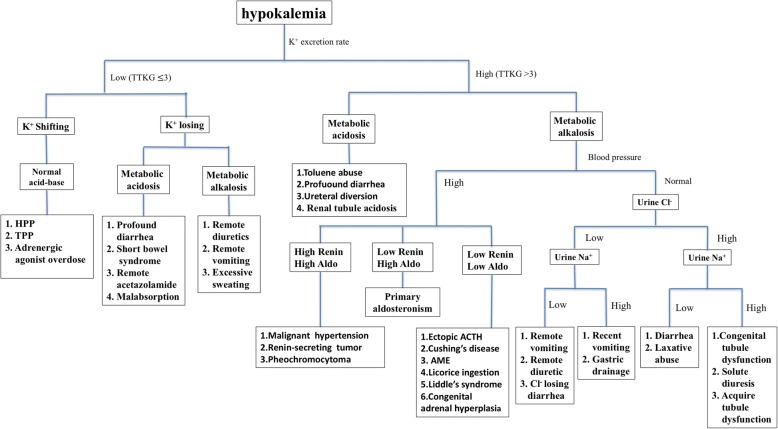
Hypokalemia is one of the most common clinical electrolyte imbalance problems, and thyrotoxic periodic paralysis (TPP) is a leading cause of presentation to the emergency department. Low renal potassium secretion rates, a normal acid-base balance in the blood, and hyperthyroidism are the hallmarks of suspected TPP.
Here we report the case of a 36-year-old man who presented to the emergency department with a sudden onset of acute muscle weakness at 5 h prior to admission. Biochemistry tests revealed hypokalemia with hyperthyroidism and renal potassium wasting. TPP was initially not favored due to the presence of renal potassium wasting. However, his serum potassium level rebounded rapidly within several hours after potassium supplementation, indicating that the intracellular shifting of potassium ions was the main etiology for his hypokalemia. The early stage of TPP development may have contributed to this paradox.
Therefore, it is premature to rule out TPP based on the presentation of high renal potassium secretion rates alone. This finding may result in an incorrect impression being made in the early stage of TTP and may consequently lead to an inappropriate potassium supplementation policy.
低钾血症是最常见的临床电解质失衡问题之一,而甲状腺功能亢进周期性瘫痪(TPP)是导致急诊科就诊的主要原因。低肾钾分泌率、血液酸碱平衡正常和甲状腺功能亢进是疑似 TPP 的特征。
这里我们报告了一例 36 岁男性的病例,他在入院前 5 小时突然出现急性肌无力。生化检查显示低钾血症伴甲状腺功能亢进和肾性失钾。由于存在肾性失钾,最初不考虑 TPP。然而,他的血清钾水平在补钾后数小时内迅速回升,表明钾离子的细胞内转移是导致他低钾血症的主要病因。TPP 的早期发展可能促成了这种矛盾。
因此,仅凭高肾钾分泌率的表现就排除 TPP 还为时过早。这一发现可能导致在 TTP 的早期阶段产生错误的印象,并可能导致不适当的补钾政策。