Vall-Sagarra Alicia, Litau Shanna, Decristoforo Clemens, Wängler Björn, Schirrmacher Ralf, Fricker Gert, Wängler Carmen
Biomedical Chemistry, Department of Clinical Radiology and Nuclear Medicine, Medical Faculty Mannheim of Heidelberg University, Theodor-Kutzer-Ufer 1-3, 68167 Mannheim, Germany.
Molecular Imaging and Radiochemistry, Department of Clinical Radiology and Nuclear Medicine, Medical Faculty Mannheim of Heidelberg University, Theodor-Kutzer-Ufer 1-3, 68167 Mannheim, Germany.
Pharmaceuticals (Basel). 2018 Jul 4;11(3):65. doi: 10.3390/ph11030065.
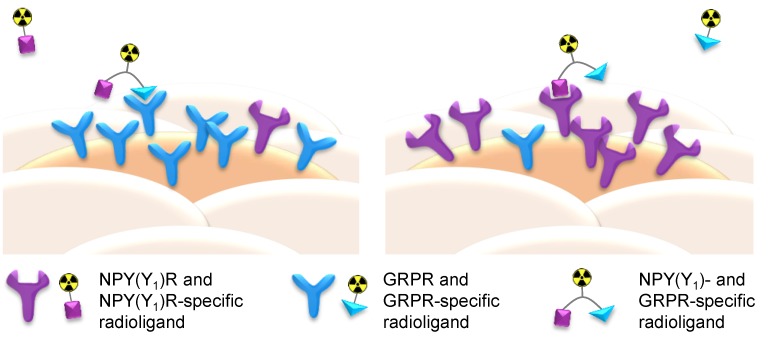
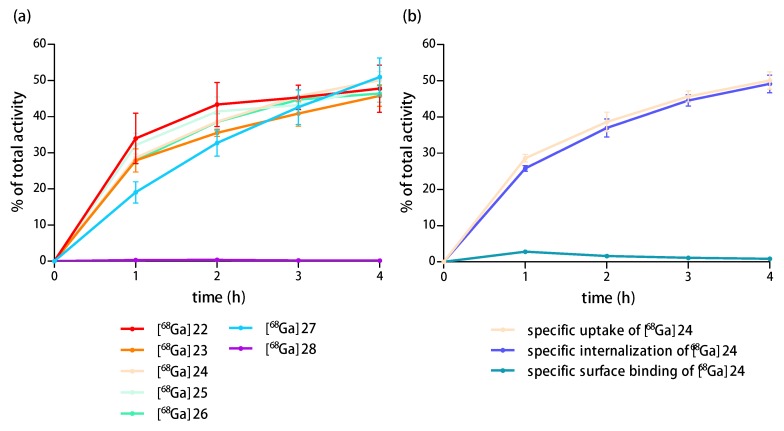
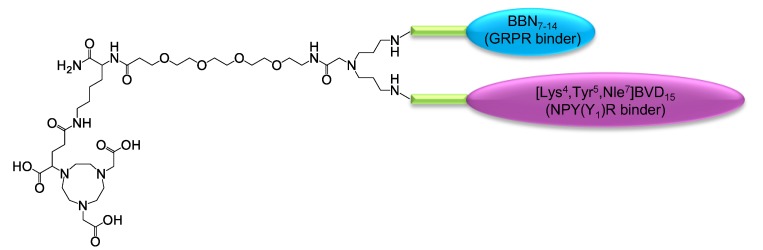
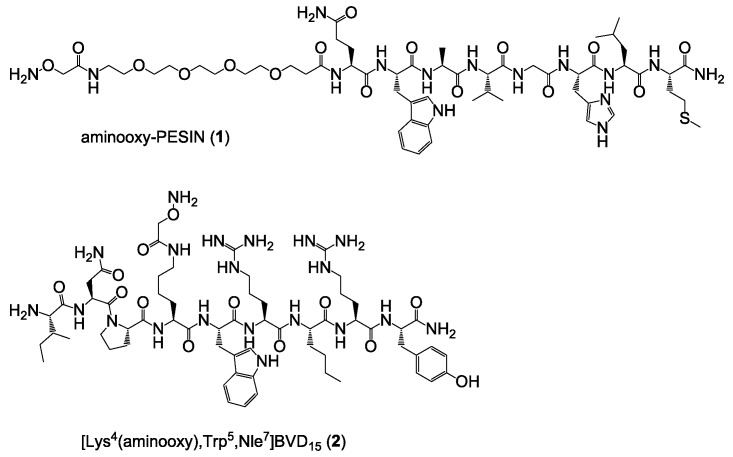
Heterobivalent peptidic ligands (HBPLs), designed to address two different receptors independently, are highly promising tumor imaging agents. For example, breast cancer has been shown to concomitantly and complementarily overexpress the neuropeptide Y receptor subtype 1 (NPY(Y₁)R) as well as the gastrin-releasing peptide receptor (GRPR). Thus, radiolabeled HBPLs being able to bind these two receptors should exhibit an improved tumor targeting efficiency compared to monospecific ligands. We developed here such bispecific HBPLs and radiolabeled them with Ga, achieving high radiochemical yields, purities, and molar activities. We evaluated the HBPLs and their monospecific reference peptides in vitro regarding stability and uptake into different breast cancer cell lines and found that the Ga-HBPLs were efficiently taken up via the GRPR. We also performed in vivo PET/CT imaging and ex vivo biodistribution studies in T-47D tumor-bearing mice for the most promising Ga-HBPL and compared the results to those obtained for its scrambled analogs. The tumors could easily be visualized by the newly developed Ga-HBPL and considerably higher tumor uptakes and tumor-to-background ratios were obtained compared to the scrambled analogs in and ex vivo. These results demonstrate the general feasibility of the approach to use bispecific radioligands for in vivo imaging of breast cancer.
异二价肽配体(HBPLs)旨在独立作用于两种不同的受体,是极具潜力的肿瘤成像剂。例如,已证明乳腺癌会同时且互补性地过度表达神经肽Y受体亚型1(NPY(Y₁)R)以及胃泌素释放肽受体(GRPR)。因此,能够结合这两种受体的放射性标记HBPLs与单特异性配体相比,应表现出更高的肿瘤靶向效率。我们在此开发了这种双特异性HBPLs并用镓进行放射性标记,获得了高放射化学产率、纯度和摩尔活性。我们在体外评估了HBPLs及其单特异性参考肽的稳定性以及它们对不同乳腺癌细胞系的摄取情况,发现镓标记的HBPLs通过GRPR被有效摄取。我们还对最具潜力的镓标记HBPLs在荷T - 47D肿瘤小鼠中进行了体内PET/CT成像和体外生物分布研究,并将结果与其乱序类似物的结果进行了比较。新开发的镓标记HBPLs能够轻松实现肿瘤可视化,与乱序类似物相比,体内外均获得了显著更高的肿瘤摄取和肿瘤与背景比值。这些结果证明了使用双特异性放射性配体进行乳腺癌体内成像方法的总体可行性。