Daneshi Nima, Fararouei Mohammad, Mohammadianpanah Mohammad, Zare-Bandamiri Mohammad, Parvin Somayeh, Dianatinasab Mostafa
Behbahan Faculty of Medical Sciences, Behbahan, Iran.
Shiraz HIV/AIDS Research Center, Institute of Health, Shiraz University of Medical Sciences, Shiraz, Iran.
J Cancer Epidemiol. 2018 Jun 3;2018:9678097. doi: 10.1155/2018/9678097. eCollection 2018.
Laryngeal cancer is the second most common cancer in the head and neck. Since laryngeal cancer management is a complex process, there is still no standard strategy to treat this disease in order to increase the survival rate of the patients especially among those with advanced form of the disease.
A cohort study was undertaken to analyze factors predicting survival of the patients in advanced stage laryngeal cancer in the Southern Iran among all patients newly diagnosed with laryngeal cancer between 2000 and 2015.
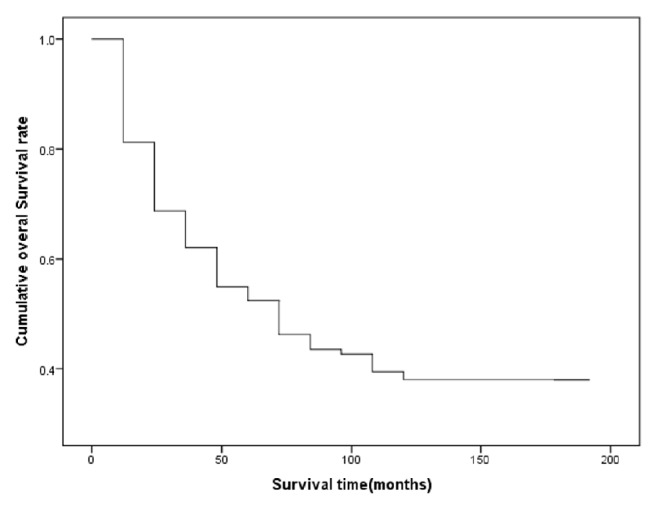
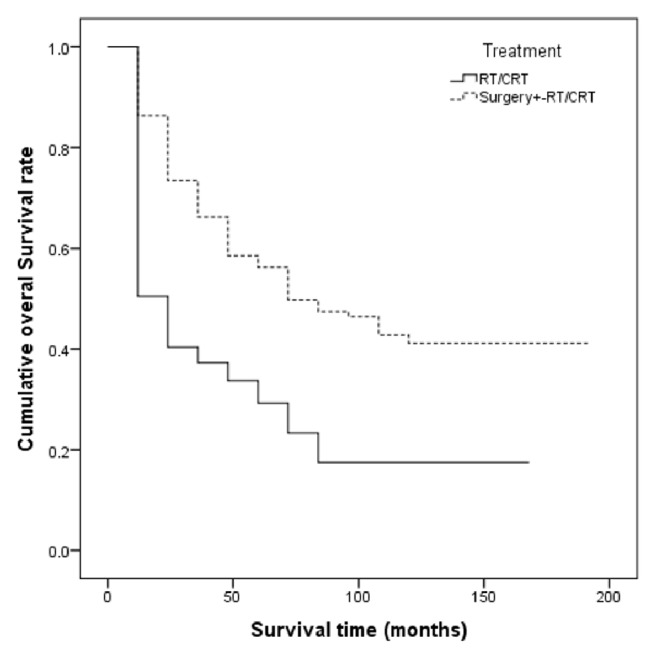
Data of a total number of 415 patients who have had been diagnosed with advanced laryngeal cancer during this period was used for analysis. The patients' 1-, 3-, 5-, and 10-year survival rates were 81%, 62%, 53%, and 38%, respectively. Multivariable Cox regression analyses indicated a significant relationship between patients' survival and age at diagnosis ( < 0.001), disease stage ( = 0.002), tumor grade ( = 0.008), positive L. node ( = 0.008), and type of treatment ( < 0.001). As expected, treatment strategy was identified as the most effective factor in survival of the patients. According to the results, patients who undergone surgical treatment experienced a longer survival than those who received other treatments.
This study showed that the survival of patients depends on several factors, among which, treatment strategy is the most important. Combination of total laryngectomy plus chemoradiation provides superior local control and better survival compared to either radiotherapy or chemoradiation in patients with advanced laryngeal cancer.
喉癌是头颈部第二常见的癌症。由于喉癌的治疗是一个复杂的过程,目前仍没有标准的治疗策略来提高患者的生存率,尤其是那些患有晚期喉癌的患者。
进行了一项队列研究,以分析2000年至2015年间在伊朗南部所有新诊断为喉癌的患者中,晚期喉癌患者生存的预测因素。
在此期间被诊断为晚期喉癌的415例患者的数据用于分析。患者的1年、3年、5年和10年生存率分别为81%、62%、53%和38%。多变量Cox回归分析表明,患者的生存与诊断时的年龄(<0.001)、疾病分期(=0.002)、肿瘤分级(=0.008)、阳性淋巴结(=0.008)和治疗类型(<0.001)之间存在显著关系。正如预期的那样,治疗策略被确定为患者生存中最有效的因素。根据结果,接受手术治疗的患者比接受其他治疗的患者生存期更长。
本研究表明,患者的生存取决于几个因素,其中治疗策略是最重要的。与单纯放疗或放化疗相比,全喉切除术加放化疗相结合在晚期喉癌患者中提供了更好的局部控制和更高的生存率。