1 Department of General Surgery, Jinling Hospital, Medical School of Nanjing University, China.
2 Department of General Surgery, Jinling Hospital, Southern Medical University, China.
Innate Immun. 2018 Jul;24(5):297-306. doi: 10.1177/1753425918785016. Epub 2018 Jul 5.
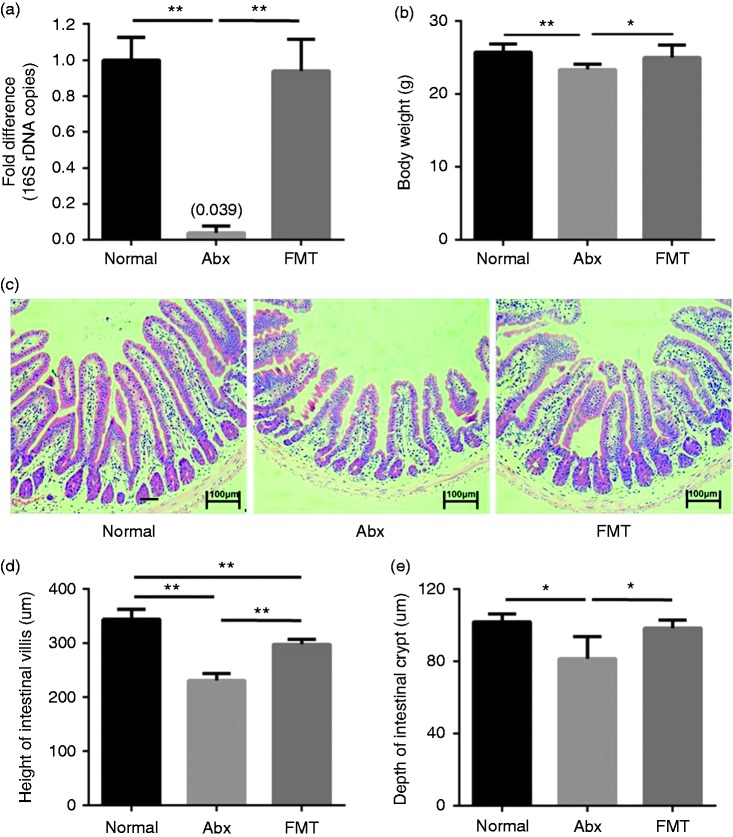
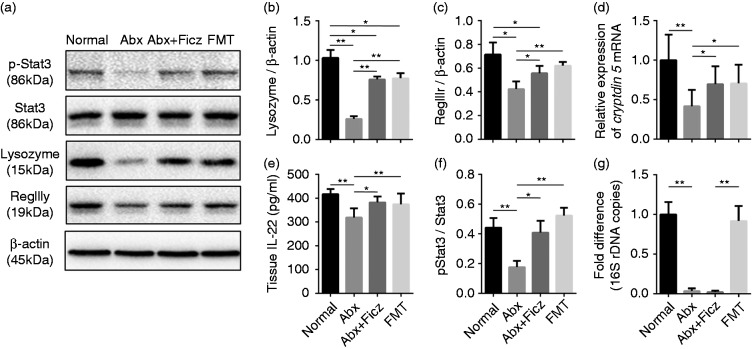
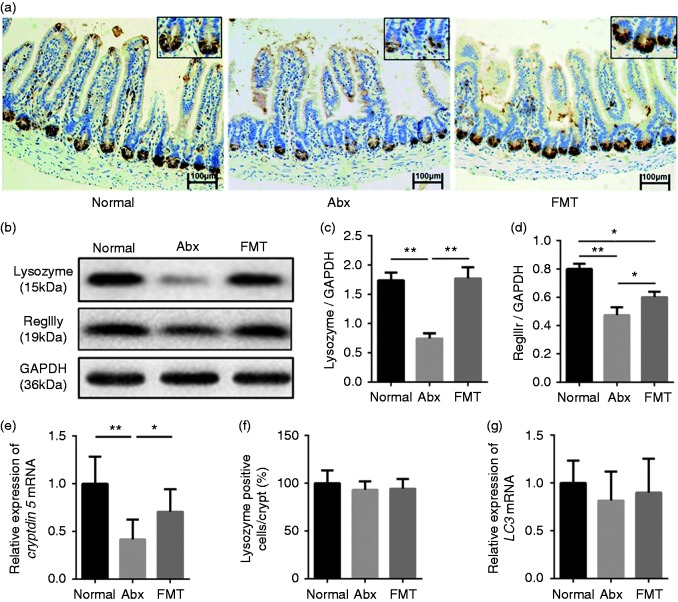
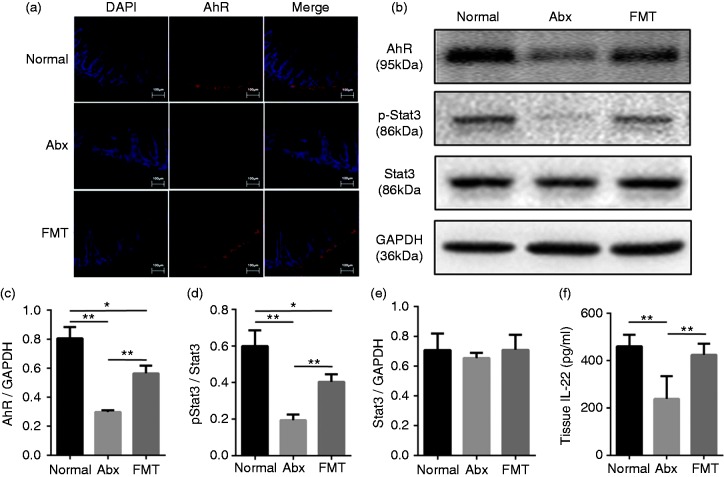
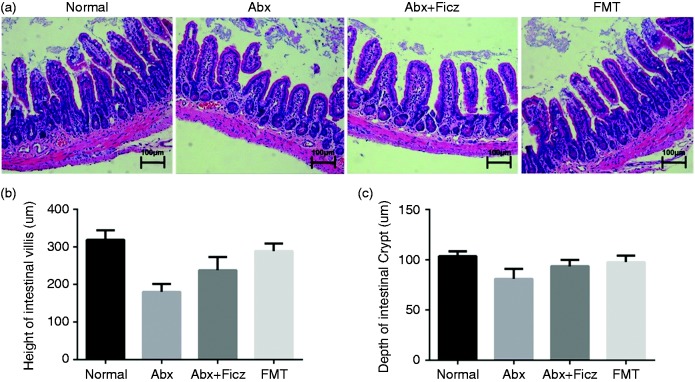
Compelling evidence demonstrates the crucial role of the commensal microbiota in host physiology and the detrimental effects of its perturbations following antibiotic treatment. However, the effects of commensal microbiota on intestinal mucosa antimicrobial molecules have not been elucidated systematically. Here, we investigate the impacts of antibiotic-induced depletion and subsequent restoration of the intestinal microbiota on the murine antimicrobial molecules in intestinal mucosa. Our results demonstrate that depletion of commensal microbiota leads to intestinal mucosa atrophy and reduction of antimicrobial molecules, including lysozyme, regenerating islet-derived protein 3 gamma (RegIIIγ), and cryptdin 5 mRNA, whereas subsequent reconstitution of intestinal microbiota by fecal microbiota transplantation (FMT) rescues mucosa morphology and antimicrobials. Importantly, our study shows that down-regulation of aryl hydrocarbon receptor (AhR), interleukin-22 (IL-22), and phosphorylated Stat3 (p-Stat3) is associated with decreased antimicrobials, which might mediate the antibiotic-associated intestinal mucosa injury. Last, exogenous activation of the AhR/IL-22/Stat3 signaling pathway with the AhR agonist 6-formylindolo(3,2-b)carbazole (Ficz) rescued antimicrobial molecule levels markedly after antibiotic treatment to levels similar to those following reconstitution of intestinal microbiota by FMT. Together, our results demonstrate that the AhR/IL-22/Stat3 signaling pathway is involved in the modulation of intestinal mucosa antimicrobial molecules by commensal microbiota and suggest this pathway as a promising target in the treatment of antibiotic-associated gut barrier damage.
大量证据表明,共生微生物菌群在宿主生理学中起着至关重要的作用,而抗生素治疗后其紊乱会产生有害影响。然而,共生微生物菌群对肠道黏膜抗菌分子的影响尚未得到系统阐明。在这里,我们研究了抗生素诱导的肠道共生菌群耗竭及其随后的恢复对肠道黏膜中鼠类抗菌分子的影响。我们的研究结果表明,共生微生物菌群的耗竭会导致肠道黏膜萎缩和抗菌分子减少,包括溶菌酶、再生胰岛衍生蛋白 3γ(RegIIIγ)和隐窝素 5mRNA,而随后通过粪便微生物群移植(FMT)重建肠道微生物群则可以挽救黏膜形态和抗菌分子。重要的是,我们的研究表明,芳香烃受体(AhR)、白细胞介素 22(IL-22)和磷酸化 Stat3(p-Stat3)的下调与抗菌分子的减少有关,这可能介导了抗生素相关的肠道黏膜损伤。最后,外源性激活 AhR/IL-22/Stat3 信号通路,使用 AhR 激动剂 6-甲氧基吲哚并[3,2-b]咔唑(Ficz),在外源激活 AhR/IL-22/Stat3 信号通路后,显著挽救了抗生素治疗后抗菌分子水平,使其恢复到 FMT 重建肠道微生物群后的水平。总之,我们的研究结果表明,AhR/IL-22/Stat3 信号通路参与了共生微生物菌群对肠道黏膜抗菌分子的调节,并提示该通路可能成为治疗抗生素相关性肠道屏障损伤的有前途的靶点。