College of Food Science and Technology, Guangdong Provincial Key Laboratory of Aquatic Product Processing and Safety, Key Laboratory of Advanced Processing of Aquatic Products of Guangdong Higher Education Institution, Guangdong Ocean University, Zhanjiang, 524088, China.
Centre for Food Research and Innovation, Department of Wine, Food and Molecular Biosciences, Lincoln University, Lincoln, Canterbury, 7647, New Zealand.
BMC Microbiol. 2018 Jul 5;18(1):65. doi: 10.1186/s12866-018-1207-7.
Two strains of Vibrio parahaemolyticus (ATCC 17802 and 33847) in shrimp, oyster, freshwater fish, pork, chicken and egg fried rice were evaluated for production of hemolysin and exoenzymes of potential importance to the pathogenicity of this bacterium.
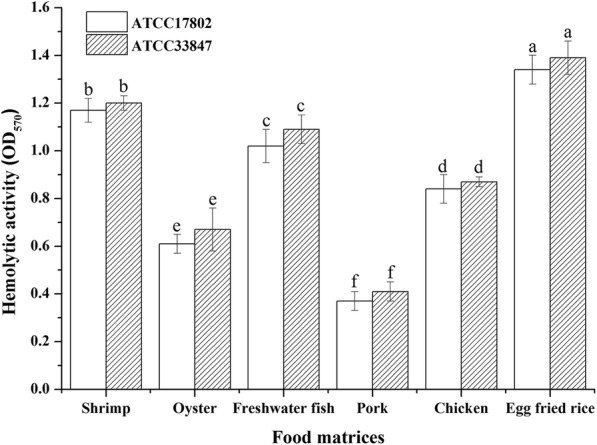
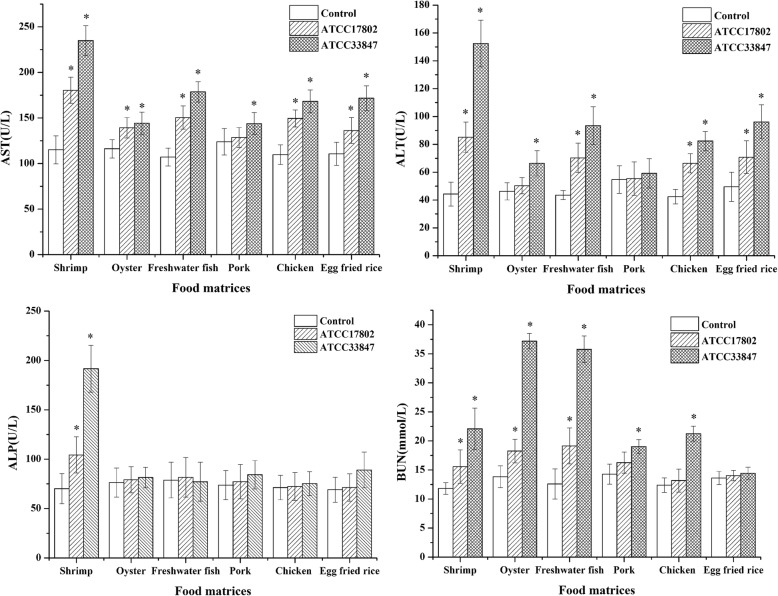
The two strains of V. parahaemolyticus produced hemolysin, gelatinase, caseinase, phospholipase, urease, DNase and amylase in selected food matrices. Significantly higher (p < 0.05) hemolytic activity was produced by V. parahaemolyticus in egg fried rice > shrimp > freshwater fish > chicken > oyster > pork. But the exoenzyme activities were not consistent with the hemolytic activity profile, being significantly higher (p < 0.05) in shrimp > freshwater fish > chicken > oyster > pork > egg fried rice. Filtrates of V. parahaemolyticus from shrimp, freshwater fish and chicken given intraperitoneally to adult mice induced marked liver and kidney damage and were highly lethal compared with the filtrates of V. parahaemolyticus from oyster > egg fried rice > pork.
From in vitro and in vivo tests, it appears that the food matrix type has a significant impact on the activity of extracellular products and the pathogenicity of V. parahaemolyticus. From a food safety aspect, it is important to determine which food matrices can stimulate V. parahaemolyticus to produce additional extracellular factors. This is the first report of non-seafood including freshwater fish and chicken contaminated with V. parahaemolyticus to have been shown to be toxic to mice in vivo.
在虾、牡蛎、淡水鱼、猪肉、鸡肉和蛋炒饭中评估了两种副溶血性弧菌(ATCC 17802 和 33847)菌株对溶血素和外酶的产生,这些外酶可能与该细菌的致病性有关。
两种副溶血性弧菌在选定的食物基质中产生溶血素、明胶酶、酪蛋白酶、磷脂酶、脲酶、DNase 和淀粉酶。在蛋炒饭中,副溶血性弧菌产生的溶血活性显著更高(p<0.05)>虾>淡水鱼>鸡肉>牡蛎>猪肉。但外酶活性与溶血活性谱不一致,在虾>淡水鱼>鸡肉>牡蛎>猪肉>蛋炒饭中显著更高(p<0.05)。腹腔内给予成年小鼠的来自虾、淡水鱼和鸡肉的副溶血性弧菌滤液引起明显的肝和肾损伤,与来自牡蛎>蛋炒饭>猪肉的副溶血性弧菌滤液相比,具有高度致死性。
从体外和体内试验来看,食物基质类型对细胞外产物的活性和副溶血性弧菌的致病性有重大影响。从食品安全方面来看,重要的是要确定哪些食物基质可以刺激副溶血性弧菌产生额外的细胞外因子。这是首次报道包括淡水鱼和鸡肉在内的非海鲜食品被污染副溶血性弧菌,在体内对小鼠具有毒性。