Division of Infectious Diseases, University of North Carolina at Chapel Hill, 130 Mason Farm Road, Chapel Hill, 27599, USA.
Program in Bioinformatics and Integrative Biology, University of Massachusetts, 368 Plantation St., Worcester, Massachusetts, 01605, USA.
Sci Rep. 2018 Jul 5;8(1):10159. doi: 10.1038/s41598-018-28534-3.
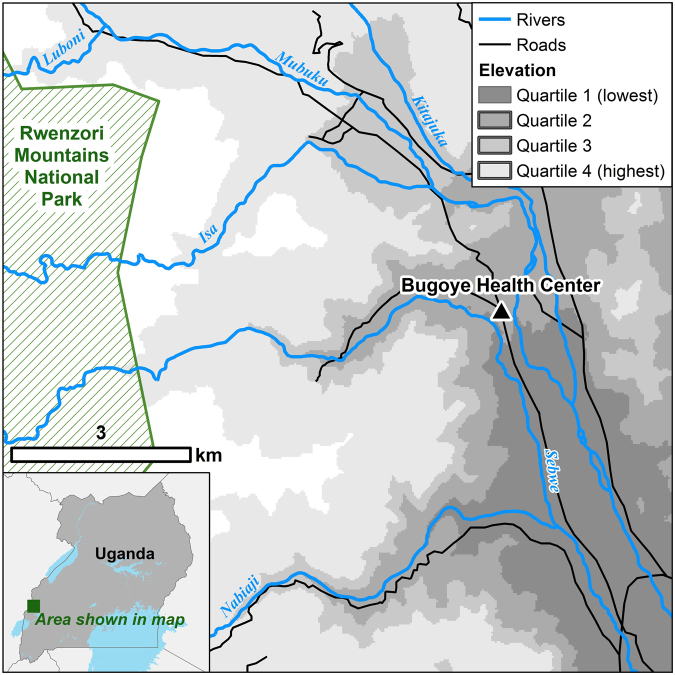
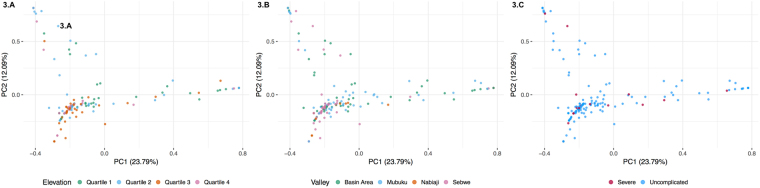
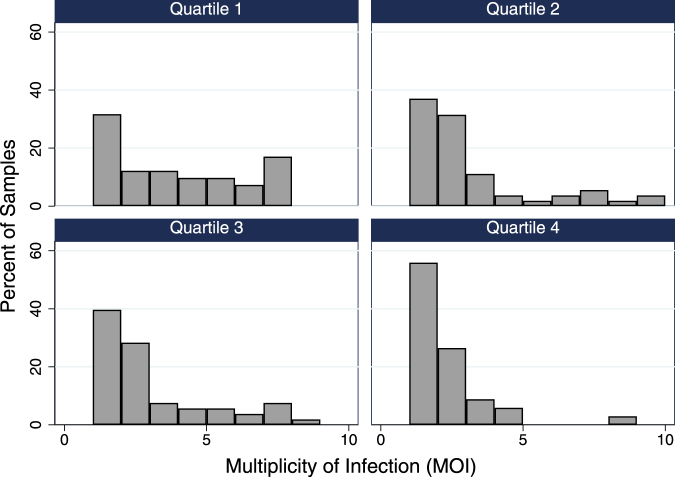
Molecular techniques are not routinely employed for malaria surveillance, while cross-sectional, community-based parasite surveys require significant resources. Here, we describe a novel use of malaria rapid diagnostic tests (RDTs) collected at a single facility as source material for sequencing to esimtate malaria transmission intensity across a relatively large catchment area. We extracted Plasmodium falciparum DNA from RDTs, then amplified and sequenced a region of the apical membrane antigen 1 (pfama1) using targeted amplicon deep sequencing. We determined the multiplicity of infection (MOI) for each sample and examined associations with demographic, clinical, and spatial factors. We successfully genotyped 223 of 287 (77.7%) of the samples. We demonstrated an inverse relationship between the MOI and elevation with individuals presenting from the highest elevation villages harboring infections approximately half as complex as those from the lowest (MOI 1.85 vs. 3.51, AOR 0.25, 95% CI 0.09-0.65, p = 0.004). This study demonstrates the feasibility and validity of using routinely-collected RDTs for molecular surveillance of malaria and has real-world utility, especially as the cost of high-throughpout sequencing continues to decline.
分子技术通常不用于疟疾监测,而基于社区的横断面寄生虫调查需要大量资源。在这里,我们描述了一种新颖的使用方法,即从单个机构收集的疟疾快速诊断检测 (RDT) 作为测序的源材料,以估计相对较大集水区的疟疾传播强度。我们从 RDT 中提取恶性疟原虫 DNA,然后使用靶向扩增子深度测序扩增和测序顶膜抗原 1(pfama1)的一个区域。我们确定了每个样本的感染多重性 (MOI),并检查了与人口统计学、临床和空间因素的关联。我们成功地对 287 个样本中的 223 个(77.7%)进行了基因分型。我们证明了 MOI 与海拔之间存在反比关系,来自海拔最高的村庄的个体携带的感染比来自海拔最低的村庄的个体(MOI 1.85 对 3.51,AOR 0.25,95%CI 0.09-0.65,p=0.004)复杂程度大约低一半。这项研究证明了使用常规收集的 RDT 进行疟疾分子监测的可行性和有效性,并且具有实际应用价值,尤其是随着高通量测序成本的持续下降。