Fan Yi-Pu, Liu Pei, Xue Wei-Kang, Zhao Wei-Jiang, Pan Hong-Chao
Center for Neuroscience, Shantou University Medical College, Shantou, China.
Guangdong Provincial Key Laboratory for Breast Cancer Diagnosis and Treatment, Cancer Hospital of Shantou University Medical College, Shantou, China.
Front Pharmacol. 2018 Jun 21;9:664. doi: 10.3389/fphar.2018.00664. eCollection 2018.
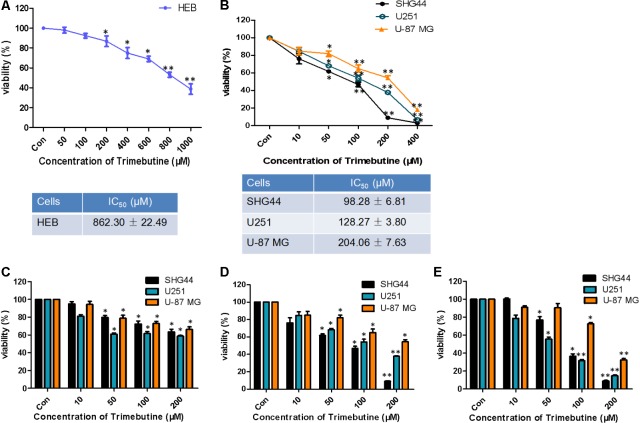
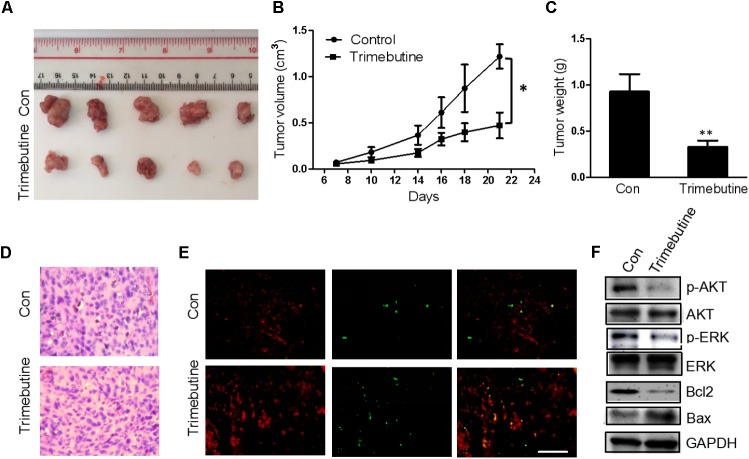
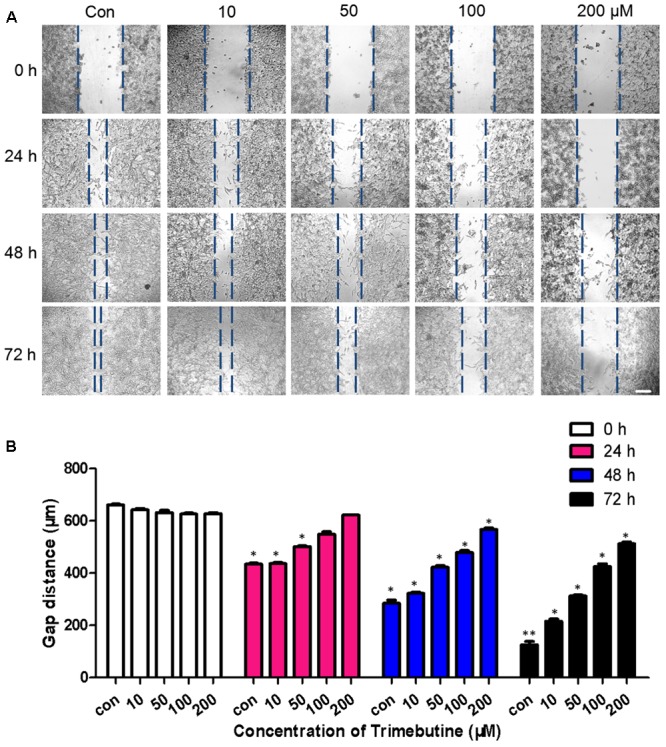
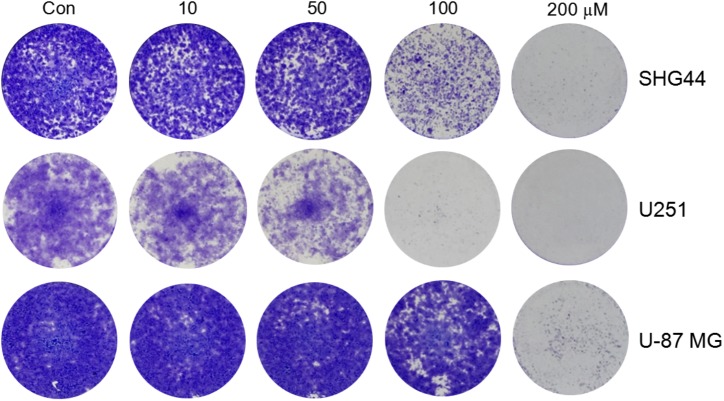
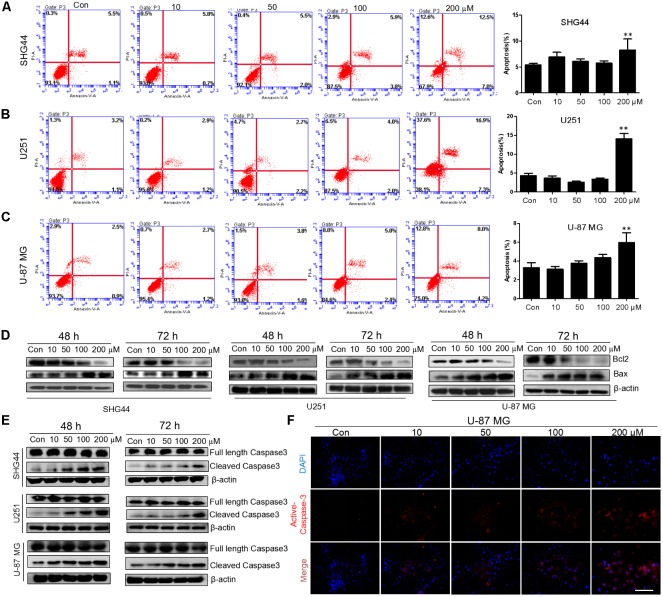
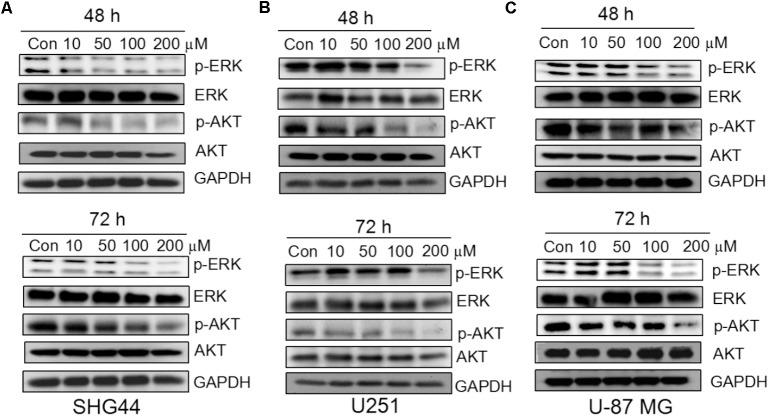
Gliomas are the most common primary brain tumors with a usually fatal malignancy. They are associated with a poor prognosis although multiple therapeutic options have been available. Trimebutine is one of the prokinetic agents and it has been mainly used for treatment of disorders of the gastrointestinal (GI) tract such as irritable bowel syndrome. However, its effects on glioma cells remain unknown. Here, we used various concentrations of trimebutine to treat SHG44, U251, and U-87 MG human glioma/glioblastoma cells. And combined experiments of MTT, colony formation assay, and wound healing assay, as well as western blot and immunofluorescence staining were used to evaluate the effects of trimebutine on glioma cells. The results demonstrated that trimebutine significantly inhibited cell viability and colony formation. A significant inhibition of glioma cell migration was also indicated by wound healing assay. In addition, trimebutine promoted cell apoptosis and induced Bcl-2 downregulation, accompanied with Bax upregulation. Both immunofluorescence staining and western blot results showed that trimebutine increased the level of active Caspase-3. Moreover, trimebutine reduced the activation of both AKT and ERK signaling pathways. In subcutaneous U-87 MG cell xenograft tumors in nude mice, trimebutine significantly inhibited tumor growth. More TUNEL-positive apoptotic cells in tumor sections were observed in trimebutine-treated mice when compared to the vehicle control. Reduced Bcl-2 and upregulated Bax, as well as perturbed p-AKT and p-ERK signaling pathways were also observed in trimebutine-treated xenograft tissues. Our combined data indicated that trimebutine may be potentially applied for the clinical management of glioma/glioblastoma.
神经胶质瘤是最常见的原发性脑肿瘤,通常具有致命的恶性程度。尽管有多种治疗选择,但它们的预后较差。曲美布汀是一种促动力药物,主要用于治疗胃肠道疾病,如肠易激综合征。然而,其对神经胶质瘤细胞的作用尚不清楚。在此,我们使用不同浓度的曲美布汀处理SHG44、U251和U - 87 MG人神经胶质瘤/胶质母细胞瘤细胞。并通过MTT、集落形成试验、伤口愈合试验以及蛋白质免疫印迹和免疫荧光染色等联合实验来评估曲美布汀对神经胶质瘤细胞的影响。结果表明,曲美布汀显著抑制细胞活力和集落形成。伤口愈合试验也表明曲美布汀对神经胶质瘤细胞迁移有显著抑制作用。此外,曲美布汀促进细胞凋亡并诱导Bcl - 2下调,同时伴有Bax上调。免疫荧光染色和蛋白质免疫印迹结果均显示曲美布汀增加了活性Caspase - 3的水平。此外,曲美布汀降低了AKT和ERK信号通路的激活。在裸鼠皮下U - 87 MG细胞异种移植瘤中,曲美布汀显著抑制肿瘤生长。与载体对照组相比,在曲美布汀处理的小鼠肿瘤切片中观察到更多TUNEL阳性凋亡细胞。在曲美布汀处理的异种移植组织中也观察到Bcl - 2减少、Bax上调以及p - AKT和p - ERK信号通路紊乱。我们的综合数据表明,曲美布汀可能有潜力应用于神经胶质瘤/胶质母细胞瘤的临床治疗。