Ahadzadeh Ashraf Sadat, Rafik-Galea Shameem, Alavi Masoumeh, Amini Mansour
Department of Journalism, Xiamen University Malaysia Campus.
Department of English Language and Communication, Faculty of Social Sciences and Liberal Arts, UCSI University.
Health Psychol Open. 2018 Jun 10;5(1):2055102918774251. doi: 10.1177/2055102918774251. eCollection 2018 Jan-Jun.
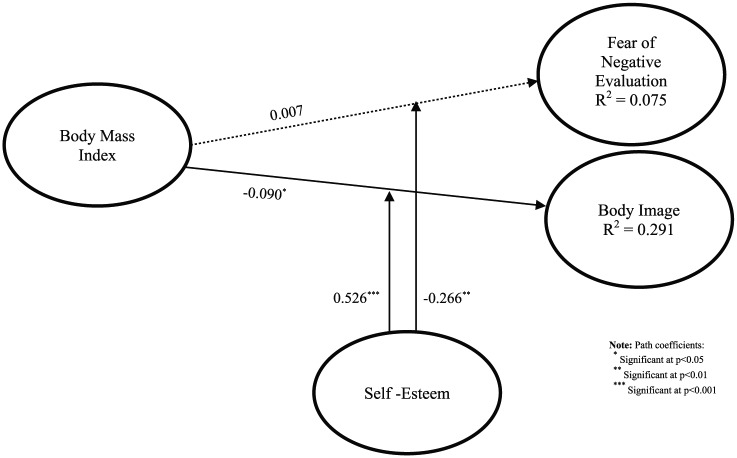
This study examined the correlation between body mass index as independent variable, and body image and fear of negative evaluation as dependent variables, as well as the moderating role of self-esteem in these correlations. A total of 318 Malaysian young adults were conveniently recruited to do the self-administered survey on the demographic characteristics body image, fear of negative evaluation, and self-esteem. Partial least squares structural equation modeling was used to test the research hypotheses. The results revealed that body mass index was negatively associated with body image, while no such correlation was found with fear of negative evaluation. Meanwhile, the negative correlation of body mass index with body image was stronger among those with lower self-esteem, while a positive association of body mass index with fear of negative evaluation was significant only among individuals with low self-esteem.
本研究考察了作为自变量的体重指数与作为因变量的身体意象和对负面评价的恐惧之间的相关性,以及自尊在这些相关性中的调节作用。通过便利抽样招募了318名马来西亚年轻人,让他们就人口统计学特征、身体意象、对负面评价的恐惧和自尊进行自填式调查。采用偏最小二乘结构方程模型来检验研究假设。结果显示,体重指数与身体意象呈负相关,而与对负面评价的恐惧未发现此类相关性。同时,体重指数与身体意象的负相关在自尊较低者中更强,而体重指数与对负面评价的恐惧的正相关仅在低自尊个体中显著。