Dukas Alex G, Shea Kevin G, Nissen Carl W, Obopilwe Elifho, Fabricant Peter D, Cannamela Peter C, Milewski Matthew D
Department of Orthopaedic Surgery, University of Connecticut Health Center, Farmington, Connecticut, USA.
Department of Orthopedic Surgery, St Luke's Health System, Boise, Idaho, USA.
Orthop J Sports Med. 2018 Jun 13;6(6):2325967118776951. doi: 10.1177/2325967118776951. eCollection 2018 Jun.
Anterior cruciate ligament (ACL) ruptures have become increasingly common in pediatric and adolescent athletes. While multiple methods exist, all-epiphyseal ACL reconstruction is a popular technique in the skeletally immature patient. Given the high rate of reruptures in this population and the increasing number of commercially available fixation devices, biomechanical testing is crucial to understand the performance of these devices in pediatric epiphyseal bone. To our knowledge, there has not been a biomechanical analysis of ACL fixation devices in skeletally immature bone.
To compare cortically based button fixation with interference screw and sheath fixation in skeletally immature femoral epiphyseal cadaveric bone. Our hypothesis was that there would be no difference in peak load to failure, stiffness, or cyclic displacement between these 2 fixation constructs.
Controlled laboratory study.
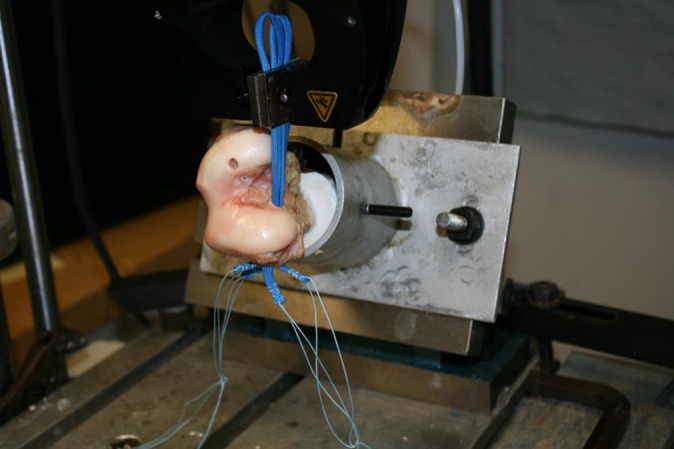
Fresh-frozen matched-pair knees from 3 pediatric cadaveric specimens were obtained. A synthetic graft was fixed in an all-epiphyseal femoral tunnel. Both the lateral and medial condyles were utilized to increase the sample size. Specimens were randomized and assigned to receive either an interference screw and sheath construct designed for pediatric patients or an adjustable loop cortical button. Biomechanical testing was performed to obtain ultimate load to failure, stiffness, total displacement after 500 cycles, and the failure mode for each condyle.
Each medial and lateral condyle in 3 pairs of skeletally immature cadaveric knees (ages 7, 9, and 11 years) was utilized for testing. One specimen was excluded after it failed by having a transphyseal fracture. The median peak load to failure was 769.80 N (interquartile range [IQR], 628.50-930.41 N) for the screw and sheath group and 862.80 N (IQR, 692.34-872.65 N) for the button group ( = .893). The median displacement after 500 cycles for the screw and sheath group was 0.65 mm (IQR, 0.47-1.03 mm) and 1.13 mm (IQR, 0.96-1.25 mm) for the button group ( = .08). The median stiffness of the screw and sheath group was significantly higher than that of the button group (31.47 N/mm [IQR, 26.40-43.00 N/mm] vs 25.22 N/mm [IQR, 21.18-27.07 N/mm], respectively) ( = .043).
When comparing femoral fixation with a screw and sheath construct developed for pediatric patients to an adjustable loop cortical button in skeletally immature bone, our results showed that fixation did not significantly differ with respect to cyclic displacement or peak load to failure. While the screw and sheath construct was significantly stiffer, its effect on clinical outcomes is not yet known.
With regard to femoral fixation, there is no significant biomechanical difference between the use of cortically based button fixation or interference screw and sheath fixation in pediatric epiphyseal cadaveric bone.
前交叉韧带(ACL)断裂在儿科和青少年运动员中越来越常见。虽然存在多种方法,但全骨骺ACL重建是骨骼未成熟患者中一种常用的技术。鉴于该人群中再断裂的发生率较高,以及市售固定装置的数量不断增加,生物力学测试对于了解这些装置在儿科骨骺骨中的性能至关重要。据我们所知,尚未对骨骼未成熟骨中的ACL固定装置进行生物力学分析。
比较基于皮质的纽扣固定与干涉螺钉及鞘管固定在骨骼未成熟的股骨骨骺尸体骨中的效果。我们的假设是,这两种固定结构在失效峰值载荷、刚度或循环位移方面没有差异。
对照实验室研究。
获取3具儿科尸体标本的新鲜冷冻配对膝关节。将合成移植物固定在全骨骺股骨隧道中。利用外侧和内侧髁来增加样本量。标本随机分组,分别接受为儿科患者设计的干涉螺钉及鞘管结构或可调环皮质纽扣。进行生物力学测试以获得每个髁的失效极限载荷、刚度、500次循环后的总位移以及失效模式。
3对骨骼未成熟尸体膝关节(年龄分别为7岁、9岁和11岁)的每个内侧和外侧髁均用于测试。1个标本因发生经骨骺骨折而失效,被排除在外。螺钉及鞘管组的失效峰值载荷中位数为769.80 N(四分位间距[IQR],628.50 - 930.41 N),纽扣组为862.80 N(IQR,692.34 - 872.65 N)(P = 0.893)。螺钉及鞘管组500次循环后的位移中位数为0.65 mm(IQR,0.47 - 1.03 mm),纽扣组为1.13 mm(IQR,0.96 - 1.25 mm)(P = 0.08)。螺钉及鞘管组的刚度中位数显著高于纽扣组(分别为31.47 N/mm[IQR,26.40 - 43.00 N/mm]和25.22 N/mm[IQR,