Simbrunner Josef, Simbrunner Clemens, Schrode Benedikt, Röthel Christian, Bedoya-Martinez Natalia, Salzmann Ingo, Resel Roland
Department of Neuroradiology, Vascular and Interventional Radiology, Medical University Graz, Auenbruggerplatz 9, Graz, 8036, Austria.
E + E Elektronik Ges.m.b.H., Langwiesen 7, Engerwitzdorf, 4209, Austria.
Acta Crystallogr A Found Adv. 2018 Jul 1;74(Pt 4):373-387. doi: 10.1107/S2053273318006629. Epub 2018 Jul 5.
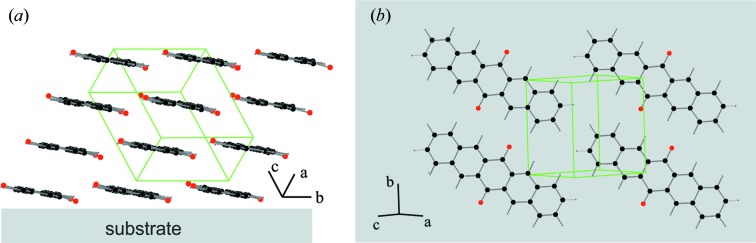
Crystal structure solutions from thin films are often performed by grazing-incidence X-ray diffraction (GIXD) experiments. In particular, on isotropic substrates the thin film crystallites grow in a fibre texture showing a well defined crystallographic plane oriented parallel to the substrate surface with random in-plane order of the microcrystallites forming the film. In the present work, analytical mathematical expressions are derived for indexing experimental diffraction patterns, a highly challenging task which hitherto mainly relied on trial-and-error approaches. The six lattice constants a, b, c, α, β and γ of the crystallographic unit cell are thereby determined, as well as the rotation parameters due to the unknown preferred orientation of the crystals with respect to the substrate surface. The mathematical analysis exploits a combination of GIXD data and information acquired by the specular X-ray diffraction. The presence of a sole specular diffraction peak series reveals fibre-textured growth with a crystallographic plane parallel to the substrate, which allows establishment of the Miller indices u, v and w as the rotation parameters. Mathematical expressions are derived which reduce the system of unknown parameters from the three- to the two-dimensional space. Thus, in the first part of the indexing routine, the integers u and v as well as the Laue indices h and k of the experimentally observed diffraction peaks are assigned by systematically varying the integer variables, and by calculating the three lattice parameters a, b and γ. Because of the symmetry of the derived equations, determining the missing parameters then becomes feasible: (i) w of the surface parallel plane, (ii) the Laue indices l of the diffraction peak and (iii) analogously the lattice constants c, α and ß. In a subsequent step, the reduced unit-cell geometry can be identified. Finally, the methodology is demonstrated by application to an example, indexing the diffraction pattern of a thin film of the organic semiconductor pentacenequinone grown on the (0001) surface of highly oriented pyrolytic graphite. The preferred orientation of the crystallites, the lattice constants of the triclinic unit cell and finally, by molecular modelling, the full crystal structure solution of the as-yet-unknown polymorph of pentacenequinone are determined.
薄膜晶体结构解析通常通过掠入射X射线衍射(GIXD)实验来进行。特别是在各向同性衬底上,薄膜微晶以纤维织构生长,呈现出一个定义明确的平行于衬底表面的结晶平面,而构成薄膜的微晶在面内具有随机排列。在本工作中,推导了用于标定实验衍射图谱的解析数学表达式,这是一项极具挑战性的任务,迄今为止主要依赖试错法。由此确定了晶体学单胞的六个晶格常数a、b、c、α、β和γ,以及由于晶体相对于衬底表面未知的择优取向而产生的旋转参数。数学分析利用了GIXD数据和镜面X射线衍射获取的信息。单一镜面衍射峰系列的存在揭示了具有平行于衬底的结晶平面的纤维织构生长,这使得能够确定米勒指数u、v和w作为旋转参数。推导了数学表达式,将未知参数系统从三维空间简化到二维空间。因此,在标定程序的第一部分,通过系统地改变整数变量并计算三个晶格参数a、b和γ,来确定实验观测衍射峰的整数u和v以及劳厄指数h和k。由于推导方程的对称性,确定缺失参数随后变得可行:(i)表面平行平面的w,(ii)衍射峰的劳厄指数l,以及(iii)类似地晶格常数c、α和β。在随后的步骤中,可以确定简化的单胞几何结构。最后,通过应用一个实例来演示该方法,即标定生长在高度取向热解石墨(0001)表面的有机半导体并五苯醌薄膜的衍射图谱。确定了微晶的择优取向、三斜单胞的晶格常数,最后通过分子建模确定了尚未知晓的并五苯醌多晶型的完整晶体结构解析。