Department of Cardiology, the Second Affiliated Hospital of Harbin Medical University, Harbin, China.
The Key Laboratory of Myocardial Ischemia, Harbin Medical University, Ministry of Education, Harbin, China.
J Cardiovasc Pharmacol. 2018 Oct;72(4):167-175. doi: 10.1097/FJC.0000000000000612.
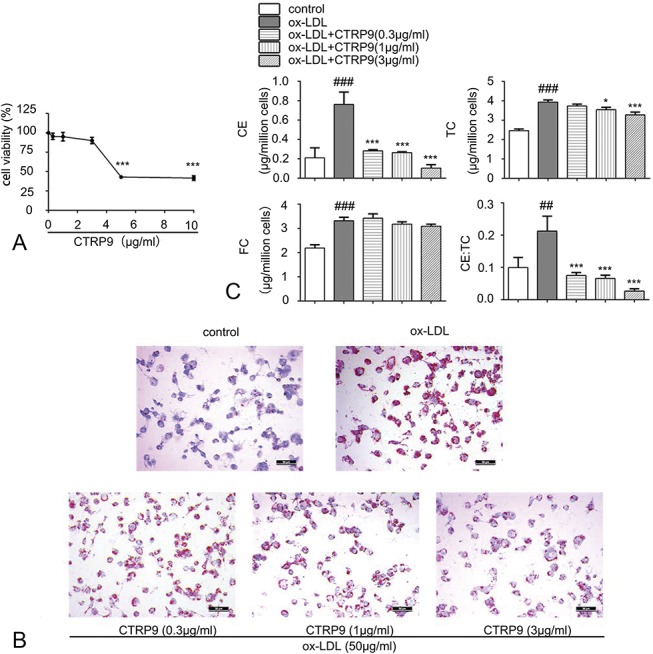
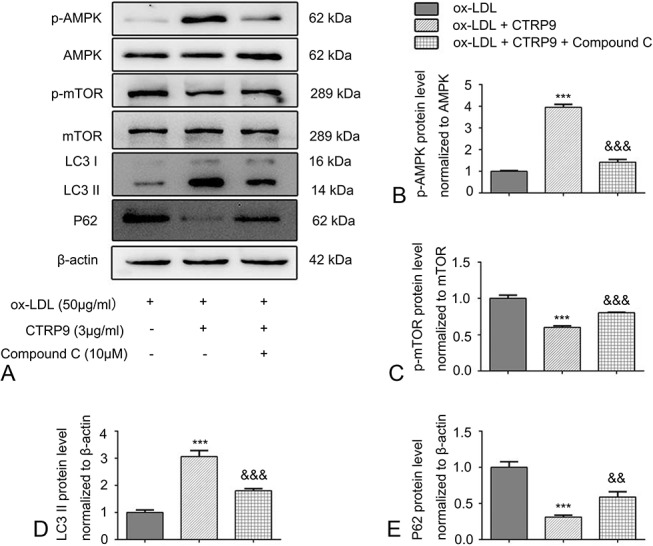
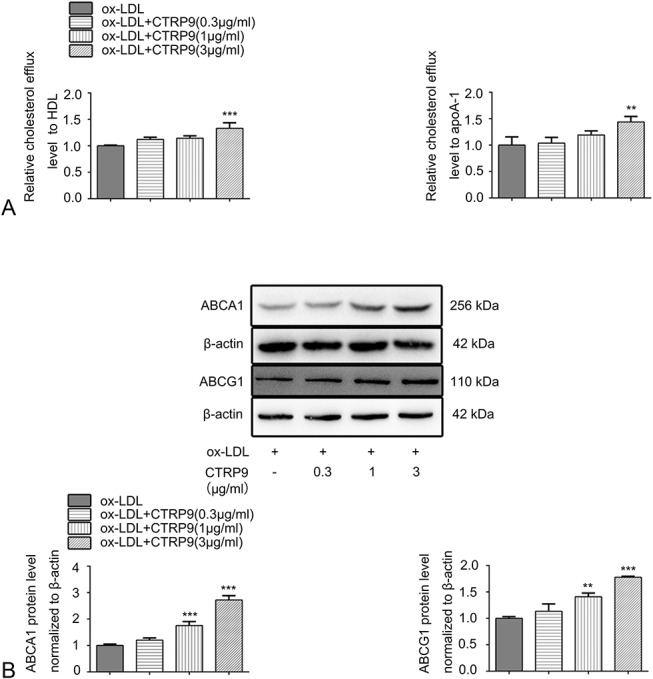
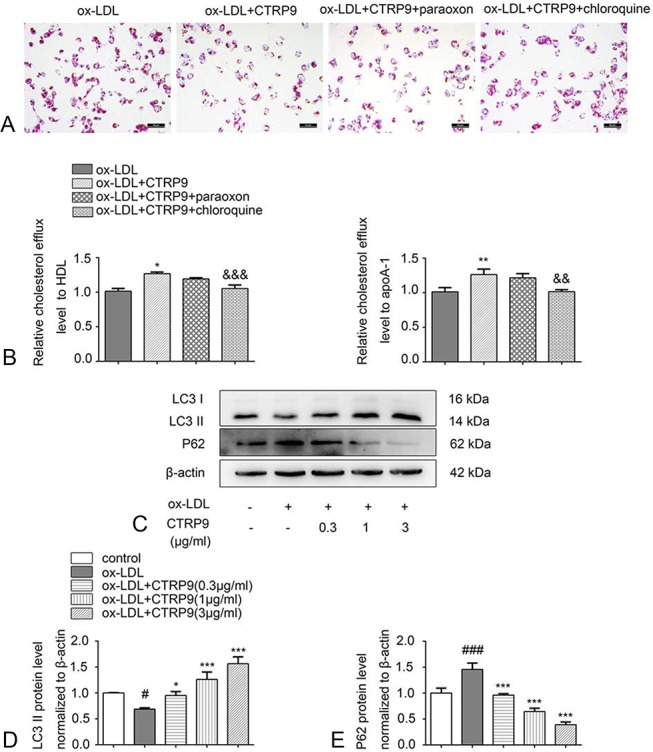
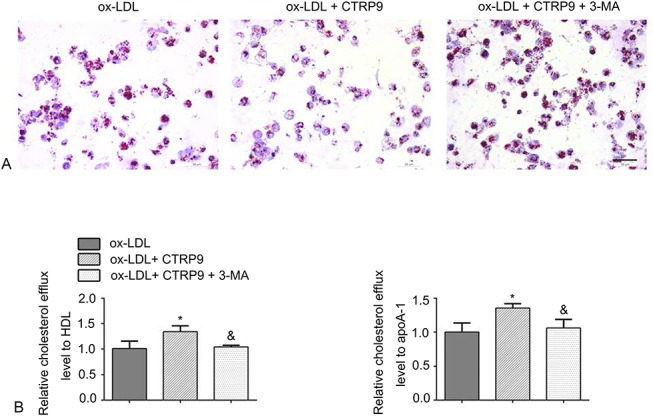
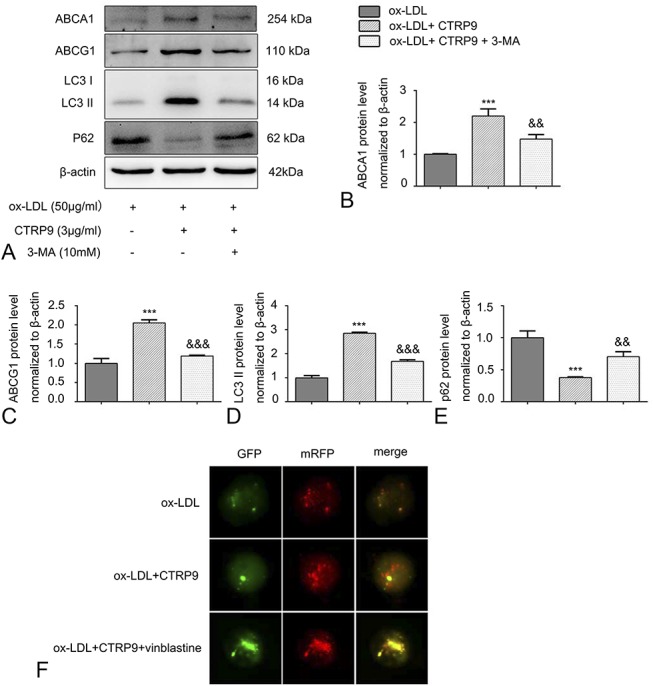
During the pathogenesis of early atherosclerosis, lipid-loaded macrophages are involved in plaque development and progression. As a novel adipokine, C1q/tumor necrosis factor-related protein-9 (CTRP9) has beneficial effects in cardiovascular disease. However, previous reports have not studied whether the formation of macrophage foam cell induced by oxidized low-density lipoprotein (ox-LDL) is affected by CTRP9. According to our study, in ox-LDL-induced THP-1 macrophages, CTRP9 could reduce the quantity of lipid droplets, lower the level of cholesteryl ester (CE), promote cholesterol efflux, as well as increase the expression level of the cholesterol transport receptors ATP-binding membrane cassette transporter A1 (ABCA1) and G1 (ABCG1). In addition, the protein of LC3 II is elevated and that of p62 is decreased in CTRP9-treated foam cells by enhancing autophagy. However, using 3-methyladenine (3-MA) abolished the role of CTRP9 by inhibiting autophagy. Mechanistically, the autophagy-promoting effects of CTRP9 on foam cells was reversed by an AMPK inhibitor, Compound C, which inhibited the signaling pathway of adenosine 5'-monophosphate (AMP)-activated protein kinase (AMPK)/mammalian target of rapamycin (mTOR). These results show that CTRP9 protects against atherosclerosis by promoting cholesterol efflux to reduce the formation of foam cell in virtue of inducing autophagy in an AMPK/mTOR signaling pathway-dependent manner.
在动脉粥样硬化早期发病过程中,载脂巨噬细胞参与斑块的形成和进展。作为一种新型脂肪因子,C1q/肿瘤坏死因子相关蛋白-9(CTRP9)在心血管疾病中有有益作用。然而,之前的报告并未研究过氧化低密度脂蛋白(ox-LDL)诱导的巨噬细胞泡沫细胞的形成是否受 CTRP9 影响。根据我们的研究,在 ox-LDL 诱导的 THP-1 巨噬细胞中,CTRP9 可以减少脂滴数量,降低胆固醇酯(CE)水平,促进胆固醇流出,并增加胆固醇转运受体 ATP 结合膜盒转运体 A1(ABCA1)和 G1(ABCG1)的表达水平。此外,CTRP9 处理的泡沫细胞中 LC3 II 蛋白升高,p62 蛋白降低,通过增强自噬作用。然而,使用 3-甲基腺嘌呤(3-MA)通过抑制自噬作用消除了 CTRP9 的作用。在机制上,CTRP9 通过抑制腺苷 5'-单磷酸(AMP)激活蛋白激酶(AMPK)/雷帕霉素靶蛋白(mTOR)信号通路的 AMPK 抑制剂 Compound C 逆转了 CTRP9 对泡沫细胞的自噬促进作用。这些结果表明,CTRP9 通过诱导自噬来促进胆固醇流出,从而减少泡沫细胞的形成,从而保护动脉粥样硬化,这种作用是通过 AMPK/mTOR 信号通路依赖性方式实现的。