Chang Jung Woo, Heo Woong, Choi Matthew Seung Suk, Lee Jang Hyun
Department of Plastic and Reconstructive Surgery, Hanyang University Guri Hospital, Hanyang University College of Medicine, Guri, Korea.
Medicine (Baltimore). 2018 Jul;97(27):e11454. doi: 10.1097/MD.0000000000011454.
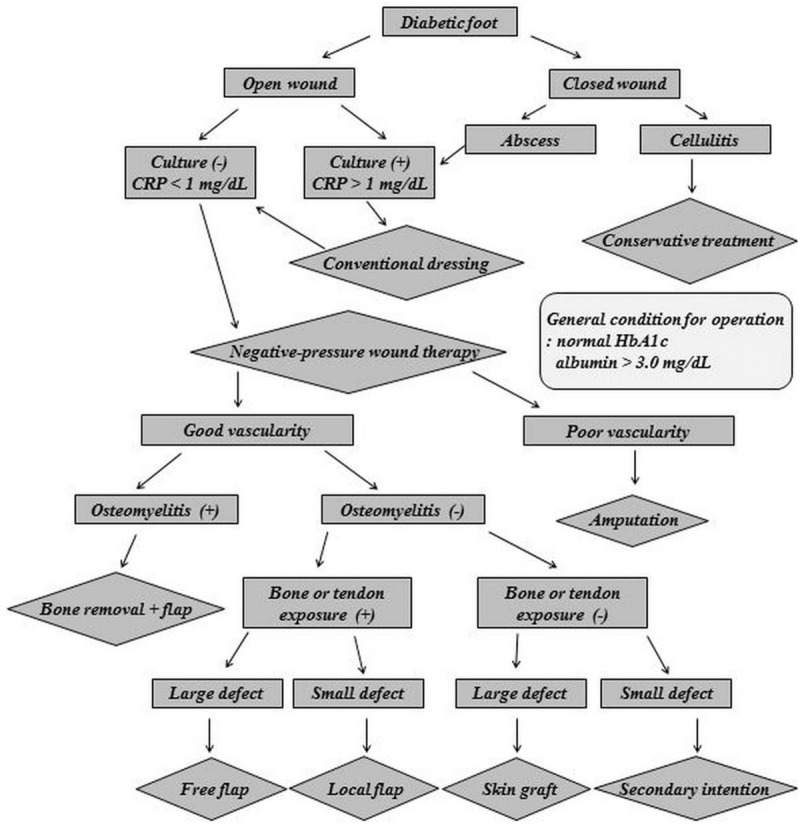
Diabetic foot management is a challenge for reconstructive surgeons because it combines dramatically decreased circulation and chronic infection. The goal of managing this condition is to maximize viable tissue; however, unsatisfactory results, such as extremity amputation, are unavoidable in some cases. For appropriate management, thorough understanding of diabetic foot and the phased approach to its management is needed. The purpose of this study is to introduce an optimal algorithm for diabetic foot management by analyzing cases >12 years.
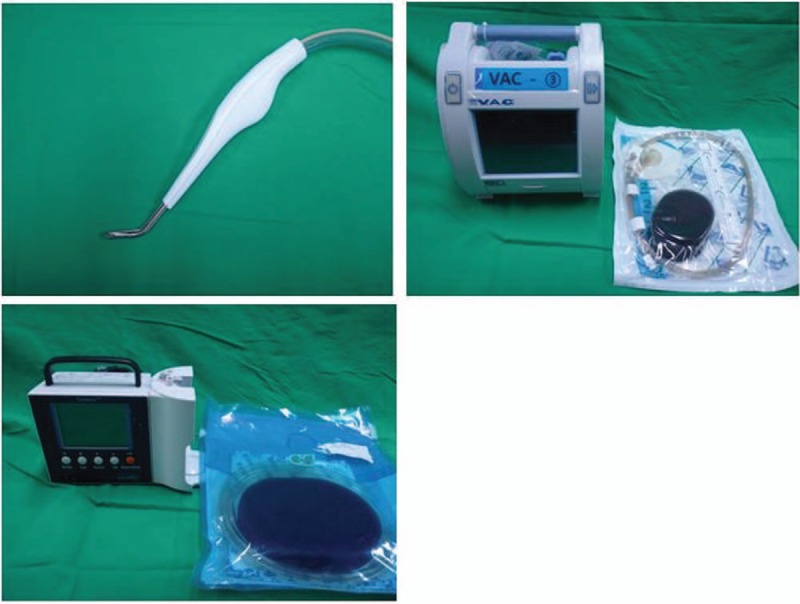
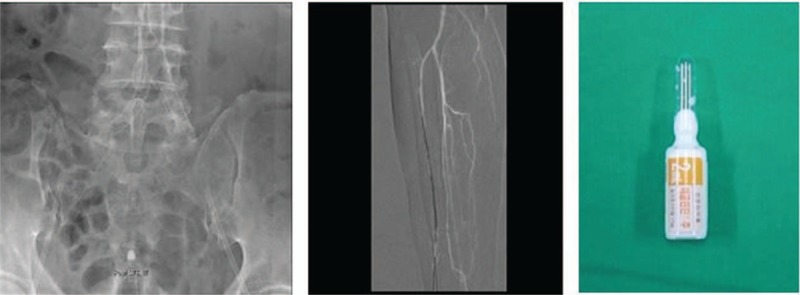
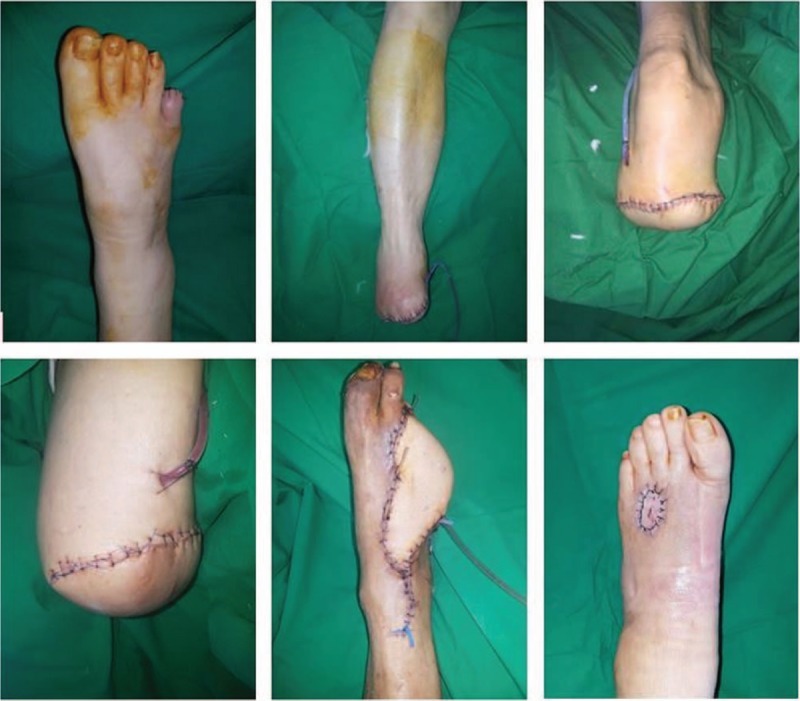
A total of 274 patients with diabetic foot at Hanyang University Guri Hospital from 2005 to 2017 were reviewed. The management process was divided into 5 steps: patient evaluation, wound preparation, improving vascularity, surgery and dressing, and rehabilitation. Patient evaluation included a microbial culture, evaluation of vascularity, and an osteomyelitis assessment. During wound preparation, debridement and negative-pressure wound therapy were performed. Vascularity was improved by radiological intervention or surgical method. Surgery and dressing were performed depending on the indications. Rehabilitation was started after complete wound healing.
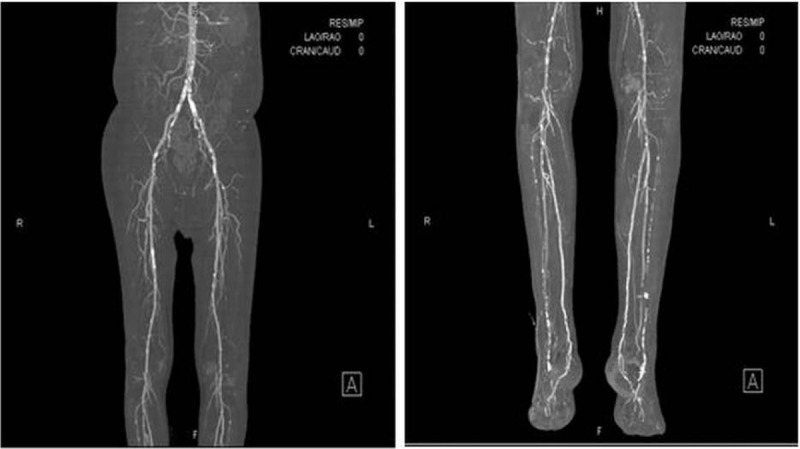
An infection was confirmed in 213 of 263 patients (81.0%). Of 74 cases in which a vascular study was performed, 83.8% showed arterial occlusion. When surgery was performed with complete eradication of the infection in 155 patients, the rate of revision surgery was 20.6%. The revision rate after surgery with a remnant infection of 66 patients was 40.9% (P = .0003). When surgery was performed after successful revascularization for improving blood flow of 47 patients, the rate of revision surgery was 21.3%. In contrast, the revision rate after surgery with unsuccessful or no revascularization of 174 patients was 28.2% (P = .359).
Diabetic foot is a debilitating disease arising from multifactorial process. As its management is complex, a comprehensive but accessible treatment algorithm is needed for successful results. For this reason, the appropriate algorithm for diabetic foot management introduced in this study is significant.
糖尿病足的治疗对重建外科医生来说是一项挑战,因为它合并了显著降低的循环和慢性感染。治疗这种疾病的目标是使存活组织最大化;然而,在某些情况下,诸如肢体截肢等不理想的结果是不可避免的。为了进行适当的治疗,需要对糖尿病足及其分阶段治疗方法有透彻的了解。本研究的目的是通过分析超过12年的病例来介绍一种糖尿病足治疗的最佳算法。
回顾了2005年至2017年在汉阳大学九里医院的274例糖尿病足患者。治疗过程分为5个步骤:患者评估、伤口准备、改善血运、手术及换药、康复。患者评估包括微生物培养、血运评估和骨髓炎评估。在伤口准备期间,进行清创和负压伤口治疗。通过放射学干预或手术方法改善血运。根据适应症进行手术及换药。伤口完全愈合后开始康复治疗。
263例患者中有213例(81.0%)确诊感染。在进行血管检查的74例病例中,83.8%显示动脉闭塞。155例患者在感染完全根除后进行手术,翻修手术率为20.6%。66例残留感染患者手术后的翻修率为40.9%(P = 0.0003)。47例患者在成功进行血运重建以改善血流后进行手术,翻修手术率为21.3%。相比之下,174例血运重建不成功或未进行血运重建的患者手术后的翻修率为28.2%(P = 0.359)。
糖尿病足是一种由多因素过程引起的使人衰弱的疾病。由于其治疗复杂,需要一种全面但易于操作的治疗算法才能取得成功的结果。因此,本研究中介绍的糖尿病足治疗的适当算法具有重要意义。