Brady Bernadette, Veljanova Irena, Schabrun Siobhan, Chipchase Lucinda
School of Science and Health, Western Sydney University, Sydney, New South Wales, Australia.
Departments of Pain Medicine and Physiotherapy, Liverpool Hospital, Liverpool, New South Wales, Australia.
BMJ Open. 2018 Jul 5;8(7):e021999. doi: 10.1136/bmjopen-2018-021999.
To evaluate patient engagement with, and the feasibility of, a novel, culturally adapted physiotherapy pain management approach.
A participant-blinded and assessor-blinded pilot randomised controlled trial.
Outpatient physiotherapy departments at two public hospitals and one district pain clinic.
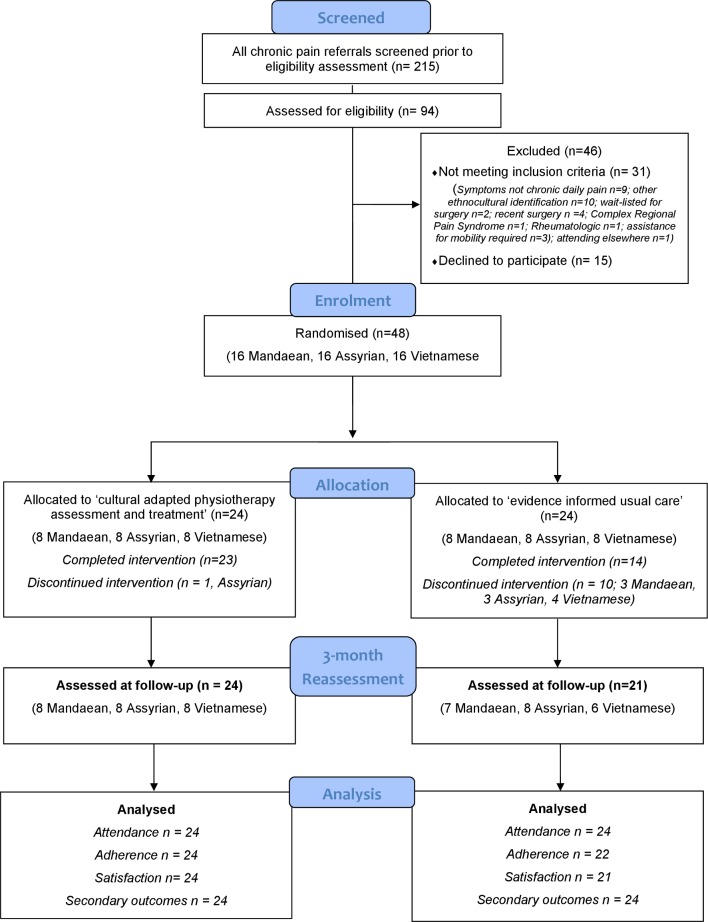
Adults (n=48) with chronic musculoskeletal pain (daily pain >3 months), who self-identified as Mandaean, Assyrian or Vietnamese, were randomised to one of two physiotherapy treatment conditions.
24 participants underwent combined group and individualised treatment described as 'culturally adapted physiotherapy', while 24 underwent evidence-informed 'usual physiotherapy care'. Both treatment arms consisted of up to 10 sessions over a 3-month period.
Patient engagement was measured via participant attendance, adherence and satisfaction data. Secondary outcomes included clinical measures of pain severity, interference and suffering, physical function and negative emotional state.
96% of participants undergoing culturally adapted physiotherapy completed treatment, compared with 58% of the usual physiotherapy group. For the culturally adapted group attendance (87%±18%) and adherence (68%±32%) were higher relative to usual care (68%±32% and 55%±43%). Satisfaction was similar for the culturally adapted (82.7%±13.4%) and usual care (79.3±17.3) groups. For secondary outcomes, a significant between-group effect for pain-related suffering in favour of the culturally adapted group was observed with a medium effect size (partial η 0.086, mean 3.56, 95% CI 0.11 to 7), while results for pain severity, interference, physical function and negative emotional state were similar.
Aligning treatment with the beliefs and values of culturally and linguistically diverse communities enhances patient engagement with physiotherapy. These results support the feasibility of a larger, multisite trial to determine if improved engagement with culturally adapted physiotherapy translates to improved clinical outcomes.
ACTRN12616000857404; Pre-results.
评估患者对一种新颖的、经文化适应的物理治疗疼痛管理方法的参与度及其可行性。
一项参与者和评估者双盲的试点随机对照试验。
两家公立医院的门诊物理治疗科和一家地区疼痛诊所。
48名患有慢性肌肉骨骼疼痛(每日疼痛超过3个月)的成年人,他们自我认定为曼达安人、亚述人或越南人,被随机分配到两种物理治疗条件之一。
24名参与者接受了被称为“文化适应物理治疗”的小组和个性化联合治疗,而24名参与者接受了基于证据的“常规物理治疗护理”。两个治疗组在3个月内最多进行10次治疗。
通过参与者的出勤、依从性和满意度数据来衡量患者的参与度。次要结果包括疼痛严重程度、干扰和痛苦、身体功能以及负面情绪状态的临床测量。
接受文化适应物理治疗的参与者中有96%完成了治疗,而常规物理治疗组的这一比例为58%。与常规护理相比,文化适应组的出勤率(87%±18%)和依从性(68%±32%)更高(常规护理组分别为68%±32%和55%±43%)。文化适应组(82.7%±13.4%)和常规护理组(79.3±17.3)的满意度相似。对于次要结果,观察到在疼痛相关痛苦方面存在显著的组间效应,有利于文化适应组,效应大小为中等(偏η²0.086,均值3.56,95%置信区间0.11至7),而疼痛严重程度、干扰、身体功能和负面情绪状态的结果相似。
使治疗与文化和语言多样化社区的信仰和价值观保持一致可提高患者对物理治疗的参与度。这些结果支持进行一项更大规模的多中心试验的可行性,以确定改善对文化适应物理治疗的参与度是否能转化为更好的临床结果。
ACTRN12616000857404;预结果。