Ma Yong, Luo Yiqian, Lin Nan, Lv Yongzhu, Zhou Yang, Li Bing, Han Kunna, Jiang Song, Gao Jianjun
Department of General Surgery, 210 Hospital of Chinese People's Liberation Army, Dalian 116000, Liaoning, China,
Onco Targets Ther. 2018 Jun 25;11:3659-3670. doi: 10.2147/OTT.S163076. eCollection 2018.
Mucinous adenocarcinoma (MC) is a special kind of colorectal adenocarcinoma that occurs more frequently in young patients and females, but the prognostic effect of lymph nodes in MC patients is unclear. This population-based study was conducted to analyze the prognostic value of the number of lymph nodes examined in different stages of colorectal MC.
We included 17,001 MC patients from the Surveillance, Epidemiology, and End Results program database between 2003 and 2013, of which 12,812 (75%) had >12 lymph nodes examined.
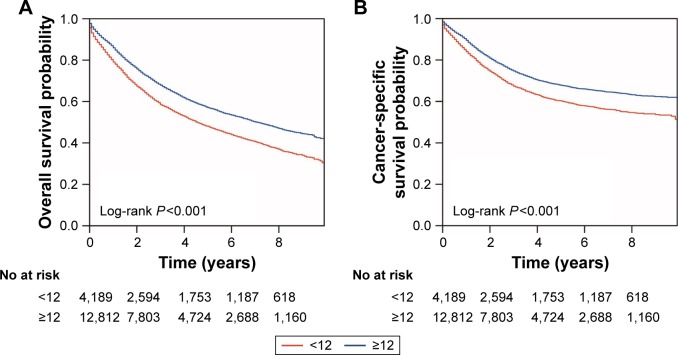
Compared to the group with insufficient lymph nodes examined, patients with more lymph nodes (>12) examined tended to come from east and central America, were more frequently female and young, were diagnosed after 2008, had larger-sized tumors of less differentiated grade and in later stages, had not received radiation therapy and had more positive nodal status. Patients with more lymph nodes (>12) examined demonstrated significantly better survival than those with insufficient lymph nodes examined only in stages II and III (stage II: overall, <0.001; cancer-specific, <0.001; stage III: overall, =0.093; cancer-specific, =0.032), even though the overall (<0.001) and cancer-specific survival (<0.001) showed significant differences between the two groups. Both univariate (overall, HR=0.739, 95% CI=0.703-0.777, <0.001; cancer-specific, HR=0.742, 95% CI=0.698-0.788, <0.001) and multivariate (overall, HR=0.601, 95% CI=0.537-0.673, <0.001; cancer-specific, HR=0.582, 95% CI=0.511-0.664, <0.001) Cox proportional hazards models verified the association between >12 lymph nodes examined and better survival.
More number of lymph nodes (.12) examined significantly increased the survival probability of MC patients in stages II and III, but had no significant influence on patients in stages I and IV, indicating the effect of number of lymph nodes examined was a stage-dependent prognostic factor in clinical utility.
黏液腺癌(MC)是一种特殊类型的结直肠癌,在年轻患者和女性中更为常见,但MC患者中淋巴结的预后影响尚不清楚。本基于人群的研究旨在分析结直肠癌MC不同阶段检查的淋巴结数量的预后价值。
我们纳入了2003年至2013年间来自监测、流行病学和最终结果计划数据库的17001例MC患者,其中12812例(75%)检查的淋巴结>12个。
与检查淋巴结不足的组相比,检查淋巴结较多(>12个)的患者倾向于来自美国东部和中部,女性和年轻人更为常见,于2008年后确诊,肿瘤较大、分化程度较低且处于晚期,未接受放射治疗,淋巴结阳性状态更多。仅在II期和III期,检查淋巴结较多(>12个)的患者的生存率明显高于检查淋巴结不足的患者(II期:总体,<0.001;癌症特异性,<0.001;III期:总体,=0.093;癌症特异性,=0.032),尽管两组之间的总体生存率(<0.001)和癌症特异性生存率(<0.001)存在显著差异。单因素(总体,HR=0.739,95%CI=0.703-0.777,<0.001;癌症特异性,HR=0.742,95%CI=0.698-0.788,<0.001)和多因素(总体,HR=0.601,95%CI=0.537-0.673,<0.001;癌症特异性,HR=0.582,95%CI=0.511-0.664,<0.001)Cox比例风险模型均验证了检查>12个淋巴结与更好的生存率之间的关联。
检查更多数量(>12个)的淋巴结显著提高了II期和III期MC患者的生存概率,但对I期和IV期患者没有显著影响,表明检查的淋巴结数量的影响是临床应用中一个依赖分期的预后因素。