Park Yoonsoo, Tae Hyun-Jin, Cho Jeong Hwi, Kim In-Shik, Ohk Taek Geun, Park Chan Woo, Moon Joong Bum, Shin Myoung Cheol, Lee Tae-Kyeong, Lee Jae-Chul, Park Joon Ha, Ahn Ji Hyeon, Kang Seok Hoon, Won Moo-Ho, Cho Jun Hwi
Department of Emergency Medicine and Institute of Medical Sciences, Kangwon National University Hospital, Kangwon National University School of Medicine, Chuncheon, Korea.
Bio Safety Research Institute, College of Veterinary Medicine, Chonbuk National University, Iksan, Korea.
Anat Cell Biol. 2018 Jun;51(2):128-135. doi: 10.5115/acb.2018.51.2.128. Epub 2018 Jun 27.
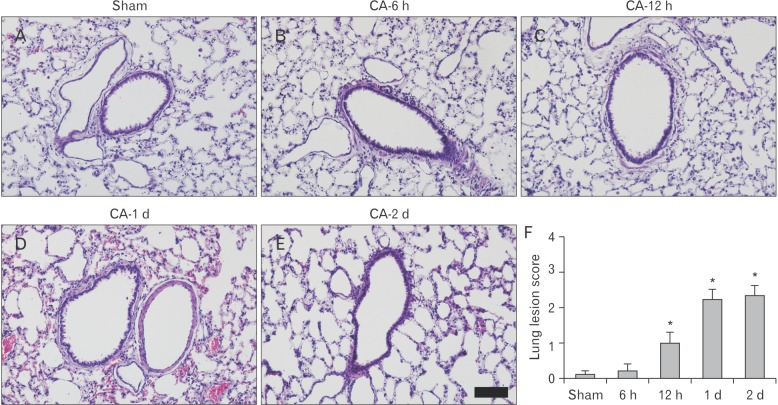
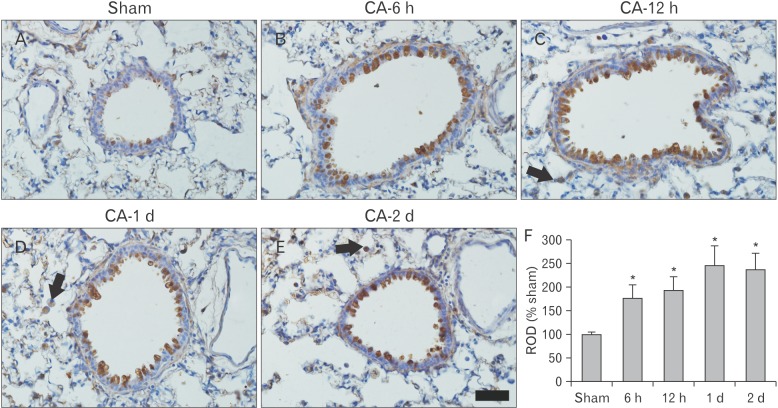
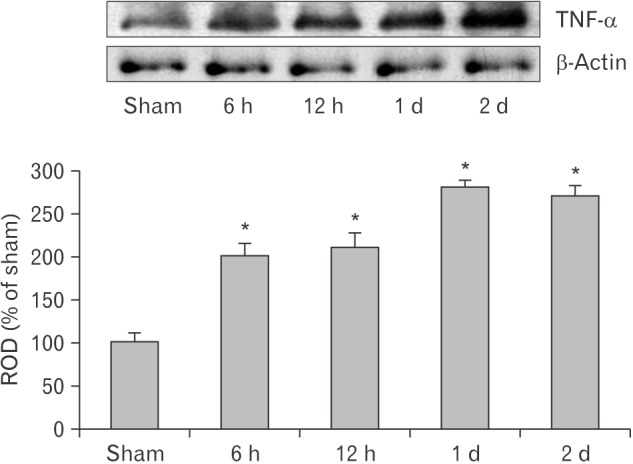
Cardiac arrest (CA) is sudden loss of heart function and abrupt stop in effective blood flow to the body. The patients who initially achieve return of spontaneous circulation (RoSC) after CA have low survival rate. It has been known that multiorgan dysfunctions after RoSC are associated with high morbidity and mortality. Most previous studies have focused on the heart and brain in RoSC after CA. Therefore, the aim of this research was to perform serological, physiological, and histopathology study in the lung and to determine whether or how pulmonary dysfunction is associated with low survival rate after CA. Experimental animals were divided into sham-operated group (n=14 at each point in time), which was not subjected to CA operation, and CA-operated group (n=14 at each point in time), which was subjected to CA. The rats in each group were sacrificed at 6 hours, 12 hours, 24 hours, and 2 days, respectively, after RoSC. Then, pathological changes of the lungs were analyzed by hematoxylin and eosin staining, Western blot and immunohistochemistry for tumor necrosis factor α (TNF-α). The survival rate after CA was decreased with time past. We found that histopathological score and TNF-α immunoreactivity were significantly increased in the lung after CA. These results indicate that inflammation triggered by ischemia-reperfusion damage after CA leads to pulmonary injury/dysfunctions and contributes to low survival rate. In addition, the finding of increase in TNF-α via inflammation in the lung after CA would be able to utilize therapeutic or diagnostic measures in the future.
心脏骤停(CA)是心脏功能的突然丧失以及身体有效血流的骤然停止。心脏骤停后最初实现自主循环恢复(RoSC)的患者生存率较低。已知RoSC后的多器官功能障碍与高发病率和死亡率相关。以往大多数研究都聚焦于心脏骤停后RoSC中的心脏和大脑。因此,本研究的目的是对肺进行血清学、生理学和组织病理学研究,并确定肺功能障碍是否与心脏骤停后的低生存率相关以及如何相关。将实验动物分为假手术组(每个时间点n = 14),该组不进行心脏骤停手术,以及心脏骤停手术组(每个时间点n = 14),该组进行心脏骤停手术。每组大鼠在RoSC后分别于6小时、12小时、24小时和2天处死。然后,通过苏木精-伊红染色、蛋白质印迹法和肿瘤坏死因子α(TNF-α)免疫组织化学分析肺的病理变化。心脏骤停后的生存率随时间推移而降低。我们发现心脏骤停后肺组织病理学评分和TNF-α免疫反应性显著增加。这些结果表明,心脏骤停后缺血再灌注损伤引发的炎症导致肺损伤/功能障碍,并导致低生存率。此外,心脏骤停后肺中通过炎症导致TNF-α增加这一发现未来有望用于治疗或诊断措施。