Haley Henry R, Shen Nathan, Qyli Tonela, Buschhaus Johanna M, Pirone Matthew, Luker Kathryn E, Luker Gary D
Department of Radiology, University of Michigan Medical School, Ann Arbor, MI.
Department of Biomedical Engineering, University of Michigan Medical School, Ann Arbor, MI.
Tomography. 2018 Jun;4(2):84-93. doi: 10.18383/j.tom.2018.00010.
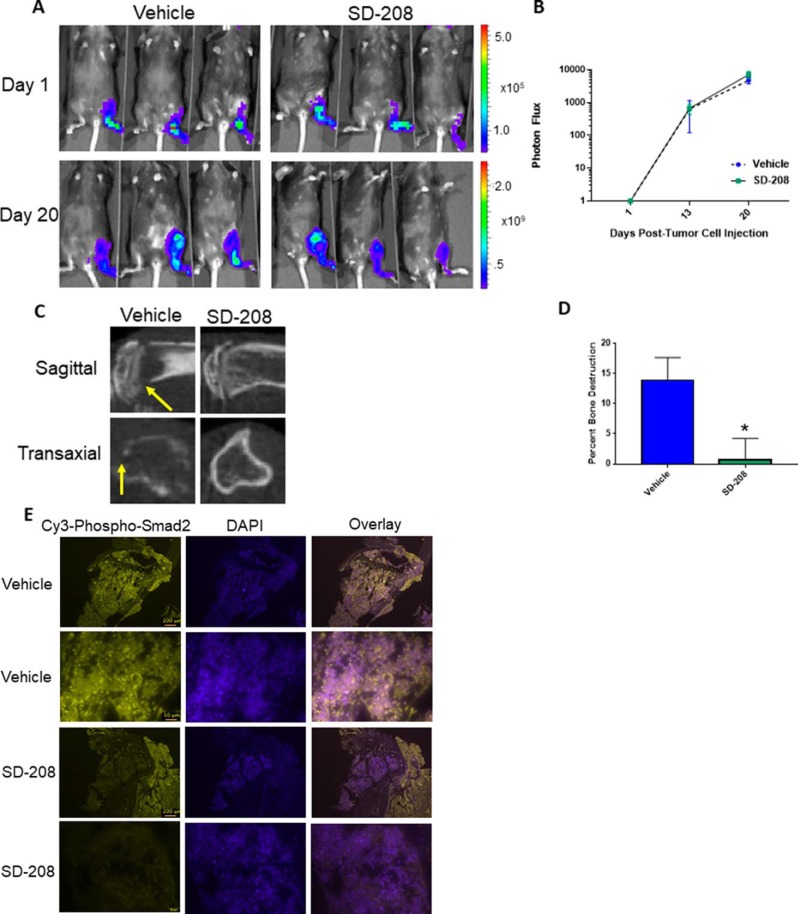
Bone constitutes the most common site of breast cancer metastases either at time of presentation or recurrent disease years after seemingly successful therapy. Bone metastases cause substantial morbidity, including life-threatening spinal cord compression and hypercalcemia. Given the high prevalence of patients with breast cancer, health-care costs of bone metastases (>$20,000 per episode) impose a tremendous economic burden on society. To investigate mechanisms of bone metastasis, we developed femoral artery injection of cancer cells as a physiologically relevant model of bone metastasis. Comparing young (6 weeks), skeletally immature mice to old (6 months) female mice with closed physes (growth plates), we showed significantly greater progression of osteolytic metastases in young animals. Bone destruction increased in the old mice following ovariectomy, emphasizing the pathologic consequences of greater bone turnover and net loss. Despite uniform initial distribution of breast cancer cells throughout the hind limb after femoral artery injection, we observed preferential formation of osteolytic bone metastases in the proximal tibia. Tropism for the proximal tibia arises in part because of TGF-, a cytokine abundant in both physes of skeletally immature mice and matrix of bone in mice of all ages. We also showed that age-dependent effects on osteolytic bone metastases did not occur in male mice with disseminated breast cancer cells in bone. These studies establish a model system to specifically focus on pathophysiology and treatment of bone metastases and underscore the need to match biologic variables in the model to relevant subsets of patients with breast cancer.
无论是在初次就诊时还是在看似成功治疗数年之后疾病复发时,骨都是乳腺癌转移最常见的部位。骨转移会导致严重的发病率,包括危及生命的脊髓压迫和高钙血症。鉴于乳腺癌患者的高患病率,骨转移的医疗费用(每次发作超过20,000美元)给社会带来了巨大的经济负担。为了研究骨转移的机制,我们开发了股动脉注射癌细胞作为骨转移的生理相关模型。将年轻(约6周)、骨骼未成熟的小鼠与年老(约6个月)、骨骺闭合(生长板)的雌性小鼠进行比较,我们发现年轻动物中溶骨性转移的进展明显更大。卵巢切除术后老年小鼠的骨破坏增加,强调了骨转换增加和净损失的病理后果。尽管股动脉注射后乳腺癌细胞在整个后肢的初始分布均匀,但我们观察到在胫骨近端优先形成溶骨性骨转移。对胫骨近端的嗜性部分源于转化生长因子,这种细胞因子在骨骼未成熟小鼠的骨骺和所有年龄段小鼠的骨基质中都很丰富。我们还表明,在骨中播散有乳腺癌细胞的雄性小鼠中,未出现年龄对溶骨性骨转移的影响。这些研究建立了一个模型系统,专门关注骨转移的病理生理学和治疗,并强调在模型中匹配生物学变量与乳腺癌相关患者亚组的必要性。