Division of Cellular Signaling, National Cancer Center Research Institute, Tokyo 104-0045, Japan.
Department of Life Science and Medical Bioscience, School of Advanced Science and Engineering, Waseda University, Tokyo 162-8480, Japan.
Int J Mol Sci. 2021 Feb 14;22(4):1886. doi: 10.3390/ijms22041886.
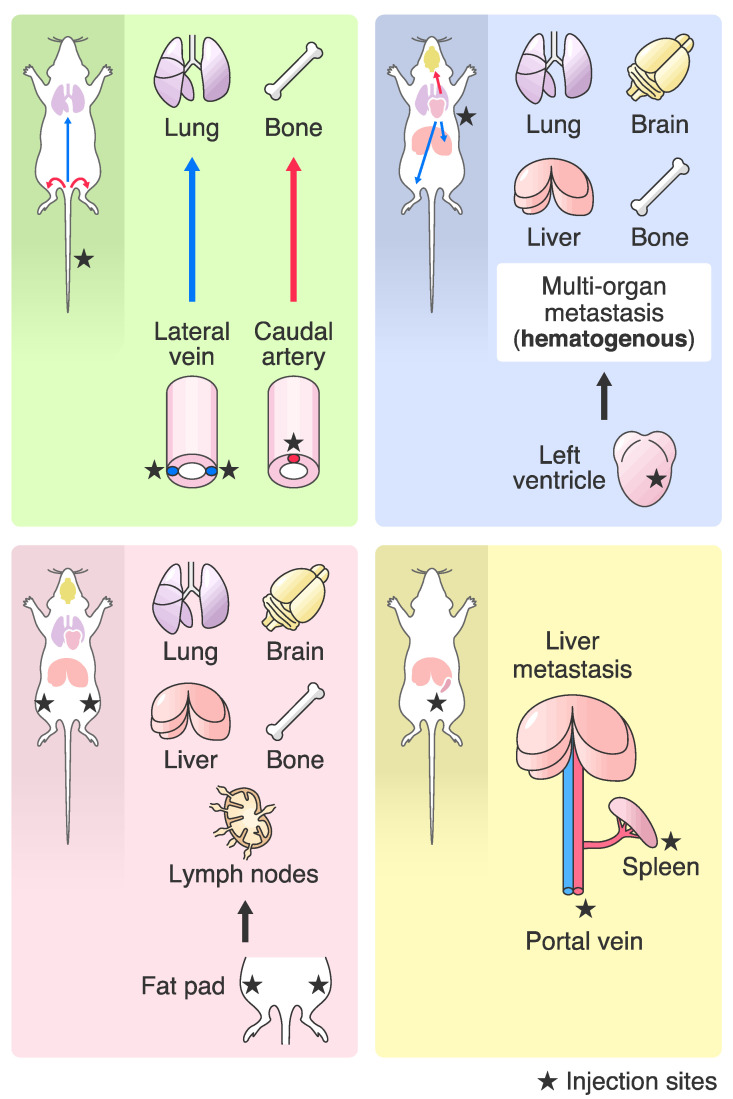
Metastasis is a complex event in cancer progression and causes most deaths from cancer. Repeated transplantation of metastatic cancer cells derived from transplanted murine organs can be used to select the population of highly metastatic cancer cells; this method is called as in vivo selection. The in vivo selection method and highly metastatic cancer cell lines have contributed to reveal the molecular mechanisms of cancer metastasis. Here, we present an overview of the methodology for the in vivo selection method. Recent comparative analysis of the transplantation methods for metastasis have revealed the divergence of metastasis gene signatures. Even cancer cells that metastasize to the same organ show various metastatic cascades and gene expression patterns by changing the transplantation method for the in vivo selection. These findings suggest that the selection of metastasis models for the study of metastasis gene signatures has the potential to influence research results. The study of novel gene signatures that are identified from novel highly metastatic cell lines and patient-derived xenografts (PDXs) will be helpful for understanding the novel mechanisms of metastasis.
转移是癌症进展中的一个复杂事件,导致大多数癌症死亡。从移植的鼠器官中衍生的转移性癌细胞的反复移植可用于选择高度转移性癌细胞群体;这种方法称为体内选择。体内选择方法和高转移性癌细胞系有助于揭示癌症转移的分子机制。在这里,我们概述了体内选择方法的方法学。最近对转移的移植方法的比较分析揭示了转移基因特征的分歧。即使转移到同一器官的癌细胞,通过改变体内选择的移植方法,也会显示出不同的转移级联和基因表达模式。这些发现表明,选择转移模型进行转移基因特征的研究有可能影响研究结果。从新型高转移性细胞系和患者来源异种移植(PDX)中鉴定的新型基因特征的研究将有助于理解转移的新机制。