Lee Keith A, Preston Aidan J, Wise Taylor B, Templer Victoria L
Department of Psychology, Providence College.
Department of Psychology, Providence College;
J Vis Exp. 2018 Jun 18(136):57489. doi: 10.3791/57489.
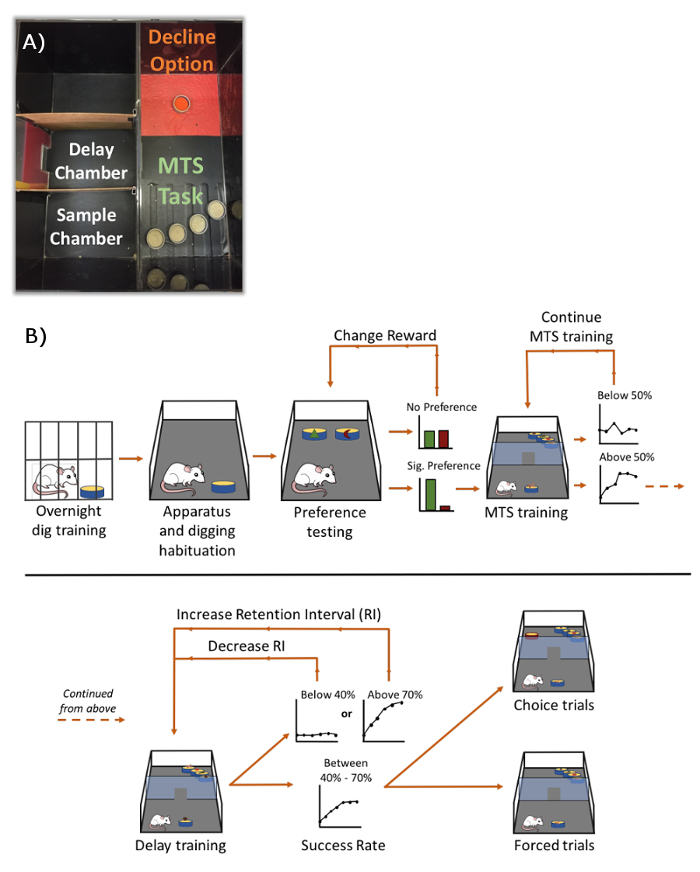
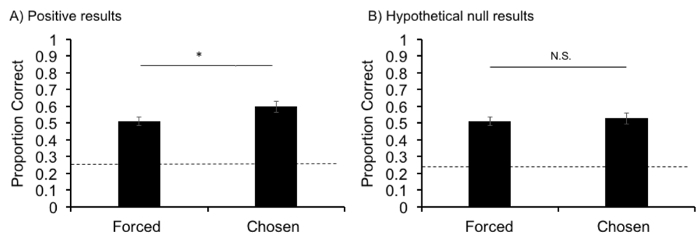
Metamemory involves the cognitive ability to assess the strength of one's memories. To explore the possibility of metamemory in non-human animals, numerous behavioral tasks have been created, many of which utilize an option to decline memory tests. To assess metamemory in rats, we utilized this decline-test option paradigm by adapting previous visual delayed-match-to-sample tests (DMTS) developed for primate species to an odor-based test suitable for rodents. First, rats are given a sample to remember by digging in a cup of scented sand. After a delay, the rat is presented with four distinctly scented cups, one of which contains the identical scent experienced during the sample; if this matching cup is selected, then the rat obtains a preferred, larger reward. Selection of any of the other three non-matching sand-filled scented cups results in no reward. Retention intervals are individually titrated such that subjects perform between 40 and 70% correct, therefore ensuring rats sometimes remember and sometimes forget the sample. Here, the operational definition of metamemory is the ability to distinguish between the presence and absence of memory through behavioral responding. Towards this end, on two-thirds of trials, a decline option is presented in addition to the four choice cups (choice trials). If the decline-test option- an unscented colored sand cup, is selected, the subject receives a smaller less-preferred reward and avoids the memory test. On the remaining third of trials, the decline-test option is not available (forced trials), causing subjects to guess the correct cup when the sample is forgotten. On choice tests, subjects that know when they remember should select the decline option when memory is weak rather than take the test and choose incorrectly. Therefore, significantly higher performance on chosen tests as compared to forced memory tests is indicative of the adaptive use of the decline-test response and metacognitive responding.
元记忆涉及评估自身记忆强度的认知能力。为了探索非人类动物具备元记忆的可能性,人们设计了众多行为任务,其中许多任务都提供了拒绝记忆测试的选项。为了评估大鼠的元记忆,我们采用了这种拒绝测试选项范式,将先前为灵长类动物开发的视觉延迟匹配样本测试(DMTS)改编为适合啮齿动物的基于气味的测试。首先,让大鼠通过在一杯有香味的沙子中挖掘来记住一个样本。延迟一段时间后,向大鼠呈现四个气味明显不同的杯子,其中一个杯子含有与样本中相同的气味;如果选择了这个匹配的杯子,大鼠就能获得更优质、更大的奖励。选择其他三个装有不匹配沙子的有香味杯子中的任何一个都不会获得奖励。保留间隔会根据个体情况进行调整,以使受试者的正确率在40%至70%之间,从而确保大鼠有时能记住样本,有时会忘记。在这里,元记忆的操作定义是通过行为反应来区分记忆的有无。为此,在三分之二的试验中,除了四个选择杯之外,还会提供一个拒绝选项(选择试验)。如果选择了拒绝测试选项——一个没有香味的彩色沙杯,受试者会获得较小、不太喜欢的奖励,并避免进行记忆测试。在其余三分之一的试验中,不提供拒绝测试选项(强制试验),这会导致受试者在忘记样本时猜测正确的杯子。在选择测试中,知道自己何时记住的受试者在记忆较弱时应该选择拒绝选项,而不是进行测试并选错。因此,与强制记忆测试相比,选择测试中的表现显著更高,这表明受试者能够适应性地使用拒绝测试反应和元认知反应。