Cardiometabolic Research Group, Diabetes Complications Research Centre, UCD Conway Institute, University College Dublin, Belfield, 4 Dublin, Ireland.
Int J Mol Sci. 2018 Jul 6;19(7):1971. doi: 10.3390/ijms19071971.
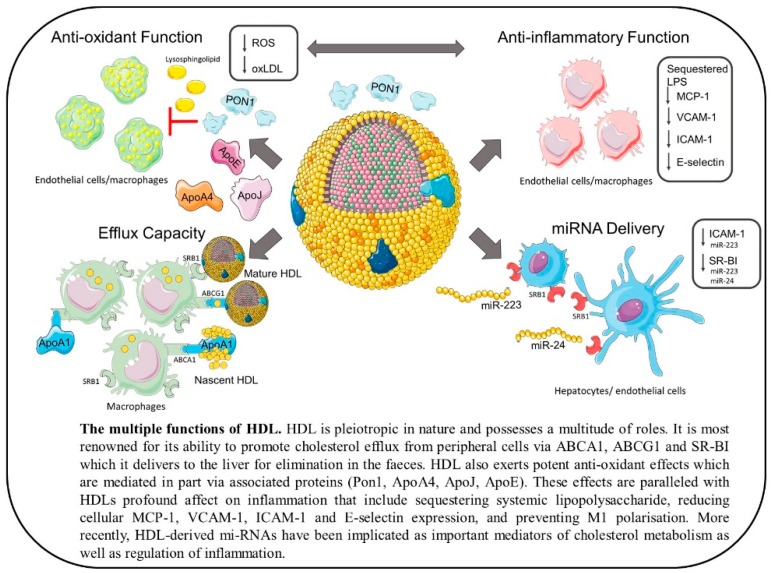
High-density lipoprotein (HDL) particles have experienced a turbulent decade of falling from grace with widespread demotion from the most-sought-after therapeutic target to reverse cardiovascular disease (CVD), to mere biomarker status. HDL is slowly emerging from these dark times due to the HDL flux hypothesis wherein measures of HDL cholesterol efflux capacity (CEC) are better predictors of reduced CVD risk than static HDL-cholesterol (HDL-C) levels. HDL particles are emulsions of metabolites, lipids, protein, and microRNA (miR) built on the backbone of Apolipoprotein A1 (ApoA1) that are growing in their complexity due to the higher sensitivity of the respective “omic” technologies. Our understanding of particle composition has increased dramatically within this era and has exposed how our understanding of these particles to date has been oversimplified. Elucidation of the HDL proteome coupled with the identification of specific miRs on HDL have highlighted the “hormonal” characteristics of HDL in that it carries and delivers messages systemically. HDL can dock to most peripheral cells via its receptors, including SR-B1, ABCA1, and ABCG1, which may be a critical step for facilitating HDL-to-cell communication. The composition of HDL particles is, in turn, altered in numerous disease states including diabetes, auto-immune disease, and CVD. The consequence of changes in composition, however, on subsequent biological activities of HDL is currently poorly understood and this is an important avenue for the field to explore in the future. Improving HDL particle quality as opposed to HDL quantity may, in turn, prove a more beneficial investment to reduce CVD risk.
高密度脂蛋白(HDL)颗粒在过去十年中经历了一场动荡,其地位从最受追捧的治疗心血管疾病(CVD)的靶点一落千丈,沦为仅仅是生物标志物。由于 HDL 流量假说的出现,HDL 的胆固醇流出能力(CEC)测量值比静态 HDL-胆固醇(HDL-C)水平更能预测降低 CVD 风险,HDL 正在慢慢走出这段黑暗时期。HDL 颗粒是载脂蛋白 A1(ApoA1)为骨架的代谢物、脂质、蛋白质和 microRNA(miR)的乳液,由于各自“组学”技术的灵敏度更高,其复杂性也在不断增加。在这个时代,我们对颗粒组成的理解有了显著提高,并揭示了我们迄今为止对这些颗粒的理解过于简单。阐明 HDL 蛋白质组学,并确定 HDL 上的特定 miRs,突出了 HDL 的“激素”特性,因为它在全身携带和传递信息。HDL 可以通过其受体(包括 SR-B1、ABCA1 和 ABCG1)与大多数外周细胞对接,这可能是促进 HDL-细胞通讯的关键步骤。反过来,HDL 颗粒的组成在包括糖尿病、自身免疫性疾病和 CVD 在内的许多疾病状态中发生改变。然而,组成变化对 HDL 随后的生物学活性的影响目前知之甚少,这是该领域未来需要探索的重要方向。与提高 HDL 数量相比,改善 HDL 颗粒质量可能更有益于降低 CVD 风险。