School of Medicine, Huaqiao University, Quanzhou 362021, China.
Int J Mol Sci. 2018 Jul 6;19(7):1982. doi: 10.3390/ijms19071982.
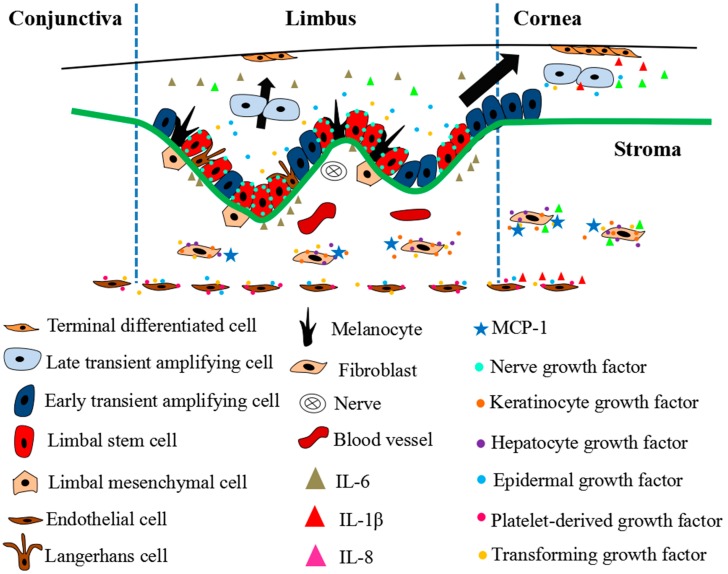
Keeping the integrity and transparency of the cornea is the most important issue to ensure normal vision. There are more than 10 million patients going blind due to the cornea diseases worldwide. One of the effective ways to cure corneal diseases is corneal transplantation. Currently, donations are the main source of corneas for transplantation, but immune rejection and a shortage of donor corneas are still serious problems. Graft rejection could cause transplanted cornea opacity to fail. Therefore, bioengineer-based corneas become a new source for corneal transplantation. Limbal stem cells (LSCs) are located at the basal layer in the epithelial palisades of Vogt, which serve a homeostatic function for the cornea epithelium and repair the damaged cornea. LSC-based transplantation is one of the hot topics currently. Clinical data showed that the ratio of LSCs to total candidate cells for a transplantation has a significant impact on the effectiveness of the transplantation. It indicates that it is very important to accurately identify the LSCs. To date, several putative biomarkers of LSCs have been widely reported, whereas their specificity is controversial. As reported, the identification of LSCs is based on the characteristics of stem cells, such as a nuclear-to-cytoplasm ratio (N/C) ≥ 0.7, label-retaining, and side population (SP) phenotype. Here, we review recently published data to provide an insight into the circumstances in the study of LSC biomarkers. The particularities of limbus anatomy and histochemistry, the limits of the current technology level for LSC isolation, the heterogeneity of LSCs and the influence of enzyme digestion are discussed. Practical approaches are proposed in order to overcome the difficulties in basic and applied research for LSC-specific biomarkers.
保持角膜的完整性和透明度是确保正常视力的最重要问题。全世界有超过 1000 万患者因角膜疾病而失明。治疗角膜疾病的有效方法之一是角膜移植。目前,捐赠是角膜移植的主要来源,但免疫排斥和供体角膜短缺仍然是严重的问题。移植物排斥可导致移植角膜混浊失败。因此,基于生物工程的角膜成为角膜移植的新来源。角膜缘干细胞(LSCs)位于 Vogt 上皮嵴的基底层,对角膜上皮具有稳态功能,并修复受损的角膜。基于 LSC 的移植是目前的热门话题之一。临床数据表明,移植中 LSCs 与总候选细胞的比例对移植的有效性有重大影响。这表明准确识别 LSCs 非常重要。迄今为止,已经广泛报道了几种 LSCs 的假定生物标志物,但它们的特异性存在争议。据报道,LSCs 的鉴定基于干细胞的特征,例如核质比(N/C)≥0.7、标记保留和侧群(SP)表型。在这里,我们回顾了最近发表的数据,以深入了解 LSC 生物标志物研究的情况。讨论了 limbus 解剖和组织化学的特殊性、当前 LSC 分离技术水平的限制、LSCs 的异质性以及酶消化的影响。提出了实用方法,以克服 LSC 特异性生物标志物的基础和应用研究中的困难。