Department of Pharmacology, Faculty of Medicine, Universiti Kebangsaan Malaysia, Cheras 56000, Malaysia.
Columbia Asia Hospital, Miri 98009, Malaysia.
Nutrients. 2018 Jul 9;10(7):881. doi: 10.3390/nu10070881.
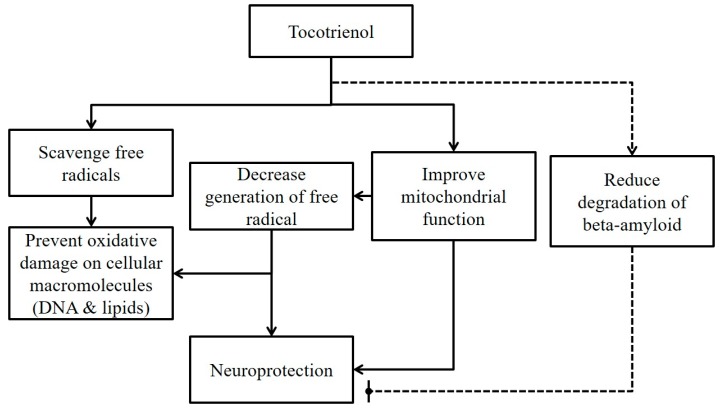
Alzheimer’s disease (AD) is plaguing the aging population worldwide due to its tremendous health care and socioeconomic burden. Current treatment of AD only offers symptomatic relief to patients. Development of agents targeting specific pathologies of AD is very slow. Tocotrienol, a member of the vitamin E family, can tackle many aspects of AD, such as oxidative stress, mitochondrial dysfunction and abnormal cholesterol synthesis. This review summarizes the current evidence on the role of tocotrienol as a neuroprotective agent. Preclinical studies showed that tocotrienol could reduce oxidative stress by acting as a free-radical scavenger and promoter of mitochondrial function and cellular repair. It also prevented glutamate-induced neurotoxicity in the cells. Human epidemiological studies showed a significant inverse relationship between tocotrienol levels and the occurrence of AD. However, there is no clinical trial to support the claim that tocotrienol can delay or prevent the onset of AD. As a conclusion, tocotrienol has the potential to be developed as an AD-preventing agent but further studies are required to validate its efficacy in humans.
阿尔茨海默病(AD)给全球老龄化人口带来了巨大的医疗和社会经济负担。目前 AD 的治疗方法仅能为患者提供症状缓解。针对 AD 特定病理的药物开发进展非常缓慢。生育三烯酚是维生素 E 家族的一员,它可以解决 AD 的许多方面的问题,如氧化应激、线粒体功能障碍和异常胆固醇合成。这篇综述总结了生育三烯酚作为神经保护剂的作用的现有证据。临床前研究表明,生育三烯酚可以通过充当自由基清除剂和促进线粒体功能和细胞修复来减少氧化应激。它还可以防止谷氨酸诱导的细胞神经毒性。人类流行病学研究表明,生育三烯酚水平与 AD 的发生呈显著负相关。然而,目前没有临床试验支持生育三烯酚可以延缓或预防 AD 的发病的说法。总之,生育三烯酚有可能被开发为预防 AD 的药物,但需要进一步的研究来验证其在人类中的疗效。